
Most organizations approach legacy BPM migration the same way they approach a kitchen renovation they have been putting off for years. They know it needs to happen, they suspect it will take months and cost more than expected, and they brace for the disruption before a single wall comes down. That expectation is not unreasonable. Traditional migrations often do require exactly that kind of investment. But one engagement now underway shows a different path is now unlocked; one where migration moves quickly and also builds the foundation for the kind of continuous re-engineering that a legacy platform was never built to support.
We introduced this story in a previous ProcessOS blog installment, which described two entry points into ProcessOS: one for processes with little automation and scattered knowledge, and one for processes already documented and running on a legacy BPM platform. This piece follows that second path in depth. One European bank is currently migrating a live process off a legacy BPMS platform, and the early results are worth sharing.
Early proof point: measurable progress in three weeks
Before the migration work itself began, the team ran discovery on the process in scope. That phase alone produced a useful data point. A numerical complexity analysis scored the process as very complex, weighing factors like task count, decision gateways, subprocesses, and backward flows into a single score. Reconstructing a process at that level of complexity traditionally takes a business analyst and several subject matter experts weeks of effort. ProcessOS completed it 40% faster and at roughly half the cost.
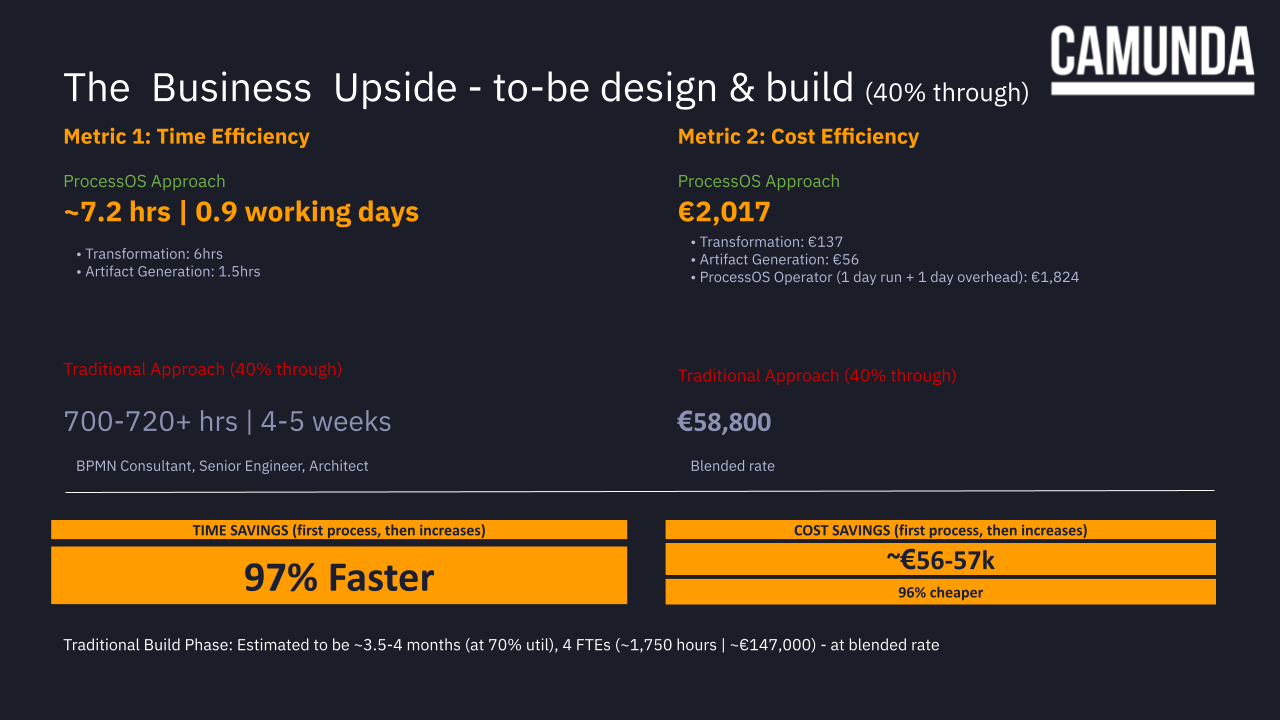
That discovery work set up the phase the team is in now: migrating the process itself from a legacy BPM platform to Camunda, and using that migration to measure both speed and cost-efficiency against a traditional build. The engagement is roughly three weeks in, and the team has completed about 40% of that migration work. Even at this early stage, the numbers stand out. Running the first iteration of the re-engineered process is 97% faster than a traditional build would take at the same point, and 96% cheaper. The traditional-build baseline sits at 7.2 hours per process or task, a figure the delivery team calculated by benchmarking against the standard approach used for migrations of this kind.
It is worth being precise about what these numbers represent. They are early delivery-team-calculated figures benchmarked against a traditional build, and they will keep moving as the remaining 60% of the work gets done. Still, three weeks into a migration that traditionally spans months, a result this clear is a meaningful early signal.
It is also worth being clear about what this particular engagement is not. This is not a deep re-engineering of the process itself. The scope here is migration: moving a process off a legacy BPM platform and onto an open, agentic platform, quickly and at a fraction of the traditional cost. That distinction matters, because a fast, low-lift migration is exactly the kind of proof point that makes a larger migration case easier to justify, and it sets up the process to take on deeper re-engineering and agentic orchestration adoption later, once it already lives on a platform built for that work.
Why the work is moving quickly
Three shifts in how the engagement runs explain most of the speed.
- The first is a lighter, more iterative operating model. Traditional BPMS migrations lean on long, resource-heavy workshops that pull subject matter experts away from their day jobs for extended stretches. This engagement replaces that pattern with short working sessions and frequent validation loops instead. Between sessions, engineers work through the process, design, and technical details on their own, then bring what they have built back to subject matter experts for direct review. Only the customer resources needed for a given decision or review get pulled in, which keeps the burden on the bank's team as light as the pace demands.
- The second is async collaboration. Camunda and the customer team communicate inside a shared Teams environment, where questions get answered in the flow of chat rather than queued up for the next scheduled workshop. Work keeps moving in the gaps between meetings instead of stalling until everyone can get back in a room.
- The third shift changes where the work physically happens. Camunda’s forward-deployed engineers work directly inside the customer's environment rather than shuttling documents and materials back and forth between systems. That approach reduces handoffs and the friction that comes with them, while still allowing the team to deliver autonomously and securely. Fewer handoffs mean fewer places for context to get lost, which is often where migration timelines slip.
Migration is the first step, not the end state
It would be easy to tell this story as a straightforward migration case study; however, that framing undersells what is happening. The migration to Camunda gives the bank a platform foundation for broader process re-engineering, and eventually for agent adoption, well beyond the single process currently in scope.
That story echoes the thesis behind ProcessOS itself: the biggest gains do not come from bolting AI onto a legacy process, they come from re-engineering the process for an AI-native world. The bank started this engagement treating the initial scope as a migration project. Early results are already shifting that conversation. The team is now discussing re-engineering additional processes rather than simply relocating them, which moves the narrative from moving off a legacy platform to modernizing processes and then continuously improving them.
Customer response and expanding opportunity
One stakeholder on the customer side summed up the reaction to the newly migrated process by saying, “It looks so good, it's hard to believe it's real.” That kind of response reflects genuine surprise at how far the work has come in such a short window, and it is opening conversations about bringing more processes and business units into scope.
Three ideas carry through this early stage of the engagement.
- Migration can be fast and cost-efficient, even when the baseline expectation is months of disruption.
- A light operating model, built on short sessions, async collaboration, and work done inside the customer's own environment, reduces the burden on the customer team dramatically.
- Camunda offers a starting point for broader re-engineering rather than a like-for-like replacement, which is the difference between migrating a process and improving it.
If your organization is weighing a legacy BPMS migration and wondering whether it has to mean months of disruption, we would like to show you what a faster path looks like, one that modernizes your processes today while creating a foundation for the automation and agent-enabled work ahead.


