Pick the outcome.
Camunda orchestrates the work that gets you there.

Loans approved, claims resolved, onboarding completed, contracts signed. These are the outcomes your business is measured on. Camunda orchestrates the AI agents, people, and systems in between, so the work completes, the audit trail holds, and the numbers move.
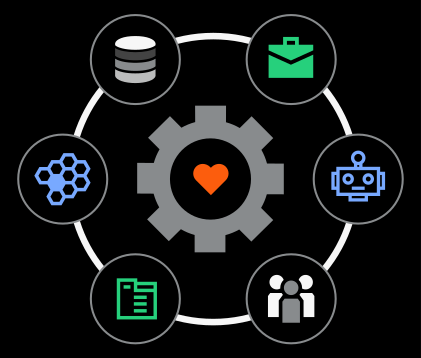
Process orchestration use cases illustration

Value across the table

Every process that defines your team's performance touches multiple systems, multiple people, and now multiple AI agents. Camunda is the orchestration layer that connects them, with the governance, real-time visibility, and exception handling your operations and risk teams need. Pick the use case that matches the outcome you are chasing.

For the line of business

Faster cycle times, fewer dropped handoffs, real-time SLA visibility, and exceptions caught before customers notice them. Your process. Your numbers. Your team focused on outcomes.

For IT and architects

Open BPMN standard, agent-agnostic, vendor-neutral. Pre-built connectors for the major enterprise systems. A durable engine proven at enterprise scale, with no proprietary lock-in.

For the executive team

AI from pilot to production with audit trails. EU AI Act and SOC 2 readiness built in. Measurable ROI tied to end-to-end outcomes, not isolated tasks.

Find your use case

Eight ways enterprises run on Camunda today. Each one is a self-contained landing page with the architecture details, customer proof, and evaluator FAQs you would expect.

Get AI agents to production with governance you can prove

Move beyond chatbots and copilots. Coordinate AI agents from any vendor inside the end-to-end processes that drive revenue, with audit trails, human approval gates, and real-time control built in.

Orchestrate AI agents

Speed up the work that depends on human judgment

Approvals, reviews, exceptions, complex case decisions. Camunda routes work to the right person, surfaces the context they need, tracks SLAs against escalation timers, and keeps AI agents in the loop where they help.

Orchestrate human workflows

Resolve complex cases in hours, not days

Insurance claims, healthcare appeals, fraud investigations, account disputes. Every case is different. The platform underneath should not have to be. AI agents, specialists, and systems on one orchestration layer with full visibility from intake to resolution.

See case management

End-to-end reliability across every service you ship

Distributed systems break in distributed ways. Camunda gives engineering teams a process model that handles state, failure, and long-running transactions across every microservice, with the operational visibility business teams keep asking for.

Orchestrate microservices

Turn hundreds of API calls into one reliable process

When the value of a process depends on dozens of APIs lining up correctly, you need more than an integration tool. Compose REST, SOAP, gRPC, and webhook APIs into durable workflows with retries, saga compensation, and full audit replay.

Orchestrate APIs

Make every RPA bot part of an end-to-end process

Bots are great at clicking screens. They are not great at handling exceptions, scaling under load, or showing up in an audit. Camunda orchestrates the bots you already run, plus new ones, as first-class participants in the broader business process.

Orchestrate RPA bots

Modernize legacy BPMS without recreating the lock-in

The BPM suites that ran your last decade were not designed for AI agents. Camunda is the open, agent-ready orchestration platform enterprise architects move to without trading one walled garden for another.

Replace legacy BPMS

Stop maintaining the workflow engine you didn't mean to build

Most homegrown systems started as one state machine, one queue, or one DAG to solve one problem. Years later, your team has accidentally built a workflow engine, minus the durability, observability, governance, and agent support a real orchestration platform ships out of the box.

Replace homegrown workflows

Modernize legacy IT systems without rebuilding what already works

Rip-and-replace projects fail more often than they succeed, take years longer than planned, and freeze innovation while they run. Camunda sits above your legacy stack as a neutral orchestration layer, so you can modernize incrementally, coordinating mainframes, ERPs, custom apps, and AI agents in one model.

Modernize legacy IT

Frequently asked questions

Most-asked questions from line-of-business leaders, enterprise architects, and CIOs evaluating Camunda for these use cases.

What is process orchestration?
Process orchestration is the coordination of AI agents, people, and systems across an end-to-end business process so the work completes reliably, with governance and audit trails built in. It is different from task automation, which only handles a single step in isolation. Orchestration owns the sequencing, the timers, the exceptions, and the state across days, weeks, or months.
How is Camunda different from RPA, iPaaS, or workflow tools?
RPA automates UI clicks. iPaaS connects systems. Workflow tools route tasks. Camunda orchestrates all of them, plus AI agents and human work, on one open BPMN-based runtime. The orchestration layer governs end-to-end outcomes, not individual steps, which is why it can survive AI vendor changes, system migrations, and regulatory shifts without a rewrite.
Which use case should we start with?
Start with a process that is bounded, valuable, and deliverable in a quarter. Common starting points include a single claims journey, a loan origination flow, an order-to-cash segment, or replacing a brittle homegrown workflow your team is already maintaining. The first process is where the operational learning takes shape, so pick something you can ship and measure.
Does Camunda work with our existing systems?
Yes. Camunda is agent-agnostic and system-agnostic. Pre-built connectors cover the major enterprise systems, alongside open standards like REST, SOAP, gRPC, MCP, and A2A. Mainframes, ERPs, and existing BPMS platforms can stay in place while Camunda orchestrates around them, so modernization moves at the pace your business can absorb.
How does Camunda handle compliance and governance?
Every decision, path, and exception is captured automatically in an immutable execution history. Approval gates, escalation rules, and human review steps are part of the process model itself, not bolted on after. That makes EU AI Act readiness, SOC 2, and regulatory audits achievable without custom instrumentation, and it gives compliance officers a single place to answer the question of why something happened.

Ready to get started?