Agentic Orchestration: Model, deploy & manage AI agents seamlessly into your end-to-end processes with Camunda
If you are tired of hearing about what AI can do and want to see it in action, watch this 15-minute overview and discover how to build processes with agentic orchestration.
Watch agentic orchestration in action
This 15-minute overview shows exactly how to build and deploy AI agents using Camunda's agentic orchestration platform. See how BPMN models serve as the governance layer for AI agents — making them observable, auditable, and production-ready.
Move from prototype to production with enterprise-grade orchestration that gives your AI agents durable state, guardrails, and human oversight.
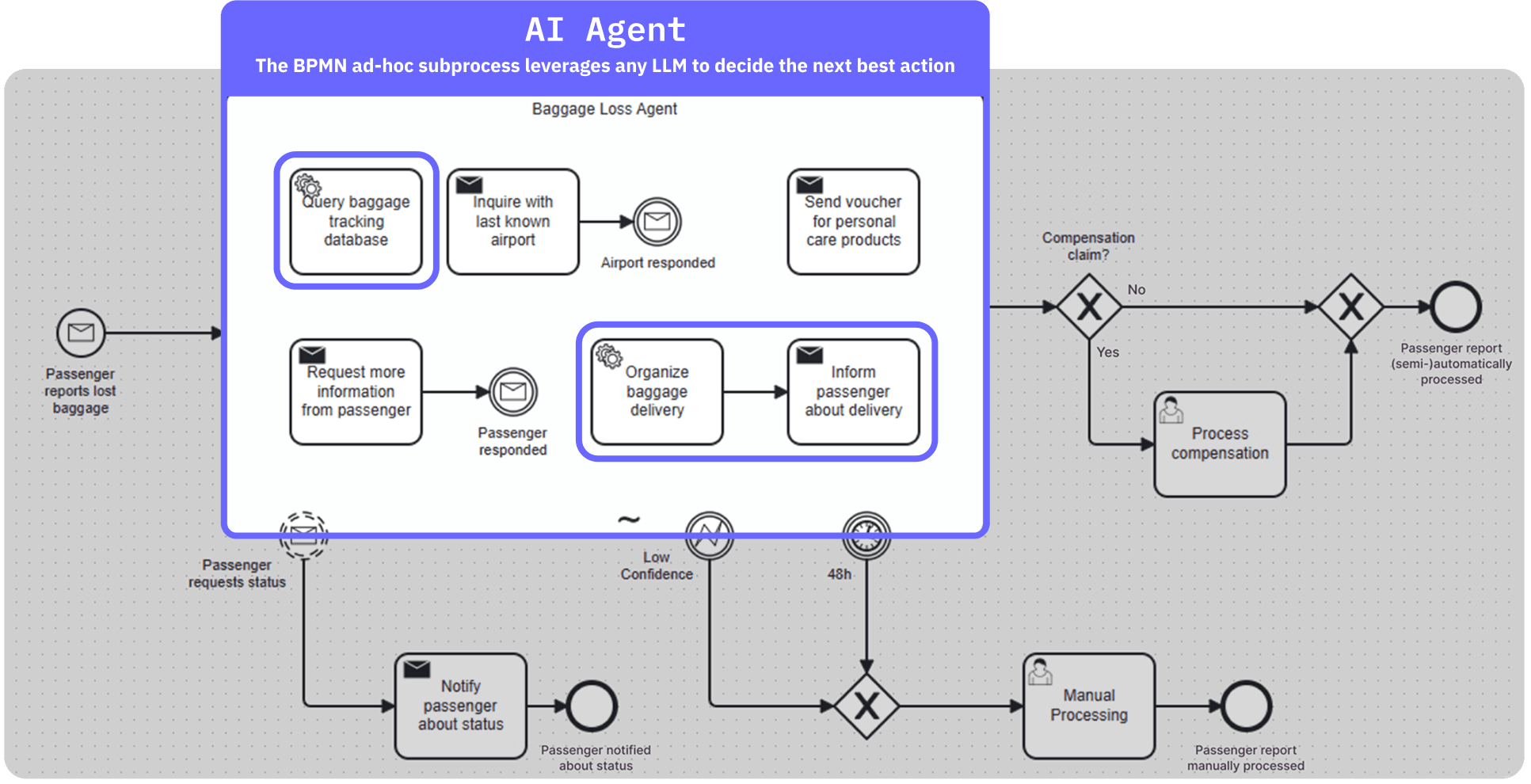
AI agents in BPMN: a real example
This BPMN model shows how an AI agent handles baggage-loss resolution — autonomously gathering information, making decisions, and escalating to a human when needed. Every step is observable, auditable, and governed by the process boundary.
The ad-hoc sub-process at the center of the model is the agent's reasoning loop — where the agent plans, acts, and reflects before deciding on the next action. This is agentic orchestration: AI autonomy within a structured, governable process.
Empower AI agents to drive business processes at scale
AI agents are powerful, but without orchestration, they lack the coordination, accountability, and reliability needed for real-world, business-critical processes. Without durable state management, agents lose context between steps. Without governance, they act outside enterprise boundaries. Without human oversight, they cannot be trusted for high-stakes decisions.
Camunda provides the orchestration infrastructure that solves all of these challenges — enabling AI agents to operate reliably, transparently, and at enterprise scale.
State of Agentic Orchestration and Automation 2026
Discover insights from 1,150 senior IT leaders on today's automation landscape, AI agent adoption, and the challenges of scaling them in production. The 2026 State of Agentic Orchestration and Automation Report reveals how leading organizations are moving from AI experimentation to enterprise-scale production.
Why AI needs orchestration
Context switching
Without durable state management, AI agents lose context between steps, API calls, and reasoning loops. Camunda's Zeebe engine persists agent state across the full process lifecycle.
Governance and compliance
AI agents operating without boundaries create compliance risk. BPMN guardrails define exactly what agents can do — and when human approval is required.
Collaboration
Real-world processes involve multiple agents, systems, and humans. Orchestration coordinates all participants — ensuring agents work together reliably rather than independently.
Scalability
A single AI agent prototype is easy. Thousands of concurrent agentic process instances, with full observability and recovery capabilities, require enterprise-grade orchestration infrastructure.
How agentic orchestration works
Architect end-to-end agentic processes: Use BPMN to model the full process — including deterministic steps, agent reasoning loops, human approvals, and exception handling — in a single executable diagram.
Build with state-of-the-art agent frameworks: Camunda supports LangChain, LlamaIndex, and custom agent implementations. The AI Agent Connector simplifies LLM integration for standard patterns.
Blend code and modeling via multi-layer architecture: Developers can work at the level they prefer — visual BPMN modeling for business logic, code for complex agent behavior — within the same platform.
Govern intelligent decisions with human oversight: Human task modeling lets you embed approval gates, escalation paths, and manual overrides directly in the BPMN process — alongside the AI agent steps.
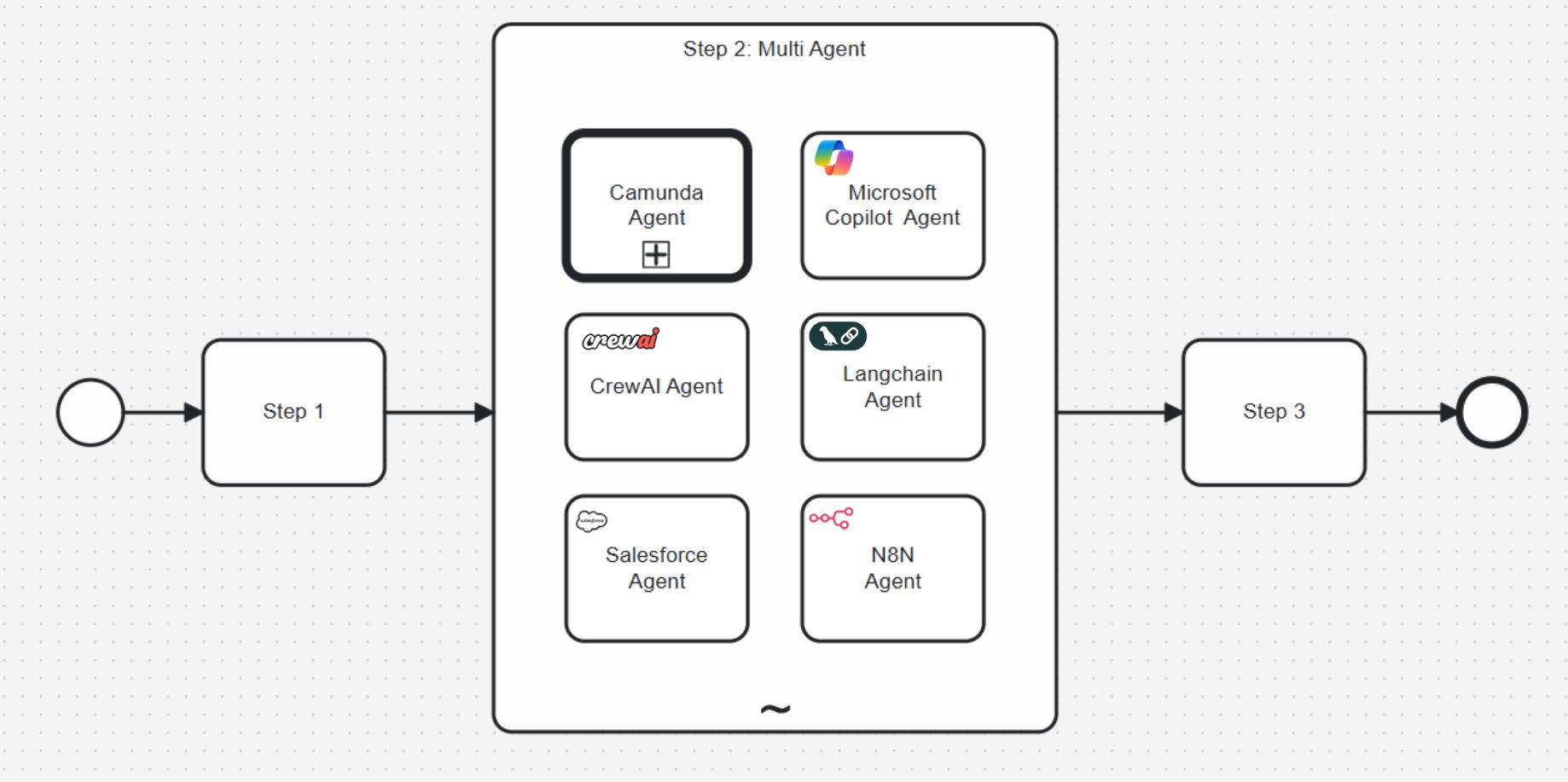
How multi-agent orchestration works
In multi-agent systems, a central orchestrator coordinates specialist agents — each with specific tool access and responsibilities. Camunda's message correlation engine enables agents to communicate, respond to events, and collaborate on shared goals with full auditability.
Pre-built connectors for Model Context Protocol (MCP) and Agent-to-Agent (A2A) communication allow different AI systems to synchronize work — enabling sophisticated multi-agent pipelines with enterprise-grade reliability.
Agentic orchestration solutions built by Camunda partners
BP3 Global
Intelligent process automation combining Camunda orchestration with advanced AI capabilities for enterprise deployments.
HCLTech
End-to-end agentic orchestration solutions integrating Camunda with HCL's enterprise AI and automation platform.
Capgemini
Enterprise agentic automation solutions leveraging Camunda to orchestrate AI agents across complex business processes.
Incentro
Rapid deployment of agentic orchestration for mid-market and enterprise organizations with Camunda at the core.
Cognizant
Agentic process automation solutions combining Camunda orchestration with Cognizant's AI and digital transformation expertise.
Infosys
Scalable agentic orchestration deployments built with Camunda, supporting Infosys's enterprise automation practice.
EY
Agentic orchestration for audit, risk, and compliance processes — governed by Camunda's enterprise-grade platform.
Why Camunda for agentic orchestration?
• Unified orchestration: Model agents, humans, and systems in the same BPMN process — no separate agent layer disconnected from the rest of your business processes.
• Process-level determinism: Blend AI autonomy with deterministic process logic — giving teams the control and auditability they need for production deployments.
• Observability and governance: Full audit trails for every agent action, with Camunda Optimize for real-time KPI monitoring and process performance analysis.
• Access to real SDKs: Build agent logic in Java, JavaScript, Python, or any language through REST and gRPC APIs. Camunda is API-first and language-agnostic.
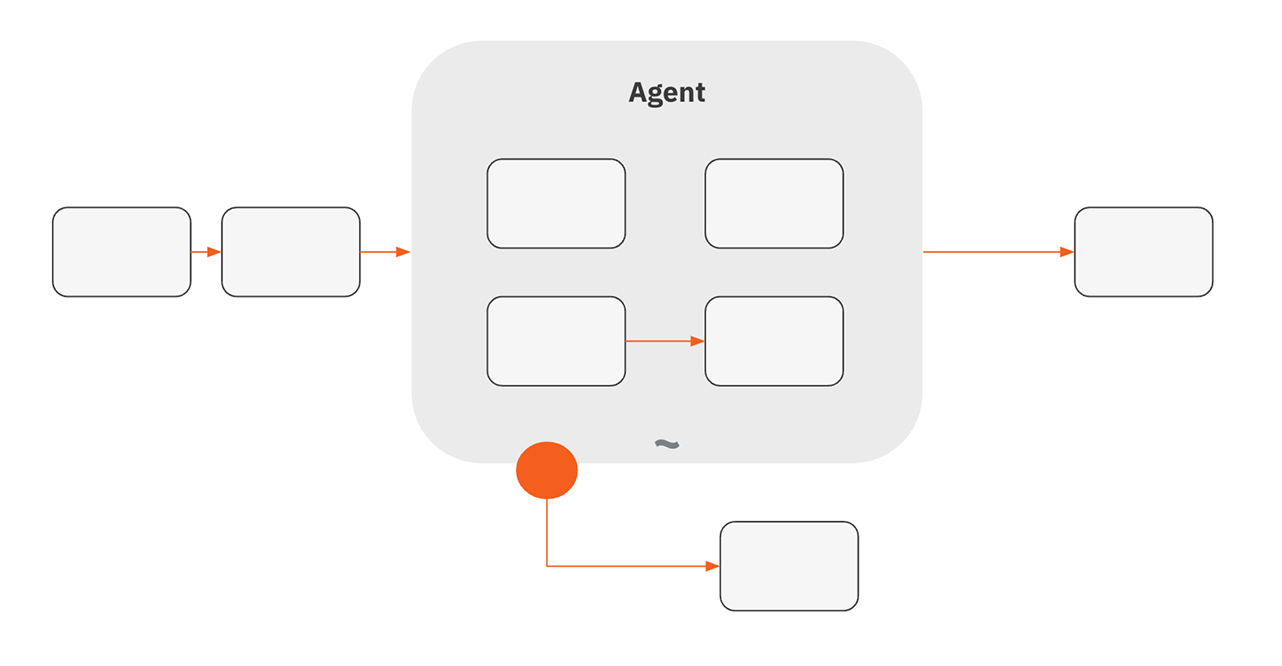
Process orchestration gives you the flexibility that agents require
Agentic orchestration blends deterministic and dynamic process execution to give you the best of both worlds. Deterministic steps handle compliance-critical actions; AI agents handle dynamic decision-making within governed boundaries.
This BPMN model shows exactly how guardrails work in practice: the agent's reasoning loop is contained within an ad-hoc sub-process, while deterministic approval gates, escalation paths, and compliance checkpoints surround it — making AI behavior explicit and controllable.
Key features
Adaptive AI agent coordination
Coordinate agents that plan, act, and reflect — with durable state management across reasoning loops and configurable memory strategies.
Human-in-the-loop governance
Native human task modeling with Slack, Teams, and email connectors for seamless human approval gates at any point in the process.
Scalable execution
Zeebe's distributed architecture scales to millions of concurrent agentic process instances with no performance degradation.
Enterprise-ready integrations
500+ pre-built Connectors plus MCP and A2A support for connecting agents to any tool, system, or external service.
Real-time monitoring
Camunda Operate for live process visibility and Camunda Optimize for KPI tracking, bottleneck analysis, and continuous improvement.
Use cases
Automated customer support
AI agents handle tier-1 inquiries, gather customer data, resolve common issues, and escalate to humans for complex cases — all within a governed BPMN process.
Governance, auditing, and compliance
Automate compliance checks, audit processes, and regulatory reporting with AI agents that operate within explicit governance boundaries and maintain full audit trails.
Supply chain optimization
AI agents monitor inventory, predict disruptions, coordinate with suppliers, and trigger corrective actions — orchestrated as an end-to-end supply chain process.
IT and security operations
Agents detect anomalies, investigate incidents, coordinate remediation steps, and escalate to on-call engineers — with full audit trails for post-incident review.
Why Camunda?
Enterprise-grade orchestration
Battle-tested in production by hundreds of enterprise organizations worldwide. Zeebe processes billions of workflow steps per month with enterprise reliability guarantees.
AI-first approach
Built-in AI Agent Connector, MCP support, and agentic BPMN patterns — making Camunda the platform of choice for organizations moving AI from prototype to production.
Open and extensible
BPMN 2.0, DMN, and open APIs ensure your investment is portable. Build with any language, deploy anywhere, and integrate with any tool.
On-Demand Webinar: Closing the Gap Between Agentic AI Vision and Reality
Hear our panel break down findings from Camunda's latest research and explain how organizations can move AI agents from pilot projects into production for true end-to-end value. Featuring insights from 1,150 senior IT leaders on what separates organizations that succeed with agentic AI from those that stall in experimentation.
Frequently asked questions
What is agentic orchestration?
Agentic orchestration is the combination of AI agents and process orchestration infrastructure. AI agents reason and act autonomously, while Camunda's orchestration layer provides durable state, governance guardrails, human-in-the-loop support, and observability — enabling AI to operate reliably in production business processes.
What are the benefits of agentic orchestration?
Key benefits include: enterprise-grade reliability for AI agent deployments, full audit trails for compliance, human oversight at critical decision points, persistent memory across long-running processes, and the ability to blend deterministic and AI-driven process logic in a single executable model.
What are the use cases for agentic orchestration?
Agentic orchestration is applicable wherever complex, multi-step processes benefit from AI autonomy: customer service automation, supply chain optimization, compliance monitoring, document processing, fraud detection, and IT operations — among many others.
How does agentic orchestration compare to RPA?
RPA automates deterministic, rule-based tasks by mimicking human actions in UIs. Agentic orchestration coordinates AI agents that can reason, adapt, and handle unstructured data — going beyond what RPA can address. Camunda can orchestrate both RPA bots and AI agents within the same end-to-end process.
What is the relationship between process orchestration and agentic orchestration?
Process orchestration is the foundation that makes agentic orchestration production-ready. AI agents need durable state management, governance guardrails, observability, and human oversight — all of which process orchestration provides. Agentic orchestration is process orchestration with AI agents as first-class participants.

Get started with agentic orchestration
Talk to a Camunda expert about building production-ready AI agents