AI added to a legacy process
~20% faster
AI speeds up existing steps, but the process still carries the same structural constraints.

ProcessOS is the intelligence layer of the Camunda platform, using specialized AI agents to discover how work really runs, redesign processes around the outcomes you want, build and deploy them, and continuously improve what goes live.
ProcessOS is currently in closed beta. Request early access to share your use case and help Camunda determine fit and prioritize access.
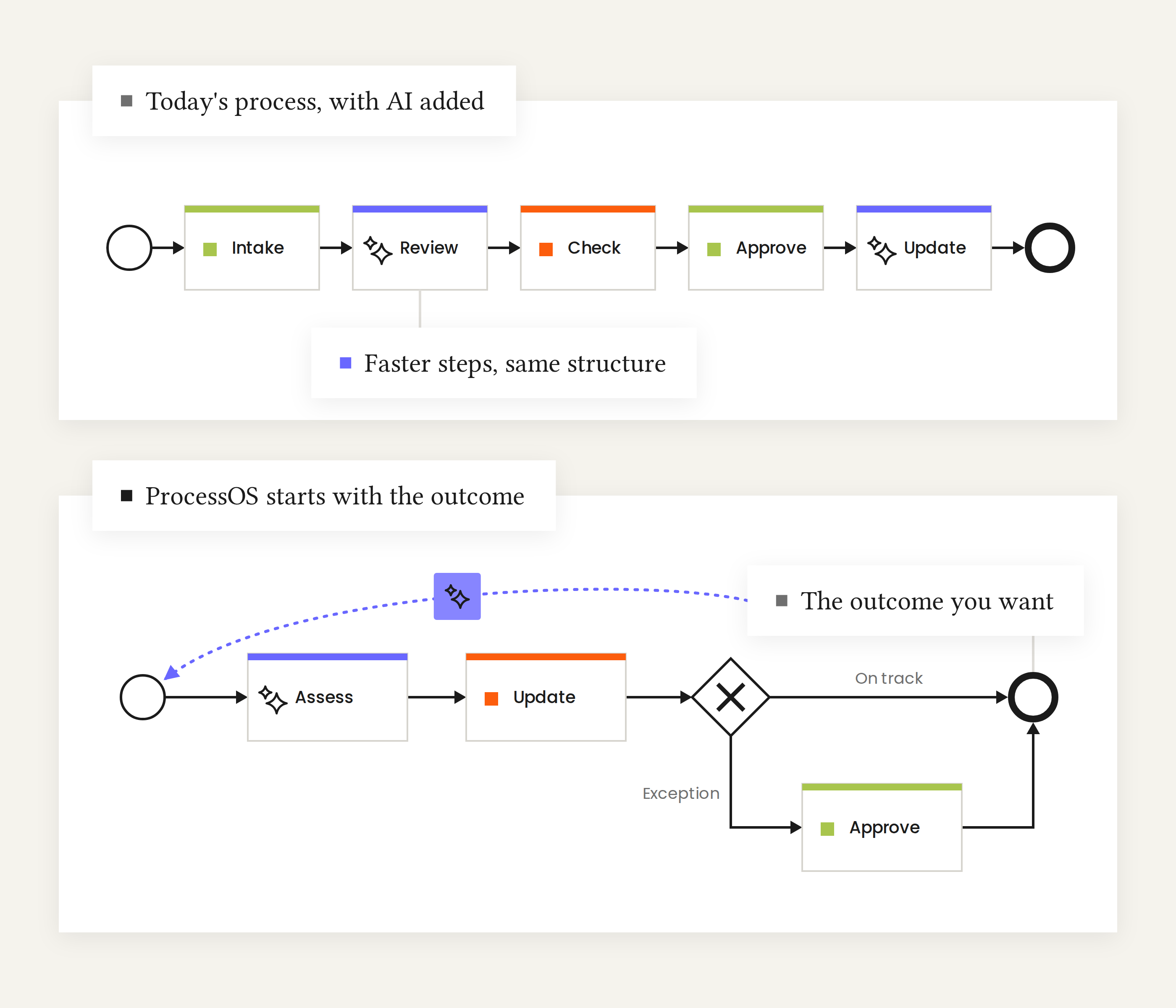
Most business processes were designed around human work, existing systems, and constraints that predate AI. Adding AI can accelerate individual steps, but the structure of the process stays the same.
ProcessOS starts somewhere different: with the outcome you want. It uses AI to understand the process you have today, re-engineer what it should become, and turn that design into something you can run and improve.
AI added to a legacy process
~20% faster
AI speeds up existing steps, but the process still carries the same structural constraints.
Re-engineered AI-native process
Months → days
Danica redesigned customer onboarding end to end with Camunda, reducing a process that took months to days.
ProcessOS tackles the real reason AI adoption stalls: we can't build tomorrow's processes using only what we know today. Transformation starts with a bold vision of the future.
Lily Wang
Managing Director, Barclays
CamundaCon 2026 opening keynote — Jakob Freund and Daniel Meyer
CamundaCon · May 2026
See the first public introduction of ProcessOS and why becoming AI-native requires more than automating the processes you already have.
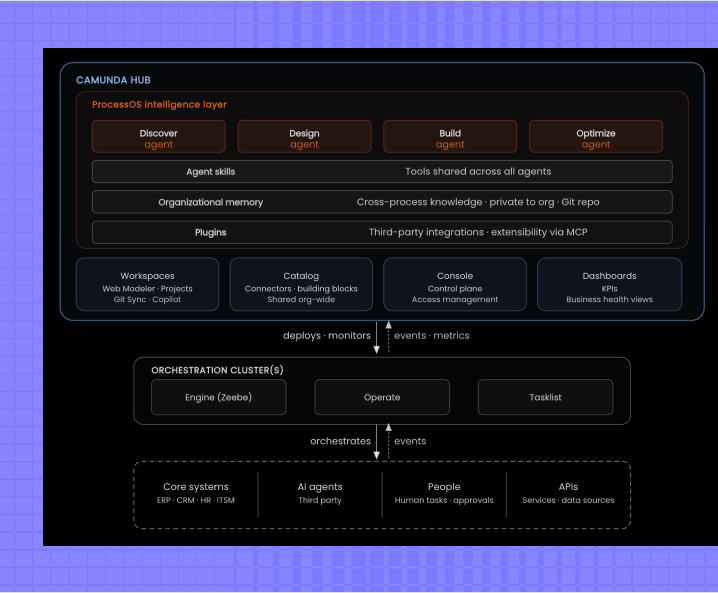
ProcessOS is the agentic operating system for your business processes and the intelligence layer of the Camunda platform. Four specialized AI agents work across the process lifecycle: discovering how work actually runs, re-engineering it around the outcomes you want, building and deploying the new process, and continuously improving it in production.
Describe the process in natural language, then define the outcome and KPIs that matter. ProcessOS uses that brief as ground truth to reconstruct the as-is process, design the to-be process, and generate what is needed to run it.
Cycle time | Manual effort | Quality | Cost | Throughput | Compliance
ProcessOS works backward from the result you want instead of forward from the steps you already have. It can explore process variants, evaluate them against the KPIs you define, and help redesign how people, agents, and systems should share the work.
ProcessOS can generate and modify process-based solutions, including process models, integrations, data mappings, agent prompts, decisions, and UI forms, then move the approved design toward deployment on the Camunda platform.
ProcessOS evaluates live process performance against the outcomes and KPIs you defined. When it identifies an improvement, it can test the proposed change against historical process data and surface the evidence for human review before anything reaches production.
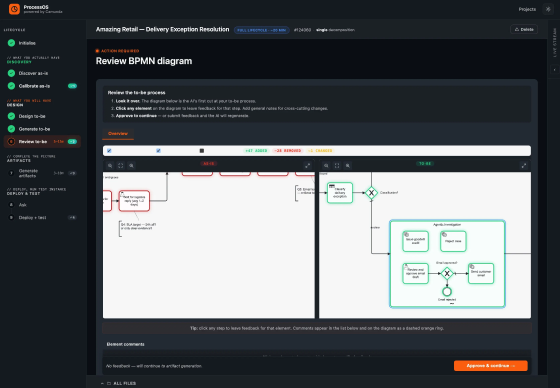
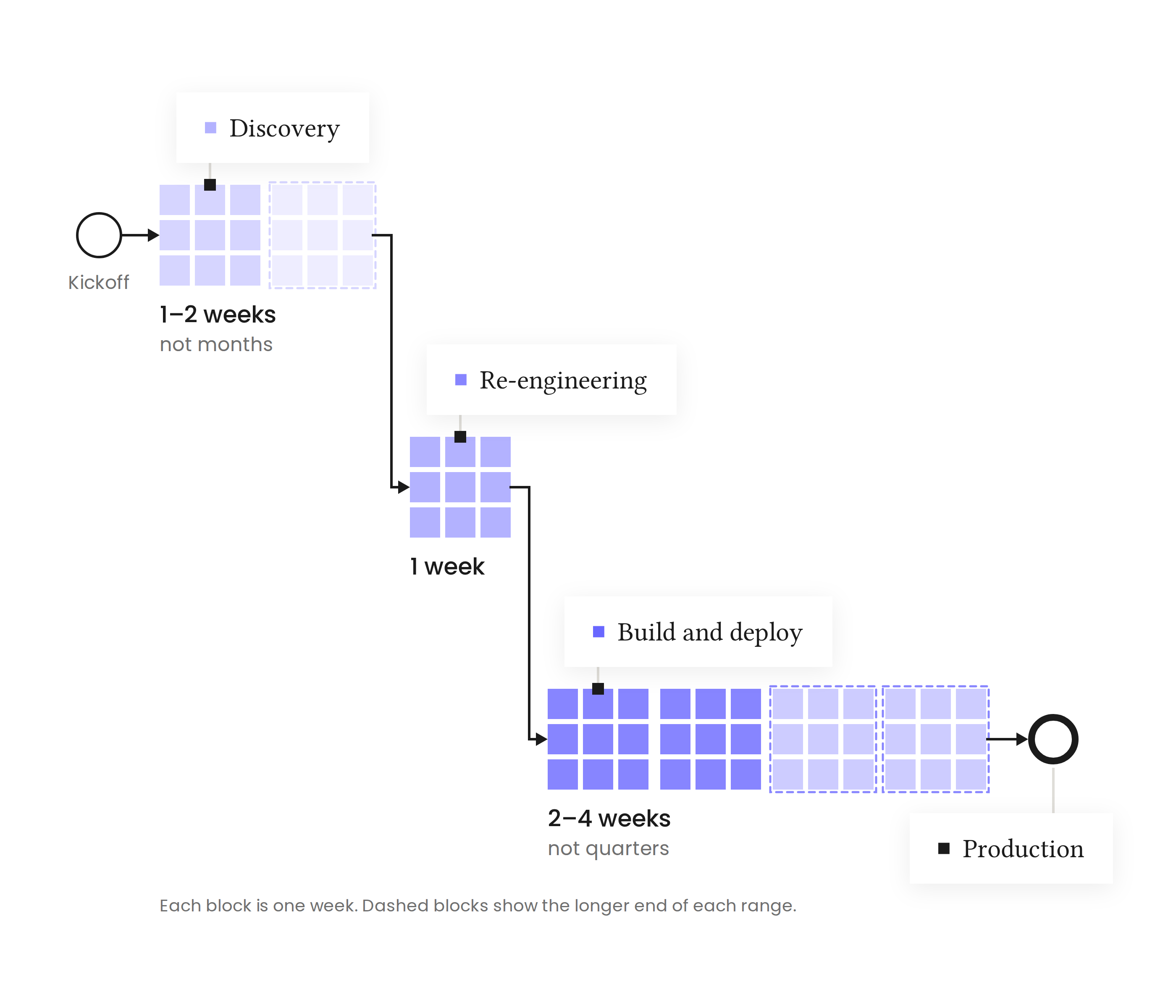
Traditional process transformation can spend months on discovery, workshops, documentation, redesign, and build. ProcessOS applies AI across the lifecycle to compress that work while retaining what it learns for the next process.
Finnova
70–80%
faster customer onboarding
Finnova redesigned an onboarding experience that took 15–30 minutes and depended on manual steps and scattered systems. The redesigned process reduced the same task to minutes.
R-KOM
Near-instant
ticket response time
R-KOM replaced a fully manual ticket-to-technician workflow with AI-agentic orchestration. Response time moved from an average of eight hours to near real-time.
ProcessOS works across the process lifecycle while Camunda provides the orchestration foundation for running the resulting processes. Teams can direct ProcessOS agents, work through their own coding agents, or work manually in the Camunda Workspace, with each mode writing to the same Project Repository.
Closed-beta engagements are limited. Tell us about the process you want to transform. Your answers help the team understand whether ProcessOS is the right starting point for your organization.