

Processes
The coordination structure
The model that sequences every participant — deterministic steps, AI agents, human tasks — into a continuous end-to-end flow. Processes that never break.
How processes work
AI agents can reason, decide, and act. Agentic orchestration connects them to the people and systems they need to get work done—with you in control.






AI agents are getting better at individual tasks. Business outcomes are harder: they depend on work moving beyond any one agent.
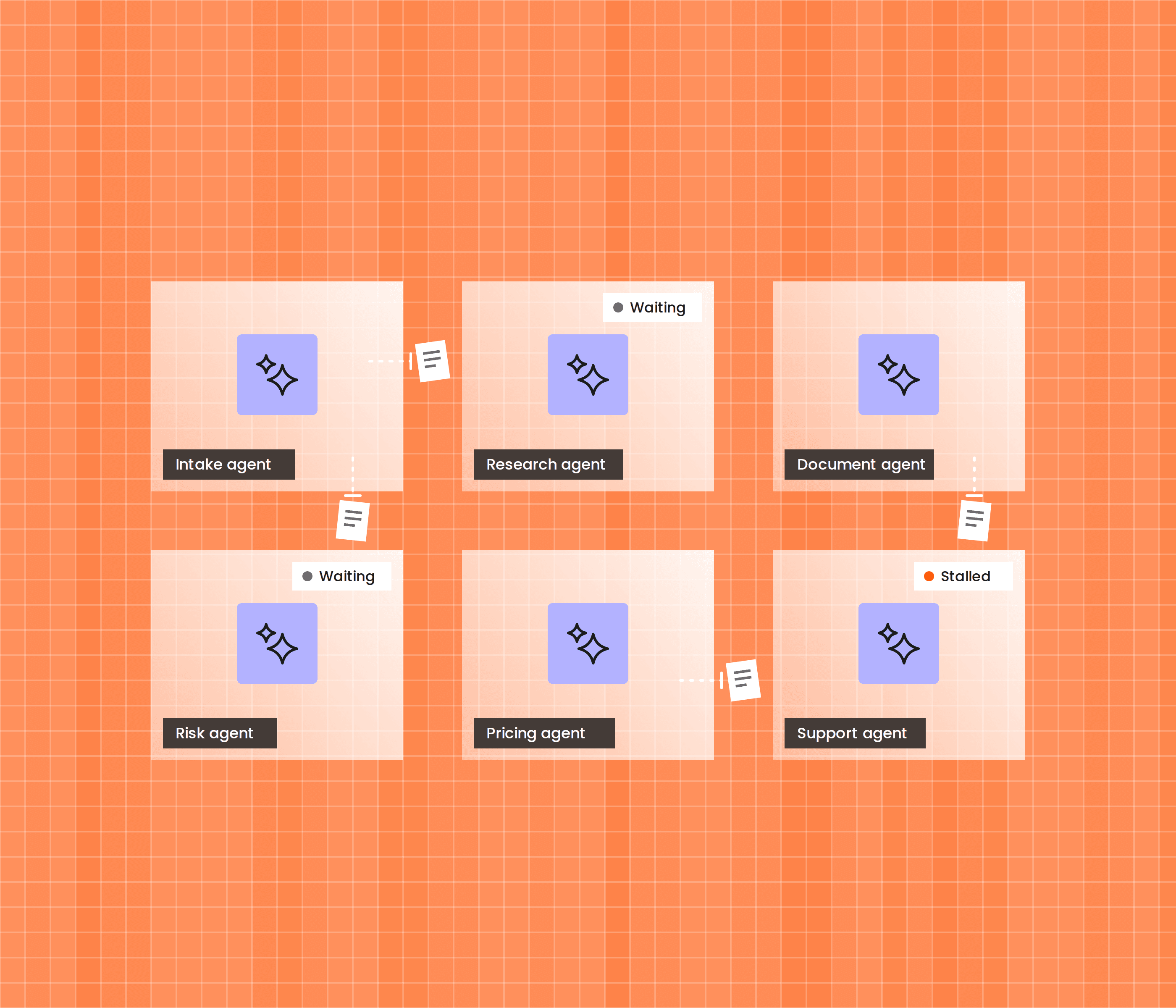
That work crosses applications, APIs, data, rules, workflows, people, and other agents. Every handoff creates another place for it to stall.
Add more agents and you add more decisions, exceptions, and handoffs to manage.
The challenge isn't getting AI to do something meaningful. It's keeping the entire process moving when AI does more.
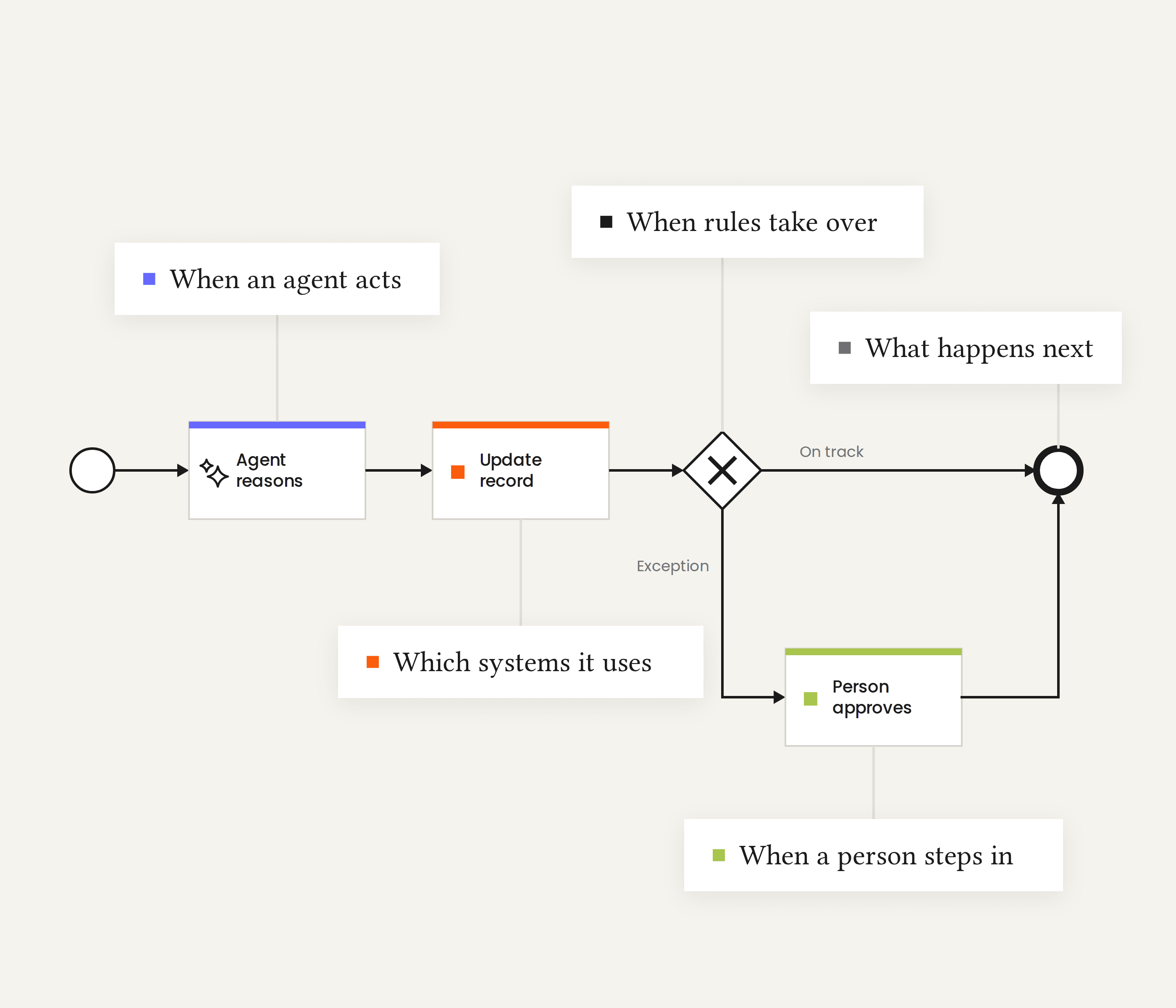
Agentic orchestration coordinates AI agents, people, and systems across end-to-end business processes, blending deterministic automation with AI reasoning in one governed process.
It turns separate actions into one coordinated process, giving agents room to reason and act while keeping the work on track: when an agent should act, which systems it can use, when rules should take over, when a person needs to step in, and what happens next.
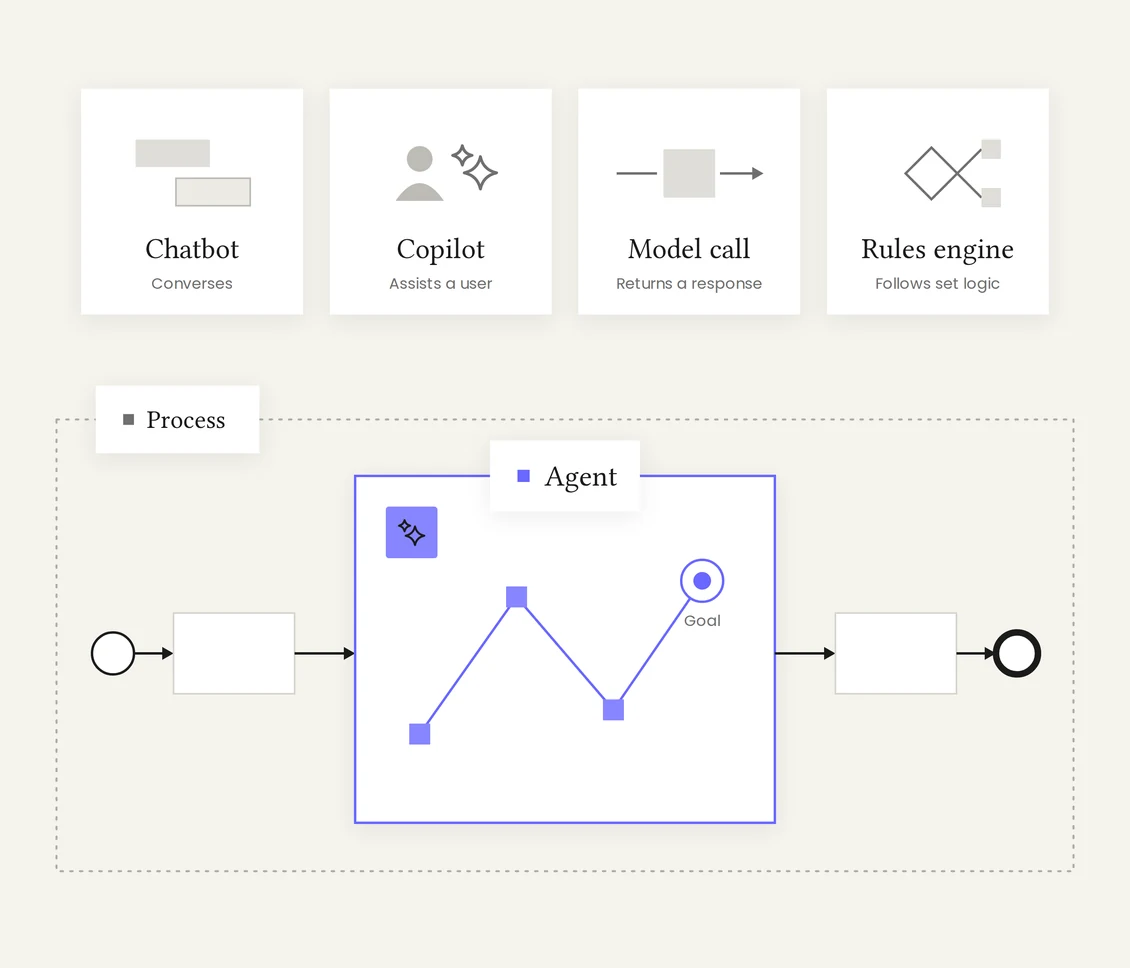
An AI agent is a goal-directed software system that can interpret information, determine the next best steps, take action using available tools, evaluate what happened, and adjust its approach.
That makes an agent fundamentally different from AI that simply responds to a prompt.
They work toward an objective rather than simply executing one instruction.
They can interact with tools, applications, APIs, data, and other systems.
They can evaluate results and adjust what they do next.
The path to an outcome doesn't always have to be defined in advance.
A chatbot primarily carries on a conversation. A copilot assists a user. A model call produces a response. A rules engine follows predefined logic.
An agent can determine and execute a sequence of actions toward a goal.
But even an autonomous agent is only one part of a larger process. That's why agents need orchestration.
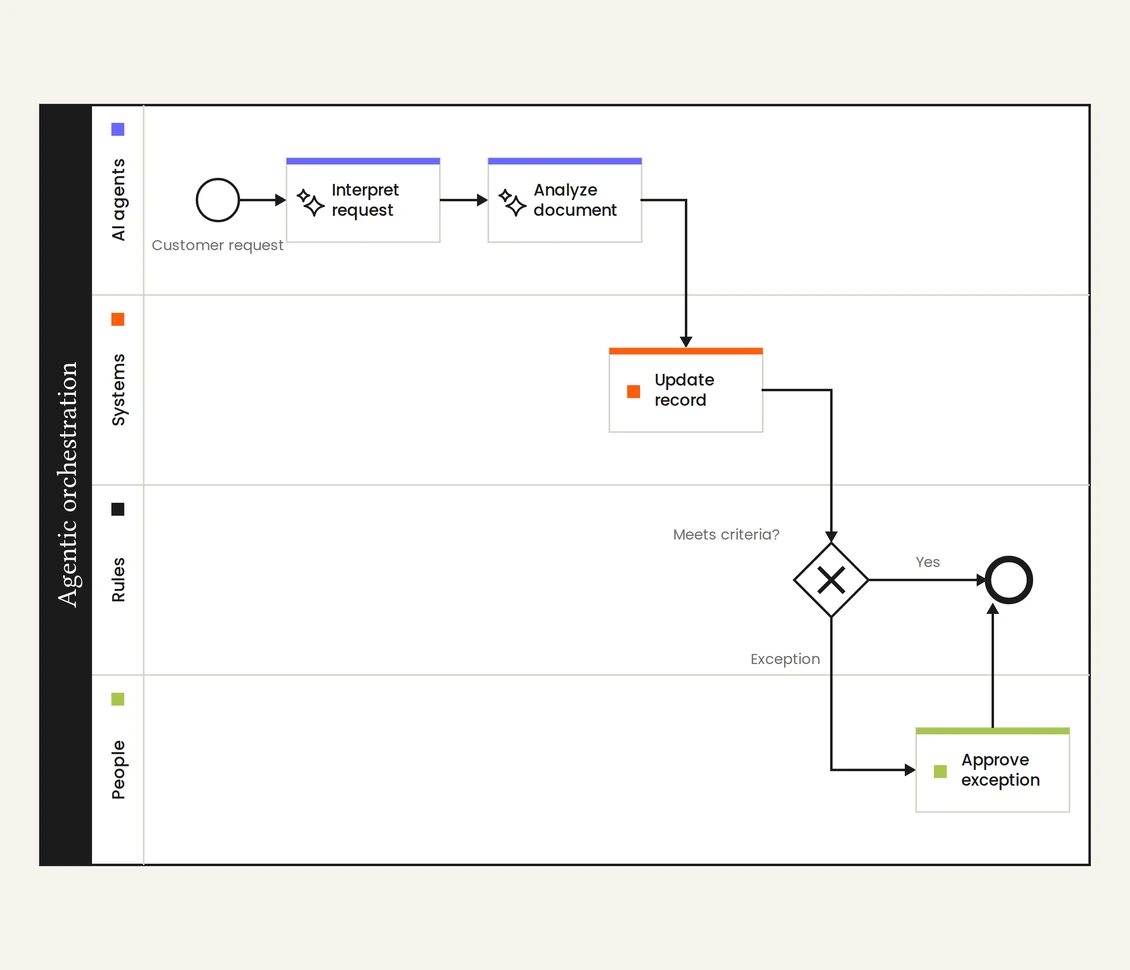
Consider a process that starts with a customer request.
An agent can interpret the request and determine what information is needed. Another agent might analyze a document. An enterprise system may need to retrieve or update a record. A business rule can determine whether a transaction meets defined criteria. A person may need to approve an exception.
Each participant does what it does best. Agentic orchestration decides when each one acts, passes along the information they need, handles dependencies and exceptions, and keeps the process moving.
So you can give AI more autonomy without losing control of the process.
The right level of autonomy depends on the work.
Fully deterministic
When the path is known, define it.
Rules and predefined logic execute predictable, repeatable work consistently.
Agentic / hybrid
When judgment adds value, use it.
Agents reason and adapt inside an orchestrated process while deterministic automation and people provide structure where needed.
Fully dynamic
When the path can't be known in advance, let it emerge.
Agents have greater autonomy to decide which actions and tools are required to reach the goal.
Most processes sit in the middle, moving between predefined steps, AI reasoning, and human judgment as the work requires.
The spectrum shows what's possible. The operating principle is simpler: don't spend AI reasoning on work that doesn't need it.
Keep predictable work predictable. Add AI reasoning where it helps, and increase autonomy as confidence grows.
Keep known, repeatable work fast and predictable.
Use defined logic where consistency, compliance, and accountability matter.
Reserve AI reasoning for decisions where adaptability earns its cost.
Agentic orchestration connects work with the systems that get it done.
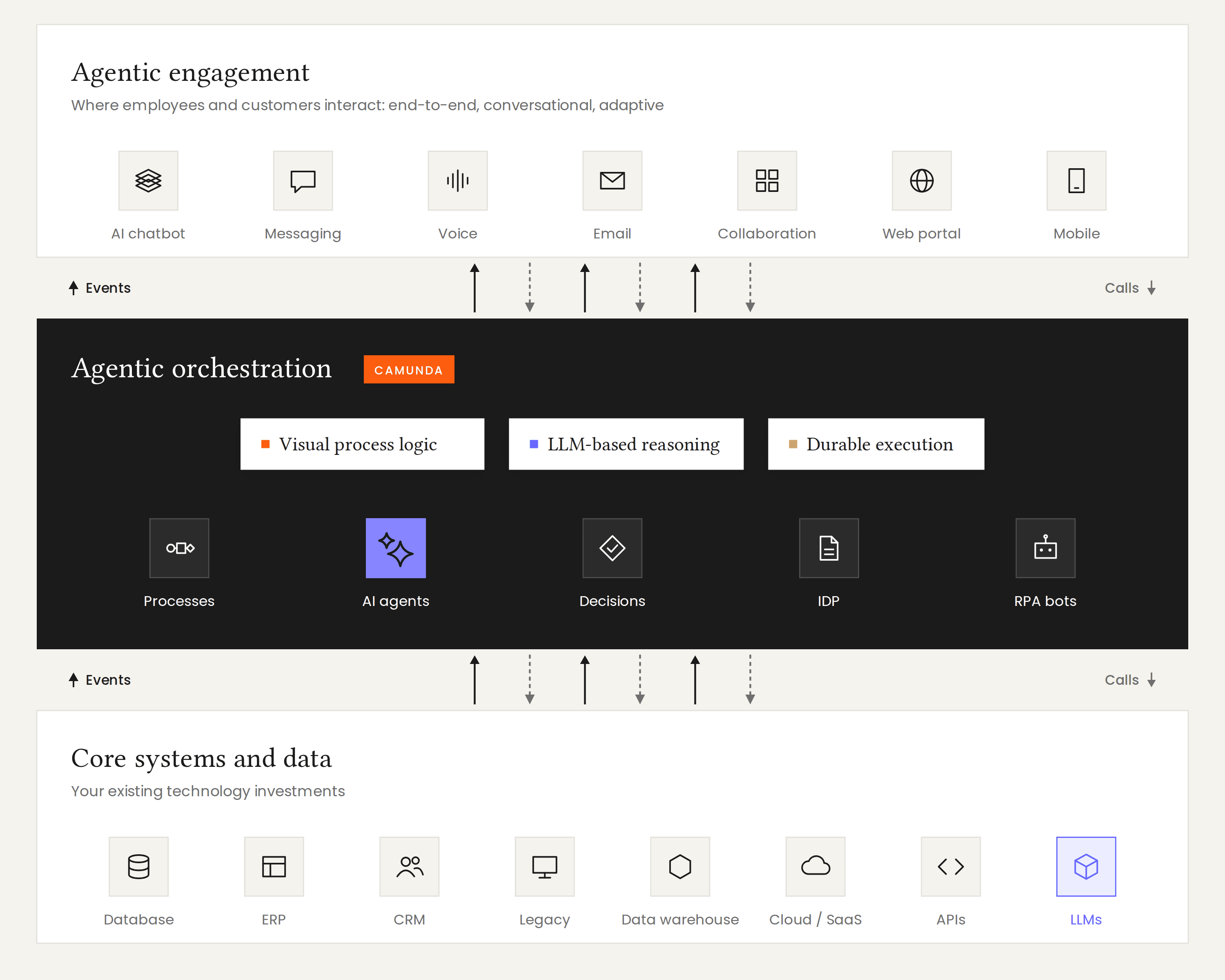
Agentic engagement
Customers, employees, applications, and experiences initiate work.
Agentic orchestration
One process coordinates AI agents, people, decisions, and automation.
Core systems and data
Enterprise applications, APIs, databases, and existing technology perform and record the work.
Your SAP keeps running. Your Salesforce keeps running. Orchestration coordinates across them without replacing any of them.
Any framework. Any LLM. Any vendor. Connected via MCP and A2A. The agents you have today and the ones you'll build tomorrow.
BPMN is an ISO-ratified open standard. Swap the LLM. Change the infrastructure. The orchestration logic stays valid.
Processes
The coordination structure
The model that sequences every participant — deterministic steps, AI agents, human tasks — into a continuous end-to-end flow. Processes that never break.
How processes work
Agents
AI reasoning inside the process
From simple task agents to complex orchestrator agents coordinating multi-agent systems. Built natively into the process model — with governance, audit trail, and resilience included.
How agents work
Building blocks
Composable steps for every process
Decisions, human judgment, integrations, RPA, intelligent document processing, and custom code. Composable steps for every type of work, under one governance model.
How building blocks workThe point isn't to replace all of these technologies. It's to make them operate as one process.
The payoff isn't more AI. It's better business execution.
Faster end-to-end outcomes
Reduce delays across the process, not just within one task.

Complete traceability
Trace decisions, handoffs, and exceptions from start to finish.

Scale without constant rework
Swap technologies without redesigning the process around them.

Less operational fragmentation
Reduce handoffs and silos across the technology you already use.
Governance by design
Make policies, approvals, and oversight part of execution by design.

Visibility into performance and ROI
Measure the outcome, find bottlenecks, and improve what happens next.

One process for every participant
Bring agents, people, and systems together around the same outcome.
Agentic orchestration builds on process automation by handling work that can change course as it runs. Here's how it differs from other approaches.
| Category | What it does | Scope | Handles agents | Audit trail | Best for |
|---|---|---|---|---|---|
| Agentic orchestration | Coordinates agents, people, and systems across complete processes, with governance built in | End-to-end | Yes, native | Yes, full | Mission-critical processes that need AI plus governance |
| Process orchestration | Coordinates deterministic steps across systems and people in a governed runtime | End-to-end | Partial | Yes | Structured, rules-driven enterprise processes |
| Workflow automation (iPaaS) | Connects SaaS apps and triggers short, predefined sequences | Local / task | Limited | Partial | SaaS integrations and simple multi-step flows |
| Business process management (BPM) | Models and automates structured processes with human tasks and decisions | End-to-end | No | Yes | High-volume structured processes with compliance needs |
| Robotic process automation (RPA) | Mimics user actions in legacy interfaces to automate repetitive UI tasks | Local / task | No | Partial | Legacy integration where APIs don't exist |
| Agent frameworks | Build individual AI agents: prompt chaining, memory, and tool calling | Local / task | Build only | No | Prototyping agents and task-level AI reasoning |
Putting agents into production takes more than managing how they behave. Let teams change agents, models, and tools without locking the process into one AI ecosystem.
Connect business and IT
Give business teams visibility while technical teams maintain the control they need to build and run it.
Keep critical processes running
Move long-running, high-volume work through delays, failures, and interruptions.
Understand what's happening across the process
Track decisions and execution so teams can troubleshoot problems, measure results, and improve the process.
AI technology will change. Your orchestration strategy shouldn't have to start over when it does.
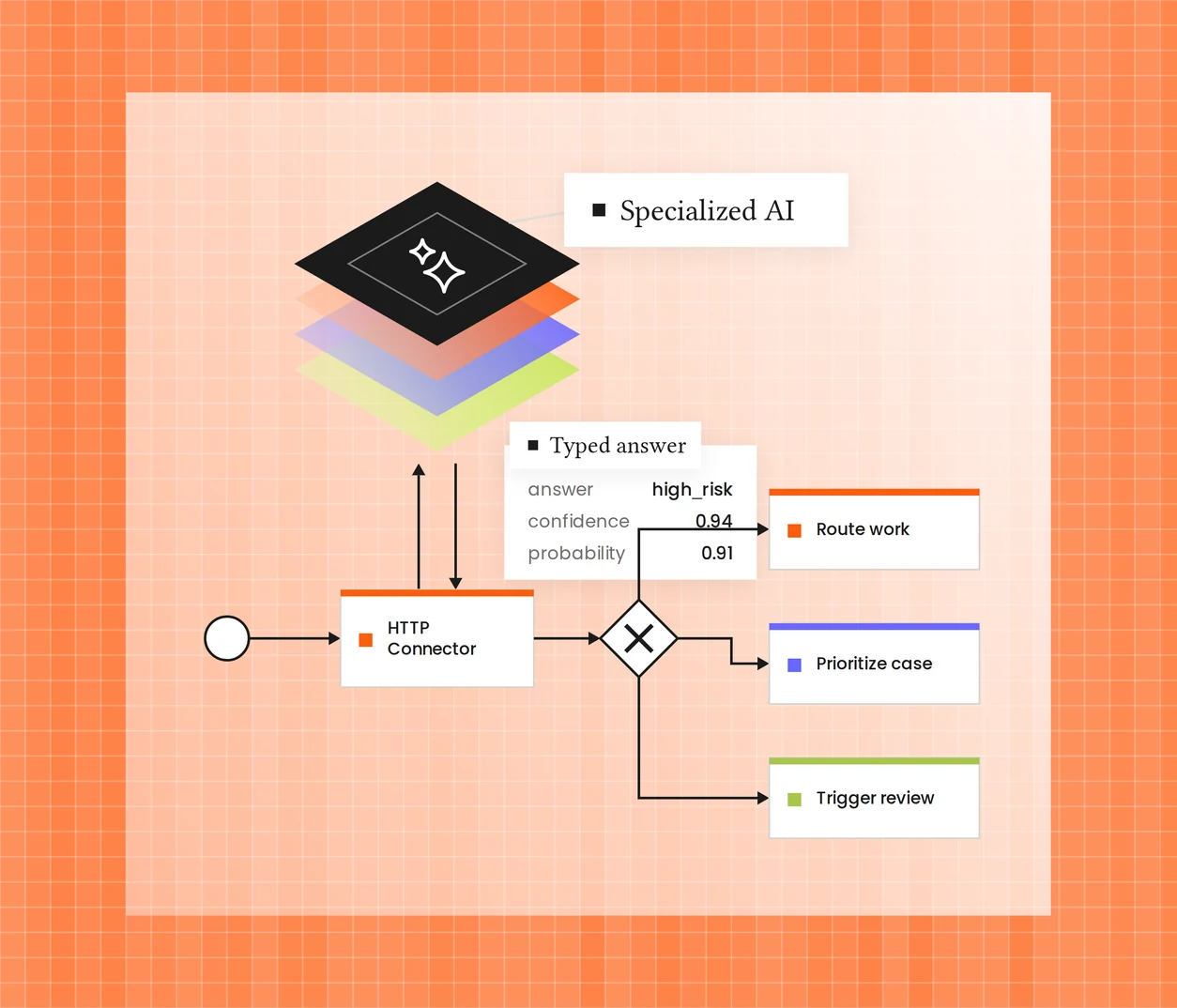
The Jev (TypeSafe) Connector shows how specialized AI can plug into an orchestrated process without locking the process into one AI ecosystem. Jev can classify, score, or judge text and structured data, returning typed answers, confidence scores, and probabilities that Camunda can use to route work, prioritize cases, or trigger reviews.
It runs through Camunda's standard HTTP Connector, so teams can add a specialized AI capability without deploying a custom worker or additional connector runtime.
Norfolk & Dedham Group Insurance transformed legacy claims workflows with Camunda, cutting claims processing time by 35% and cost per claim by 30%, while shrinking production deployment time from one week to one hour. An AI agent triages severity, pulls policy data, and flags anomalies inside a governed process that enforces approval thresholds and documents every decision for the regulator.
DB Cargo runs its Xrail cross-border freight booking system on Camunda, connecting seven European freight railways and coordinating 4,520 trains a day at a 99.98% availability SLA. When a shipment or booking exception occurs, the process — not a person watching a dashboard — is what keeps the network moving.
Harmoney, processing more than 10,000 loan applications a month, orchestrated its full loan origination journey end-to-end with Camunda. An AI agent handles document review and initial decisioning, evaluating bank statements, flagging inconsistencies, and producing a structured recommendation in real time, while the process enforces compliance gates and escalation paths before any decision is acted on. The result: decisions that once took four days now complete in under 18 minutes — lending decisions 90x faster overall, in a system built by one developer in three weeks. The agent handles the volume. The process holds the line.
$1T+
in annual payment flows across 60 countries, orchestrating six million human tasks weekly.
Goldman Sachs$3B
in financial transactions processed and 3.5 years of processing time saved across 10 business domains.
NatWest Center of Excellence600% faster
money-transfer processing — from 54 seconds to nine seconds — with 50% fewer errors and 32 employees re-deployed to higher-value work.
Halkbank90x faster
lending decisions, with the full loan origination journey orchestrated end-to-end.
HarmoneyIndustry recognition
Camunda was named a Visionary in the 2025 Gartner Magic Quadrant for Business Orchestration and Automation Technologies, recognized specifically for its approach to agentic orchestration. Forrester rated Camunda 5 out of 5 in Orchestration and Process Standards in The Forrester Wave: Digital Process Automation Software, Q3 2025.
Agentic orchestration doesn't erase the automation technologies enterprises already use. It expands what they can coordinate. It intersects with established categories:
BOAT — Business Orchestration and Automation Technologies
Platforms that coordinate and automate business processes across multiple technologies.
APO — Adaptive Process Orchestration
The use of AI and automation to continuously optimize process execution.
DPA — Digital Process Automation
Technology used to digitize and automate business processes.
BPA — Business Process Automation
The broader practice of using technology to automate repeatable business activities.
Agentic orchestration adds autonomous AI participants to this landscape while keeping the end-to-end process as the unit of control.
| Analyst / market category | Defined by | What it covers | How agentic orchestration relates |
|---|---|---|---|
| Business Orchestration and Automation Technologies (BOAT) | Gartner | The broadest analyst category — covers the full landscape of technologies that orchestrate and automate business operations, from process mining and RPA to orchestration and low-code | Agentic orchestration is the emerging capability layer within BOAT that adds AI agent coordination, governance, and human-agent collaboration to the orchestration and automation stack. Camunda was named a Visionary in the 2025 Gartner Magic Quadrant for BOAT, recognized specifically for agentic orchestration. |
| Adaptive Process Orchestration (APO) | Forrester | A newer Forrester category focused on platforms that coordinate work across humans, systems, and increasingly AI — with an emphasis on adaptability, real-time decision-making, and continuous optimization | Agentic orchestration delivers the adaptive, AI-driven coordination that APO describes. Camunda's blend of deterministic and dynamic orchestration, combined with built-in observability and continuous optimization, maps directly to the APO vision. |
| Digital Process Automation (DPA) | Forrester | The established Forrester category for platforms that automate and manage end-to-end business processes, spanning structured workflow, human tasks, and system integration | DPA is the foundation that agentic orchestration extends into the AI era. Camunda was named a Strong Performer in The Forrester Wave: Digital Process Automation Software, Q3 2025, rated 5 out of 5 in Orchestration and Process Standards. |
| Business Process Automation (BPA) | General market | The broad market category for any technology that automates business processes — often used as a catch-all that spans BPM, RPA, workflow automation, and process orchestration | Agentic orchestration is the next evolution of BPA: it adds AI agents as first-class participants in the processes BPA has always automated, with the governance and auditability that enterprise-grade BPA requires. |
Start with one critical process. Look for a measurable business outcome being held back by disconnected systems, manual handoffs, or an isolated AI experiment.
Use deterministic automation.
Introduce agent reasoning.
Keep human judgment in the process.
Orchestrate all three, set the right guardrails, and expand autonomy as confidence grows. The winners won't have the most agents. They'll be the ones that orchestrate them best.