
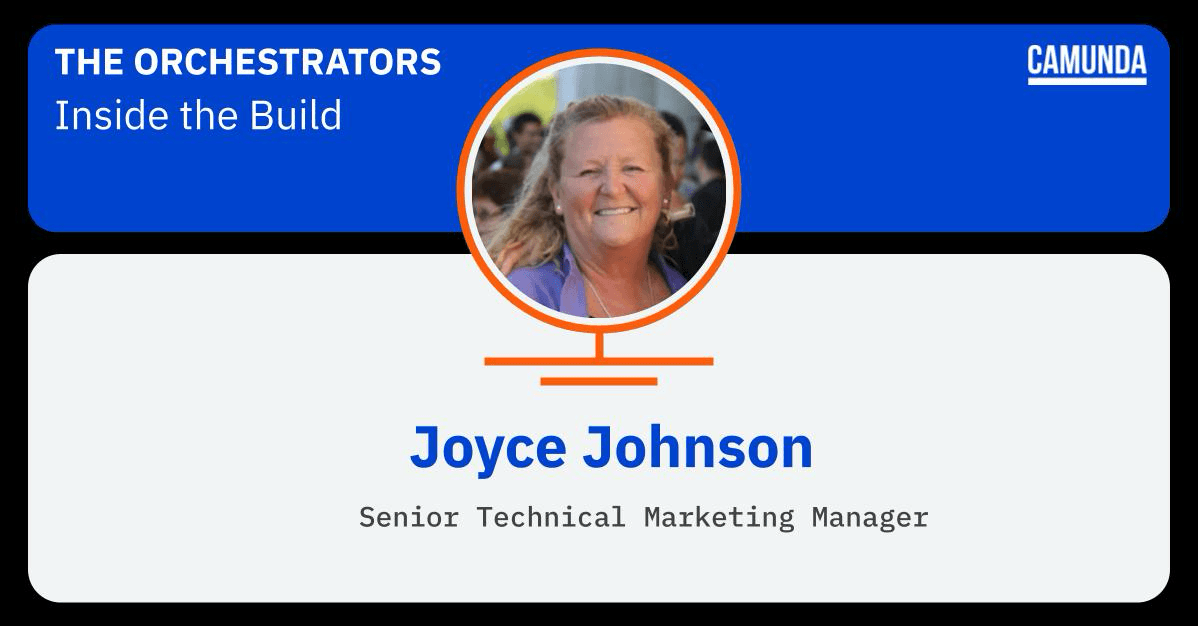
Every Camundi has a before and an after with AI. Before AI became part of how we work. And after it started changing the way we think, build, and solve problems.
This series is about that journey. The moment someone tried something, broke something, improved something, or built something they did not expect.
Each month, one Camundi from somewhere across the business walks us through their AI adoption journey. An open look at how people are figuring it out as they go, across teams.
If you have been curious but have not started yet, this is for you. If you have started and feel like you are doing it wrong, this is for you too.
Who are you and what do you do at Camunda?
My name is Joyce Johnson and I am a senior technical marketing manager at Camunda.
What did the work look like before and why did you decide to try AI on it?
My work has many facets which include writing technical blogs about our product, reviewing blogs by others for technical accuracy and to add Camunda messaging, trying out and showcasing new features of the product so that I can write about them, and designing/building/delivering complex demonstrations. Before AI, I did all of this alone with some assistance from engineering, presales, and product management.
With AI, I have built skills that assist in all of these facets of my job. I have skills that write like me to help provide outlines and structure for blog posts, skills that will review content (video, written, etc.) to confirm it adheres to how we want to highlight the product, skills to “humanize” responses, and provide suggestions for improvement. But most importantly, I have loaded all of the Camunda AI Skills that we provide to our prospects and customers and have used that to enhance and help build demonstrations with more complexity that highlight certain features and functionality.
AI enables me to perform my duties faster and probably, more effectively.

What did you actually build or change and what's the impact?
For the demonstrations that I created during this spring and summer, I anticipate that AI provided the work of an additional engineer, in some cases two, in building demonstration assets, creating components for the demonstration as well as building tools and documentation assets that assisted in the demonstration setup and delivery.
For blog writing, sometimes coming up with the idea or the blog structure can be intimidating. My blog writer skills along with product messaging have streamlined the process and I would assume I can write blogs in about half the time.
I have also shared many of my skills within the organization so others can benefit. I also have some specific skills around building demonstration components: DMN tables, Optimize dashboards, click-through demos, etc.
I mostly use Opus 4.8 for my model and focus on using Claude Code for my work. I have worked alone on most items, but did have some “challenges” posed by others in the organization to see what product stack would work best for something and how good the output would be.
I have to note that I really had only used ChatGPT (without skills) for assisting in writing blogs and generating DMN tables prior to Camunda’s adoption of Claude. I was “tasked” with seeing if Claude could build snippet videos of Camunda product features that would explain and showcase specific features. This was an important catalyst in my AI adoption because I went all in at a fast and furious pace.

What went wrong, and where does it still let you down?
I think for me, it is making sure that I communicate effectively with Claude or the outcomes are not what I expect. I need to be descriptive and clarify exactly what I am requesting. At the beginning, I allowed a little too much “liberty” to let AI do what it thought was best and found that my outcomes were not optimized.
If you were starting from scratch tomorrow, what would you do differently?
I would do more upfront training, honestly. I was brought in early to try some projects for senior leadership and I didn’t really research enough about how certain tools worked, how to set up connectors, the best way to prompt for what I wanted, etc. I think I could have saved time (and probably some tokens and frustration) had I been a bit more prepared before I jumped in; however, I did find that sometimes Claude told or suggested to me the right tool for the job, what connector I might need, etc. and I learned to trust some of those recommendations.
What can other teams steal or try right now?
One of the most useful ways I’ve found to work with AI is to combine information from multiple sources into one clear summary. Use approved spreadsheets, documentation, websites, and connected tools, then review the output carefully before sharing it.
Come build with us
The problems Camunda is solving are hard. The people solving them are curious, lifelong learners who bring empathy and persistence to everything they do. The work we do at Camunda isn’t for everyone, but if this kind of thinking energizes you, you’ll likely feel right at home.
If this series made you think, “I would love to do that,” you probably would. Come see what we're building. Explore our open roles here.


