
Every Camundi has a before and an after with AI. Before AI became part of how we work. And after it started changing the way we think, build, and solve problems.
This series is about that journey. The moment someone tried something, broke something, improved something, or built something they did not expect.
Each month, one Camundi from somewhere across the business walks us through their AI adoption journey. An open look at how people are figuring it out as they go, across teams.
If you have been curious but have not started yet, this is for you. If you have started and feel like you are doing it wrong, this is for you too.
1. Who are you and what do you do at Camunda?
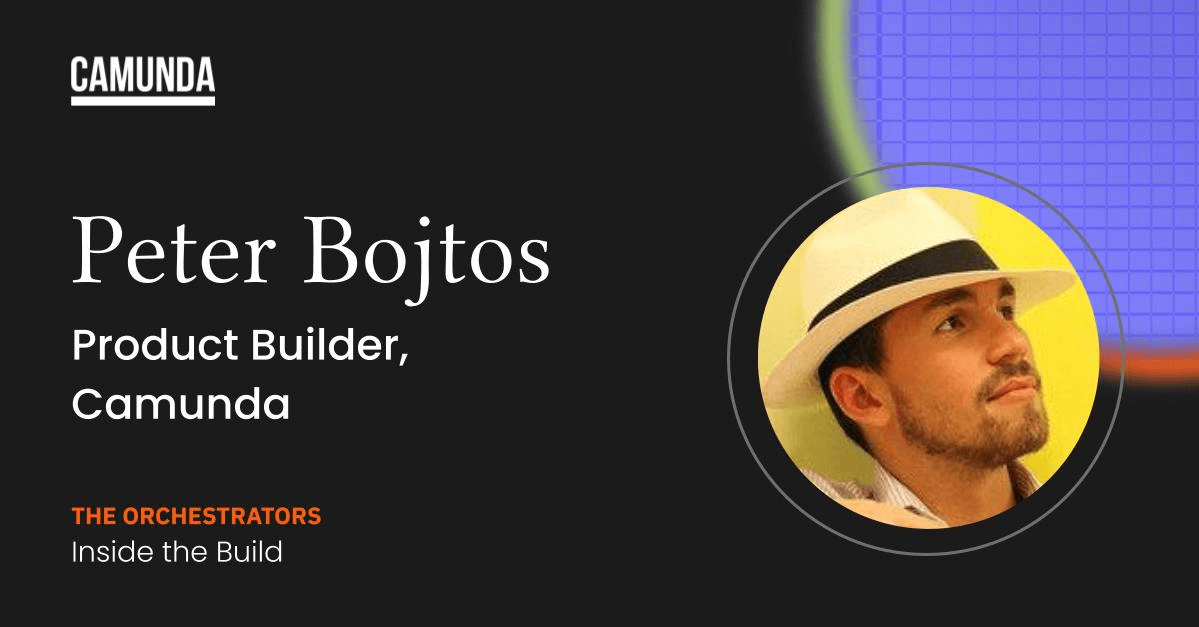
I’m Peter Bojtos, working as a Product Builder in the new Experience organization. I’m building a migration path to help customers moving from Camunda 7 to Camunda 8 do this with a guided, reviewable workflow.
I’m the sole responsible person of the migration tooling and also participating in the SDK / user facing AI skill creation. Most of my work focuses on improving the experience for Camunda 7 users, making the transition to Camunda 8 as smooth as possible.

2. What did the work look like before and why did you decide to try AI on it?
My former role was Product Manager, where we had many different channels to get customer insights and feedback. It was hard to get a clear picture around a potential new feature, so we decided to give AI tools a try. It proved itself immediately, we were able to put together a roadmap faster, backed by strong customer signals.
Another area where AI changed the way we work were prototypes. Creating a clickable prototype in Figma took a lot of effort and learning, running it with a customer in a call was not trivial. Creating an experiment branching out from the production code and building experiments with AI were also a game-changer, I could create different solutions to a problem and run it with stakeholders in hours, not days.
After the company reorganization, I became an AI builder, which means I’m the UX Designer, the Product Manager and the Engineer at the same time. Using AI in this role was a no-brainer, I’m using AI from day one of the new role.
3. What did you actually build or change and what's the impact?
When I took over the migration tooling from engineers, I realized that the code and all tooling around it was created before the agentic era. I reshaped the repository structure, integrated AI into the whole development process and that sped up the development significantly. Now the speed is 40-60 merged changes per week, which was impossible before the AI era. Not for one individual for sure.
I also realized that the most capable models are far better at writing software than I am, so I shifted my role more into adding context and guardrails to agents and letting them handle the actual code writing. I'm the sanity check at the end of the software development process though.
I was able to ship a totally new approach of migration, which is also reflecting this shift. I’ve created all the context someone migrating might need and packaged it in a way that can be used by any agentic harness. Early feedback is promising, decreasing the migration efforts significantly.


4. What went wrong, and where does it still let you down?
When I instructed my agents on how software development should happen, they sometimes followed my process, but some instruction was always missed. I realized that my instructions are more like inspirations to the agents, but no guarantee they follow every step.
Another realization was that most of the time I was the messenger between agents (the internet-term for this is meat proxy), one agent did some research, another agent created some content based on that. Or one agent wrote some code, another one reviewed it and I had to let the author know about the findings of the reviewer. This did not create too much value, but took a lot of context switching for me.
Fortunately another team within Camunda came up with a solution. Since our core product is about orchestrating complex processes, why not use it for software development as well? My agents are now orchestrated by BPMN definitions, agents are doing the reasoning and code editing, BPMN process definitions are orchestrating them.
5. If you were starting from scratch tomorrow, what would you do differently?
If I started agentic engineering today, I would not waste time managing my software development lifecycle using the agentic harnesses themselves (e.g. Claude Code), but turn to BPMN immediately. This guarantees that the whole workflow follows my expectations and agents are doing only what they are best at: reasoning and editing code. Reasoning is an LLM concern. Durability and orchestration isn't.
6. What can other teams steal or try right now?
- The Steal: If someone is working with agents and expects them to follow complex workflows, don’t bother instructing them in the traditional way. Use BPMN to describe the workflows, let the agents do the content creation and reasoning.
- What would you tell anyone, outside the company, who's building something similar with AI right now? Go big or go home. Build orchestration around your agents, let them handle their job, while your role is mostly about building context and high level goals you want your agents to achieve. You bring the vision, goals and context, agents ship the solutions.

Come build with us
The problems Camunda is solving are hard. The people solving them are interesting, lifelong learners, who bring curiosity, empathy, and persistence to everything they do. The work we do at Camunda isn’t for everyone, but if this kind of thinking energizes you, you’ll likely feel right at home.
If this series made you think, "I would love to do that” you probably would. Come see what we're building. Explore our open roles here: https://camunda.com/careers/


