
Camunda vs. Pega
From operational costs to modernization challenges, Camunda offers a superior approach.
What’s the difference between Camunda and Pega?
Pega and Camunda both sit in the The Forrester Wave: Adaptive Process Orchestration (APO), 2026. That’s where the similarities end. The platforms address different challenges and answer different questions.

Pega is an application platform.
Pega is a mature low-code environment for building case management and decisioning applications. Pega asks: what application should this work run in? The answer is usually a Pega application, built by a Pega-certified team, using Pega’s own rule types.

Camunda is an enterprise-grade agentic orchestration platform
Camunda asks a different question: how should work move across every agent, person, and system you already run? The answer is a process, modeled in Business Process Model and Notation (BPMN), an international open standard, and executed by an engine built for continuous uptime. That difference shapes everything else.

Pega builds where the work happens. Camunda governs how the work moves.
Pega’s platform is open enough to call external services and keep data outside Pega, but your logic still lives in hundreds of proprietary rule types. Camunda processes use an open standard your developers can learn in less than a week.

Pega offers certainty. Camunda offers control.
Pega calls its platform “a foundation of certainty.” AI isn’t certain. Camunda places enforceable steps between an agent’s decision and its action, so you can give AI real authority without giving up control. The agent reasons. The process decides what it’s allowed to do.

Pega’s real cost isn’t the license.
It’s the competence center, the scarce certified specialists, and the managed cloud premium. Camunda runs on skills your team already has.

Camunda ensures every process is AI ready.
With Camunda 8.10, any process becomes a callable tool through the Model Context Protocol (MCP), and you can orchestrate agents from any provider, alongside the people and systems they work with.

Every process you built on the Pega platform was designed for a world without AI.
You don’t need a big-bang migration to fix that. Re-engineer one process at a time on Camunda while Pega keeps running. Retire what you no longer need. And let Camunda orchestrate across everything in between.
Camunda vs Pega: Compare the features
| Camunda capability | Pega capability it replaces | Fit |
|---|---|---|
| BPMN processes, sub-processes, and ad-hoc case work | Case types, stages, child cases | Native |
| User tasks, candidate groups, and task listeners | Work queues, routing, approvals (including parallel) | Native |
| Timer and escalation events, plus Optimize alerts | Service levels, goals, deadlines, escalation | Native |
| DMN decision tables (ISO standard), run in-engine | Decision tables, when rules | Native |
| 100+ official Connectors plus custom Connectors, any protocol | Connect-REST, SOAP, Kafka, email listeners | Native |
| Job workers in Java, Python, Node, Go, and .NET | Queue processors, job schedulers, activities | Native |
| Headless APIs for your front end, and Camunda Forms for light UI | Constellation UI, portals | Equivalent pattern (deliberate design difference) |
| Operate and Optimize dashboards, plus RDBMS and export pipelines | Reporting, Insights, BIX | Native |
| OIDC and SAML SSO, per-resource authorizations, and audit log | Security, access groups, audit | Native |
| ProcessOS: AI-assisted discovery, design, build, deploy, and optimize | GenAI Blueprint | Native |
| AI Agent with BPMN guardrails, MCP and A2A support, and any model | Agents, predictable AI runtime | Native |
| Orchestrates it as a service. Not a Camunda goal to replace it. | Customer Decision Hub (1:1 marketing) | Stays in place, orchestrated |
Why choose Camunda?
Pega can be a strong fit for packaged case management and application delivery inside its platform. Camunda is a superior, differentiated choice: an orchestration layer for teams that need to coordinate work across their existing systems, govern AI agents in production, and keep control of how their architecture evolves.
Orchestrate across systems—not inside a closed suite
Connect people, AI agents, and systems in one end-to-end process. Keep your systems of record, data, and user interfaces where they belong. Rather than rebuilding work inside a Pega application, use Camunda to coordinate the endpoints your business already relies on.
Give agents authority—with enforceable controls
Put explicit approvals, policy checks, and escalation paths between an agent’s reasoning and its actions. Combine AI-driven decisions with deterministic process steps while maintaining an audit trail across the wider process—not just activity inside one platform.
Keep process logic on open standards
Model processes and decisions in BPMN and DMN, rather than proprietary platform formats. Give architecture, delivery, and compliance teams a shared language, while keeping your orchestration independent of a particular AI model, agent framework, or application stack.
Modernize without starting over
Improve execution across existing systems instead of moving everything into another vendor’s runtime. Evolve the process as your needs change, adding new agents and services without making a complete platform rewrite the starting point.
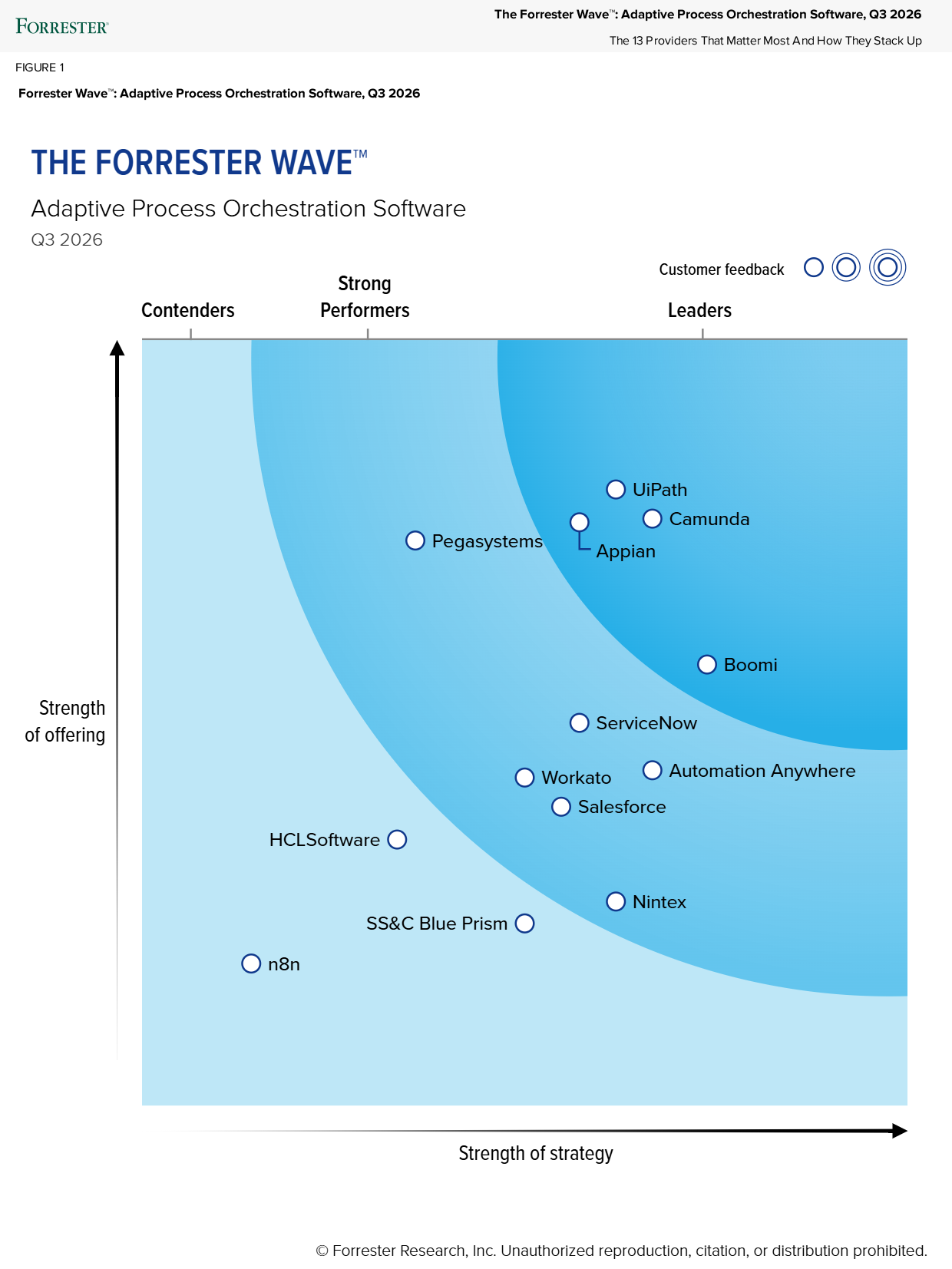
The Forrester Wave: Adaptive Process Orchestration Software, Q3 2026

A Leader in adaptive process orchestration
Camunda was named a Leader in The Forrester Wave™: Adaptive Process Orchestration Software, Q3 2026. The evaluation focuses on the architecture and capabilities needed to apply AI to complex process orchestration while maintaining control, visibility, and trust in how that AI operates.
Camunda received Forrester’s highest possible scores in process complexity handling, process volume handling, adaptivity architecture, reliability architecture, and governance and control. Forrester said Camunda is best suited for large enterprises that need scalable, reliable, and observable process orchestration with agentic AI at scale.
How easy is it to migrate from Pega to Camunda?
Very easy. Teams usually move off Pega when they want more flexibility: open standards, freedom from proprietary lock-in, and a faster path to putting AI to work across their existing systems. Migration doesn’t have to be a big-bang replacement. Most organizations start with one high-value process on Camunda, run it alongside Pega, and expand at their own pace.
Who’s chosen Camunda over Pega?
“Payments and savings is core to how we serve customers, so we needed to orchestrate it end to end with real confidence. With Camunda we cut time-to-market by around 30% and now run these journeys reliably in production, with the control to keep improving them.”

Pascal van Puijvelde, Business Analyst, Rabobank
“When we compare Camunda with other solutions such as Pega and Bizagi, we evaluated alternatives five to six years ago… It is easy to start up, conduct your POCs, and get it into production, which is a differentiator for us against the other BPMN engines we have seen.”

Ajit Dani, Principal Solutions Architect, British Telecom (PeerSpot)


Camunda vs Pega FAQs
Is Camunda a Pega alternative?
Yes. Camunda is a common alternative for teams that want to orchestrate processes across their existing systems rather than build applications inside one legacy suite. Camunda orchestrates AI agents, people, and systems using BPMN and DMN, which are open standards, so process logic stays portable. Many teams adopt Camunda alongside Pega, then move processes over one at a time.
What is the main difference between Camunda and Pega?
Pega is a low-code application platform: you build case management and decisioning applications inside Pega, using proprietary rule types. Camunda is an agentic orchestration platform: you model processes in open BPMN and coordinate the agents, people, and systems you already run. Pega asks which application the work should run in. Camunda governs how work moves across all of them.
Is Camunda cheaper than Pega?
Yes, when looking at the total cost of ownership. Pega pricing is quote-based and typically grows with cases and/or users, and most implementations rely on certified specialists and professional services. Camunda’s subscription pricing doesn’t multiply with every added user or case. It runs as Software-as-a-Service (SaaS) or Self-Managed, and BPMN skills are widely available. It’s critical to compare multi-year totals, including services and talent, not just license price.
Can you migrate from Pega to Camunda?
Yes. Pega flows look like BPMN but don’t follow an open standard, so migration means re-engineering processes, not exporting them. Most teams migrate in stages. They move one high-impact process to Camunda and run it alongside Pega against the same systems. Then they migrate adjacent processes and decommission Pega at their own pace. Camunda provides migration guidance, tooling, and services for each step.
How do Camunda and Pega compare for AI and agentic orchestration?
Both now offer AI agents and Model Context Protocol (MCP) support. The difference is where governance lives. Camunda orchestrates agents from any provider through MCP and A2A. For agents built in Camunda, BPMN steps sit between the agent’s reasoning and its actions, enforcing approvals and policy checks. Pega’s agents mainly operate inside Pega applications. Camunda was named a Leader in The Forrester Wave: Adaptive Process Orchestration Software, Q3 2026.
Are Pega and Camunda both low-code?
Pega is a low-code application platform. Teams assemble applications from Pega’s own rule types, usually with certified Pega developers. Camunda is built for developers first. They work in BPMN plus code in Java, Python, Node.js, Go, or .NET, with full API control and their own CI/CD. Business users still model visually and use prebuilt connectors, so both groups work on the same executable model.
Which has better process modeling standards support?
Camunda. It’s built natively on BPMN 2.0 (ISO/IEC 19510) and DMN, open standards from the Object Management Group (OMG), and the model you design is the model that runs. Pega flows resemble BPMN but use a proprietary format. Forrester gave Camunda its top score, 5 out of 5, for process standards in The Forrester Wave: Digital Process Automation Software, Q3 2025.
Is Camunda open source?
Not fully. Camunda 8 is source-available. Since October 2024, its Self-Managed components, including the Zeebe engine, have been released under the Camunda License 1.0. You can read the code and use it free for development and testing, but production use needs a commercial license. Camunda 7 Community Edition was open source under Apache 2.0. Pega is proprietary, closed-source software.
Does Camunda replace Pega or work with it?
Both. Many teams start by running Camunda alongside Pega. Camunda orchestrates the end-to-end process and calls Pega as one system among many, next to SAP, Salesforce, or ServiceNow. Over time, Camunda customers move processes off Pega one at a time and retire what they no longer need. Some keep specific Pega capabilities in place, such as Customer Decision Hub, and orchestrate them as a service.
When is Pega the better choice?
Pega can be the better fit when you want a packaged, industry-specific application, such as customer service or dispute management, and are happy to run it inside one vendor’s platform. Pega Customer Decision Hub is also a strong fit for real-time, one-to-one customer decisioning. Camunda fits better when you need to orchestrate across many systems, govern AI agents in production, and keep process logic on open standards.