BPMN: The open standard for process and agentic orchestration
Twenty years ago, BPMN solved the translation problem between business and engineering. Today, as AI agents enter mission-critical operations, it's the foundation that keeps them safe and accountable.
What is BPMN?
Business teams document processes in slides. Engineers build them in code. Within months the two drift apart, and no one is certain which version is real. BPMN was designed to close that gap permanently.
BPMN (Business Process Model and Notation) is the ISO-ratified open standard for modeling and executing business processes (ISO/IEC 19510:2013).
A BPMN diagram is simultaneously a visual that any stakeholder can read and an XML specification that an orchestration engine can run.
Why BPMN matters
Three properties make BPMN uniquely suited to enterprise process orchestration.
Readable by business, executable by machines
The diagram the business approves is exactly what runs in production. No translation layer.
Vendor-neutral and portable
Process logic expressed on BPMN is portable across vendors and runtimes.
AI-readable and AI-writable
LLMs can read and generate BPMN, making AI-assisted process modeling possible.
The business case for BPMN
Why enterprises standardize on BPMN across their automation programs.
Audit and compliance
The process model is the audit trail. Every decision path is documented by definition.
Faster change delivery
Visual process changes reviewed and approved in hours, not weeks.
How BPMN works
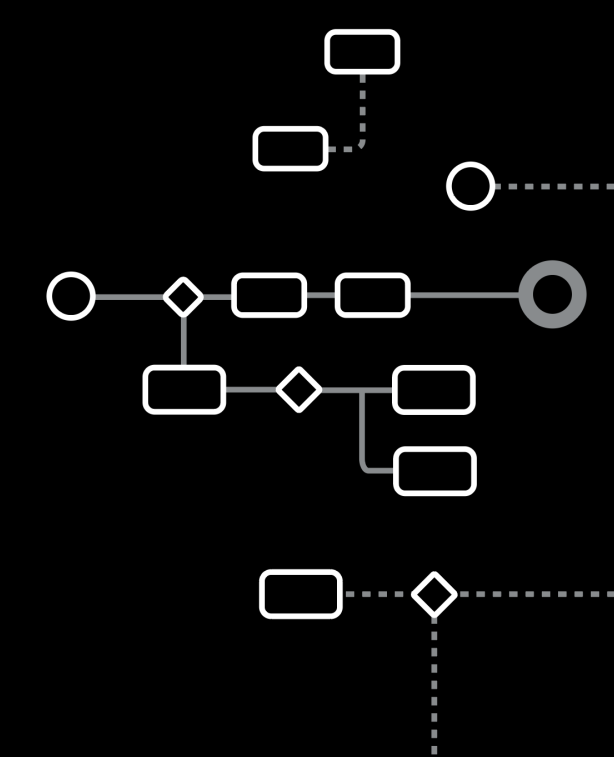
BPMN uses a small set of shapes: tasks (rectangles), gateways (diamonds), events (circles), and sequence flows (arrows).
The shapes have precise execution semantics that an orchestration engine runs directly.
Engineers work in the same notation as business stakeholders — no translation between the diagram and the code.
Core BPMN elements
The building blocks of any BPMN diagram.
Events
Events mark something that happens during a process. They can start, interrupt, influence, or end a process flow. Start events trigger the beginning of a process, intermediate events modify or delay its progress (such as a timer or message), and end events indicate completion or termination. BPMN includes many event types, each with unique behavior and visual markers.
Activities
Activities represent the work performed within a process, either by humans or systems. They can be simple tasks or sub-processes that group multiple steps together. BPMN also defines specialized activities, such as call activities (reusing another process), event subprocesses (triggered by specific events), and ad-hoc sub-processes (performed in no fixed order).
Gateways
Gateways control the flow of decisions or synchronization within a process. They determine which path the process will take. For example, an exclusive gateway (XOR) allows only one route, a parallel gateway (AND) runs paths simultaneously, and an inclusive gateway (OR) can follow one or more paths based on conditions. More advanced types, such as event-based gateways, wait for specific events before proceeding.
Flows
Flows connect and define the sequence and relationships between BPMN elements. Sequence flows show the order of activities, message flows represent communication between different participants or pools, and associations link artifacts such as data or annotations to flow objects. Together, these flows create a readable, executable model that mirrors how a real process operates across teams or systems.
BPMN for agentic orchestration
The ad-hoc subprocess extends BPMN for AI agent reasoning inside governed processes.
Agents outside the process
Governance is enforced at the seam between the agent layer and the process layer. State lives in two places. The audit trail covers each system separately.
Agents inside the process
Agent reasoning steps sit inside the same BPMN model as deterministic steps. One runtime, one audit trail, governance throughout.
What enterprises say about BPMN
Organizations running mission-critical processes on BPMN.
“BPMN gave us a single language for process design that both engineers and compliance officers can read.”
Global Financial Services Firm
BPMN versus proprietary alternatives
Some vendors prefer their own modeling language, usually because it locks customers in. Here's how BPMN compares to the alternatives most enterprises encounter.
| BPMN | Proprietary low-code suites | Code-only orchestrators | |
|---|---|---|---|
| Open standard | Yes. ISO/IEC 19510, OMG-maintained | No. Vendor-owned notation | No. Code constructs only |
| Readable by business teams | Yes. Designed for business and IT collaboration | Sometimes. Limited to vendor's UI conventions | No. Process logic lives in code and JSON |
| Tool and talent portability | 100+ tools support BPMN; talent widely available | Locked to vendor; certifications don't transfer | Locked to engine-specific SDK |
| Native human task support | First-class via user task element | First-class within the suite | No. Must be built from scratch |
| Coverage of advanced patterns | Compensation, parallel branches, escalation, ad-hoc. All native. | Limited; requires custom code at the edges | Available but engineer-only |
| Agent governance from outside and inside | Yes, via BPMN and ad-hoc subprocess (Camunda) | Outside-only; brittle when agents act | Outside-only; no business-readable model |
| Audit trail without extra instrumentation | Yes. Every step recorded automatically | Within the suite; brittle across systems | Logs only; no end-to-end process view |
Camunda's BPMN expertise
Camunda helped define the BPMN specification and has shipped BPMN tooling for over a decade.
Deep roots in the standard
Camunda engineers contributed to the OMG BPMN 2.0 specification.
The Camunda Modeler is the most-used BPMN editor in the enterprise.
What you get with Camunda
Code-first BPMN
Author process definitions in Java, Go, Python, or Node with the Camunda SDKs.
See the docs →Frequently asked questions
Common questions about BPMN.
Is BPMN only for large enterprises?
No. BPMN scales from simple single-team workflows to enterprise-wide orchestration programs. The same notation works for both.
Do I need to learn all of BPMN to get started?
No. Most real processes use fewer than a dozen element types. You can be productive with BPMN in a day.
Learn BPMN
Resources for every level, from beginner to advanced.
Real-Life BPMN
The practical guide to business process modeling written by Camunda founders.
Download free →