
One process. The right approach for every step.
Use AI where it fits, deterministic logic where it matters, people where judgment is required, and existing systems where they still work—all in one governed, end-to-end process.
Different processes need different approaches
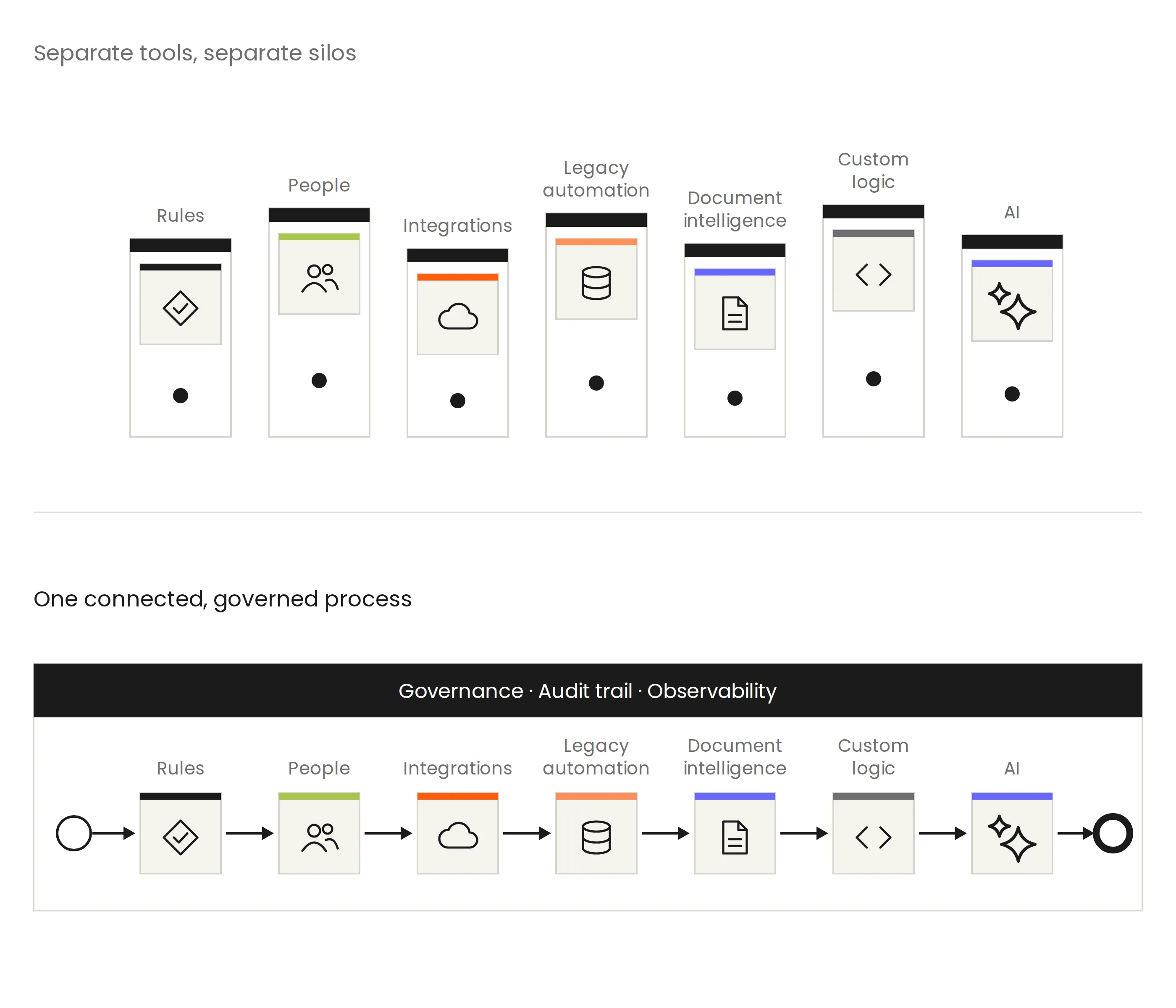
The work that runs your business rarely fits one tool or one automation pattern. Some steps need deterministic rules. Others mix in human judgment, system integrations, legacy automation, document intelligence, custom logic, or AI.
Camunda lets you combine the right building blocks for each step while keeping the entire process connected, governable, and observable from end to end.
Composable by design
Build around the outcome, not the tool
Mix and match capabilities in any order, in any process. Each step runs under the same governance model, audit trail, and observability layer, so adding new capabilities doesn’t add new silos. As the underlying technology changes, the process stays intact.
Decision automation
Apply deterministic, auditable rules that policy owners can update without writing code.
Human in the loop
Bring people into the process with the context, authority, and SLA visibility they need to make the hard calls.
Integrations
Connect hundreds of enterprise systems using reusable connectors and open standards.
Robotic process automation (RPA)
Keep legacy systems in the process today, then replace RPA tasks with APIs or agents when you’re ready.
Intelligent document processing
Classify, extract, and validate document data with human review when confidence is low.
Custom code
Plug differentiated business logic into the process using the languages your developers already use.
Add capabilities without adding blind spots
Every building block shares the same process context, governance, audit trail, and operational visibility. Teams can see what ran, what decision was made, where work is waiting, and what needs attention without stitching together separate control layers.
Decision automation
Automate decisions with confidence
Some choices require judgment. Others should follow the same policy every time. Loan eligibility, claim routing, pricing tiers, risk scoring, and fully automated transactions all depend on consistent, explainable decisions.
Camunda evaluates business rules at runtime and returns deterministic, auditable outcomes. Policy owners can read and update decision tables directly, with no code change and no deployment required. Changes are versioned and traceable, and teams can see exactly which rule applied, what data drove it, and when it last changed. The result is documented and regulator-defensible.
Example: Loan eligibility without manual intervention
A rules table evaluates application data against current policy and returns an eligibility outcome the process can act on.
- Loan amount under €100,000
- Credit score above 720
- Debt-to-income ratio below 35%
- Employment verified through connector
- Outcome: auto-approve or route to underwriter
Build once, reuse everywhere with Camunda Hub
When one team builds something that works, the next team shouldn’t have to rebuild it.
In Hub, your Center of Excellence approves element templates and connectors once. Teams find them in Web Modeler and add them to their process. A decision task that points to your lending policy, a review task with the right form, a step that calls your policy scoring task: configure each one once, then reuse it across the organization.
The decision, form, or worker itself is deployed through your existing pipeline. You can monitor versions and let teams know when they’re behind and need an update in a single place.
The composable architecture meant we could start with the building blocks we needed and add more as our processes matured.
Engineering Lead
Financial Services
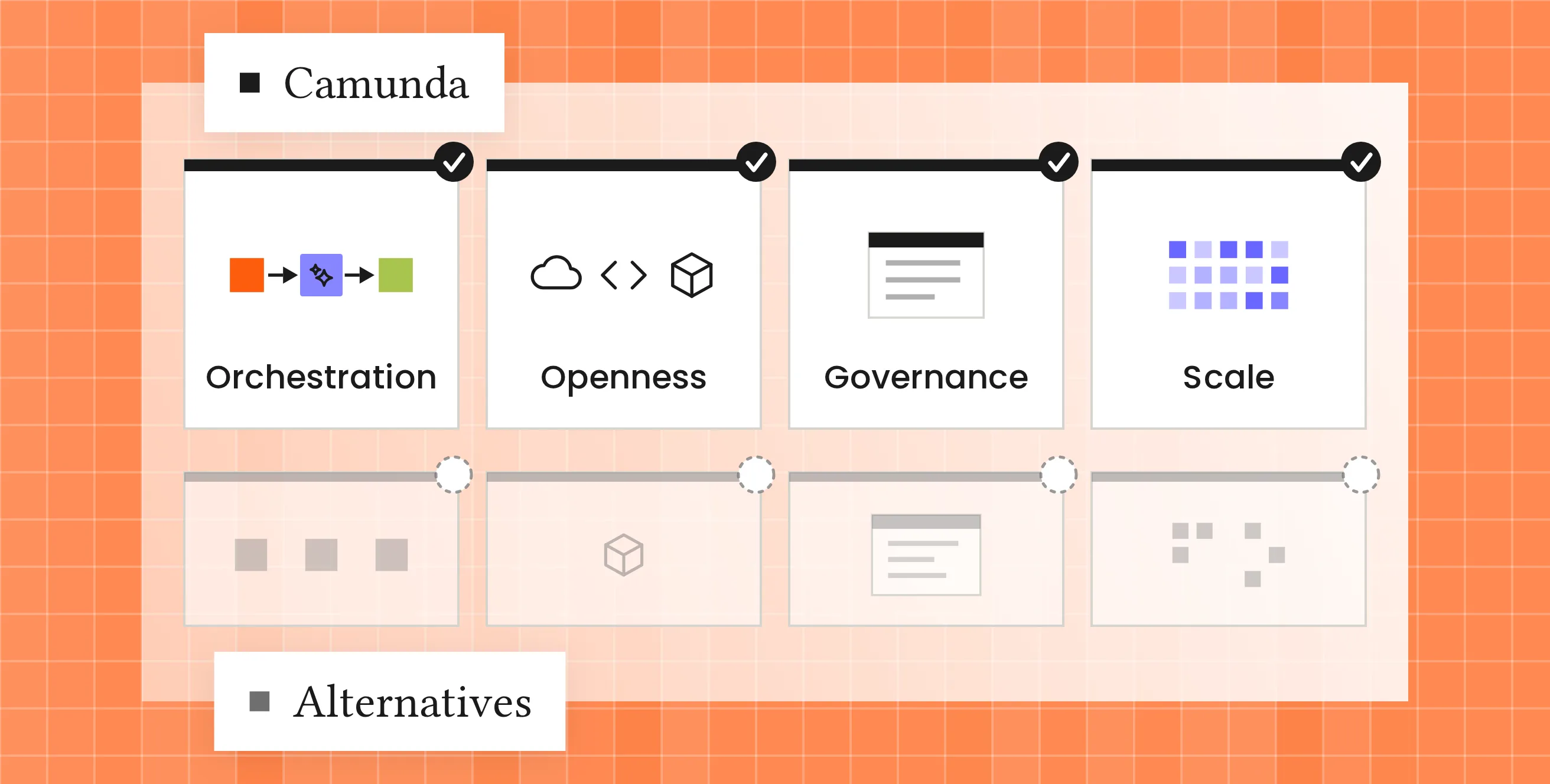
Camunda compared to alternatives
See how Camunda compares
Compare approaches to orchestration, openness, governance, and scale—and learn the critical requirements to consider when choosing a platform for end-to-end automation.
FAQ
What are the building blocks of a Camunda process?
Every step can draw from the same composable set: AI agents, deterministic decisions, human tasks, connectors, RPA, intelligent document processing, and custom code. Each step runs under the same governance, audit trail, and observability layer.How does decision automation differ from AI agents?
Decision automation applies documented business rules deterministically. AI agents reason through ambiguous situations where fixed rules can’t capture every case. Most enterprise processes use both inside the same process model.Can business teams change decision rules without IT?
Yes. Camunda uses Decision Model and Notation (DMN) to express rules as readable decision tables. Policy owners can update conditions and thresholds without writing code, with changes versioned and auditable.How do connectors work with AI agents?
Camunda connectors can run as standard process steps or as tools available to agents. Open standards such as MCP and A2A allow different agent frameworks to reuse governed integrations, while credentials, retries, and audit remain centralized.What programming languages does Camunda support for custom code?
Custom job workers can be built in Java, Go, Python, Node.js, C#, Ruby, and more. They plug into the process as standard steps and inherit the same governance, retry behavior, and audit trail.How does RPA fit into a Camunda process?
RPA bots run as standard process steps with shared error handling, retries, visibility, and audit. When a legacy system gains an API, the bot step can be replaced with a connector without redesigning the process.What document types does Camunda’s IDP support?
Camunda IDP handles structured, semi-structured, and unstructured documents, including invoices, contracts, claim forms, identity documents, and medical records. Low-confidence results can route to human review before the process continues.Do all of these capabilities work together in one process?
Yes. A single process can combine agents, deterministic decisions, human tasks, connectors, RPA, document processing, and custom code in any order—under one model, one audit trail, and one source of truth.
From building blocks to outcomes
Combine the capabilities each step needs while keeping the entire process connected, governed, and visible from end to end.