
Agentic orchestration
Orchestrate the work that runs your business
Connect people, AI, and systems across end-to-end processes to improve outcomes, adapt faster, and stay in control.
Deterministic workflows. Dynamic workflows. Human tasks.
One process.
Camunda brings deterministic workflows, dynamic workflows powered by AI agents, and human tasks together in one end-to-end process. One runtime. One audit trail.
Critical work doesn’t happen in a straight line
The processes that matter most span multiple teams, technologies, decisions, exceptions, and increasingly, AI. Automating isolated tasks can make individual steps faster, but it doesn't ensure the entire process runs smoothly.
Camunda coordinates the work from end to end, so every handoff, decision, and exception stays connected in one governed process.
End-to-end orchestration
Go beyond siloed task automation
Bring deterministic workflows, AI-driven actions, and human judgment together instead of managing them as separate systems. Camunda coordinates complex work from the first step to the final outcome.
- Keep work moving across systems and teams
- Bring human decisions into the flow when they matter
- Handle exceptions without breaking the end-to-end journey
- Maintain one source of truth for how work gets done
What enterprises have built with Camunda
Real business outcomes, running in production at scale across complex and regulated environments.

Public sector · Benefits processing
65% automated; processing time down 33%+
Benefits processing combines Camunda with machine learning across pension, DIC, and burial claims, with some claims now completed the same day they’re filed.
Read the case study
Financial services · Post-trade
<1s processing; 1.8M issuances; ~€20B in value
Post-trade orchestration connects microservices issuing more than 95% of retail digital securities in the German market.
Read the case study
Healthcare · Medication fulfillment
85% automated; manual intervention cut to 15%
Medication fulfillment uses agents for verification and logistics across a multi-step process, while human reviewers focus on exceptions.
Read the case study
Insurance · Claims
35% faster; 30% lower cost per claim
Claims and underwriting run on a modernized workflow that helps adjusters prioritize work dynamically.
Read the case study
Technology · Financial operations
30× ROI
Financial operations span revenue recognition, reconciliation, and financial close across ERP, CRM, billing, and data warehouse systems, with agents supporting anomaly detection and variance analysis.
Read the case study
Telco · Network operations
10× productivity
Network operations coordinate field teams, supply chain, compliance checks, and system updates across a national network rollout.
Read the case study
Financial services · Post-trade
Barclays post-trade services use Camunda to realize resilience, greater process visibility, improved efficiency, future scalability, and maximum flexibility.
Read the case study
Telco · Product launch
4× faster to market
The Austrian mobile operator constantly delivers new innovations in a highly competitive market through Camunda.
Read the case study
Stay in control as complexity grows
Real enterprise work branches, pauses, retries, escalates, and changes course. Camunda manages that complexity while preserving context, governance, and visibility across the entire process.
Capabilities
Coordinate parallel and sequential work
Wait for external events for days, months, or years, then resume automatically
Build human approvals directly into the process
Recover cleanly when downstream work fails
Use AI agents for complex, dynamic work that depends on context
The foundation
One governed model for work from end to end
Camunda uses Business Process Model and Notation (BPMN), the open standard for executable process modeling, to give business and technical teams a shared view of how work runs. The model you design is the model that executes—reducing the gap between business intent and production reality.
Camunda extends that foundation so deterministic and dynamic workflows can operate alongside human tasks with shared governance, state, and auditability.
Camunda combines the structure of standard BPMN with agentic capabilities for dynamic work.
Standard BPMN
- ✓Deterministic sequences, gateways, and rules
- ✓Long-running state persistence
- ✓Human tasks and approval flows
- ✓Event handling, timers, and error recovery
- ✓Executable models: what you model is what runs
- ✓ISO/IEC 19510 open standard: portable, not vendor-locked
Camunda's agentic extension
- +AI agents as first-class process participants
- +Ad-hoc subprocesses that scope agent reasoning
- +Structural guardrails between decision and action
- +Unified audit trails across deterministic and agentic steps
Keep long-running work moving
Important business processes can run for minutes, days, weeks, or years. Camunda preserves state and context throughout, so work can pause for a customer, a system, or a decision and resume exactly where it left off.
The orchestration engine is event-streamed and horizontally scalable, built to run millions of concurrent process instances at scale.
Explore ZeebeKeep context intact
Persist state at every step so long-running work resumes without manual restarts.
Make waiting part of the process
Handle reminders, deadlines, escalations, and expirations without custom polling logic.
Handle failures without losing the outcome
Retry failed work automatically and compensate cleanly when a downstream step can’t complete.
Onboard the next team without another cluster to run
In Camunda Hub, teams work in their own workspaces and projects, then deploy to environments isolated to the level their policies require: a physical tenant with its own data and identity on a shared cluster, or a dedicated cluster. Logical tenants divide either one further by brand, product line, or customer.
Every process stays on one governed platform with one set of tooling.
How organizations apply each model
| Industry label | Scenario | Tenancy model |
|---|---|---|
| Telco | Consumer and wholesale brands run the same order-to-activation process on one cluster, each as its own tenant. | Logical |
| Insurance | A CoE runs different business lines such as commercial or speciality as physical tenants on one cluster so each has control over data and policies. | Physical |
| Public sector | A regulated agency unit runs on a dedicated in-country cluster to meet data residency rules. | Dedicated |
Build, run, and continuously improve your processes
One platform. One model. A continuous path from understanding how work runs to improving it in production.
Discover
Understand what you have before you build.
Use operational data and existing documentation to identify bottlenecks, exceptions, and the highest-value opportunities for automation and AI before redesign begins.
- Process insights from operational data and logs
- Automatically generated as-is process documentation
- AI opportunity identification and prioritization
- Re-engineering brief for the build phase
Tools in this phase
ProcessOS
AI process intelligence
ProcessOS analyzes how processes actually run, identifies automation opportunities, and generates improvement proposals from production data.
Learn about ProcessOS →Stay open as your business changes
Build on open standards and connect the systems, models, and technologies your business already uses. Change what needs to change without rebuilding everything around a proprietary stack.
- Open, executable BPMN standard
- DMN for portable decision logic
- Connect across your existing architecture
- Evolve without vendor lock-in
“What we design is what we implement, what we monitor, and what we optimize. You have that single source of truth through the entire process.”
Dan Avidan, Lead Platform Architect, HSBC
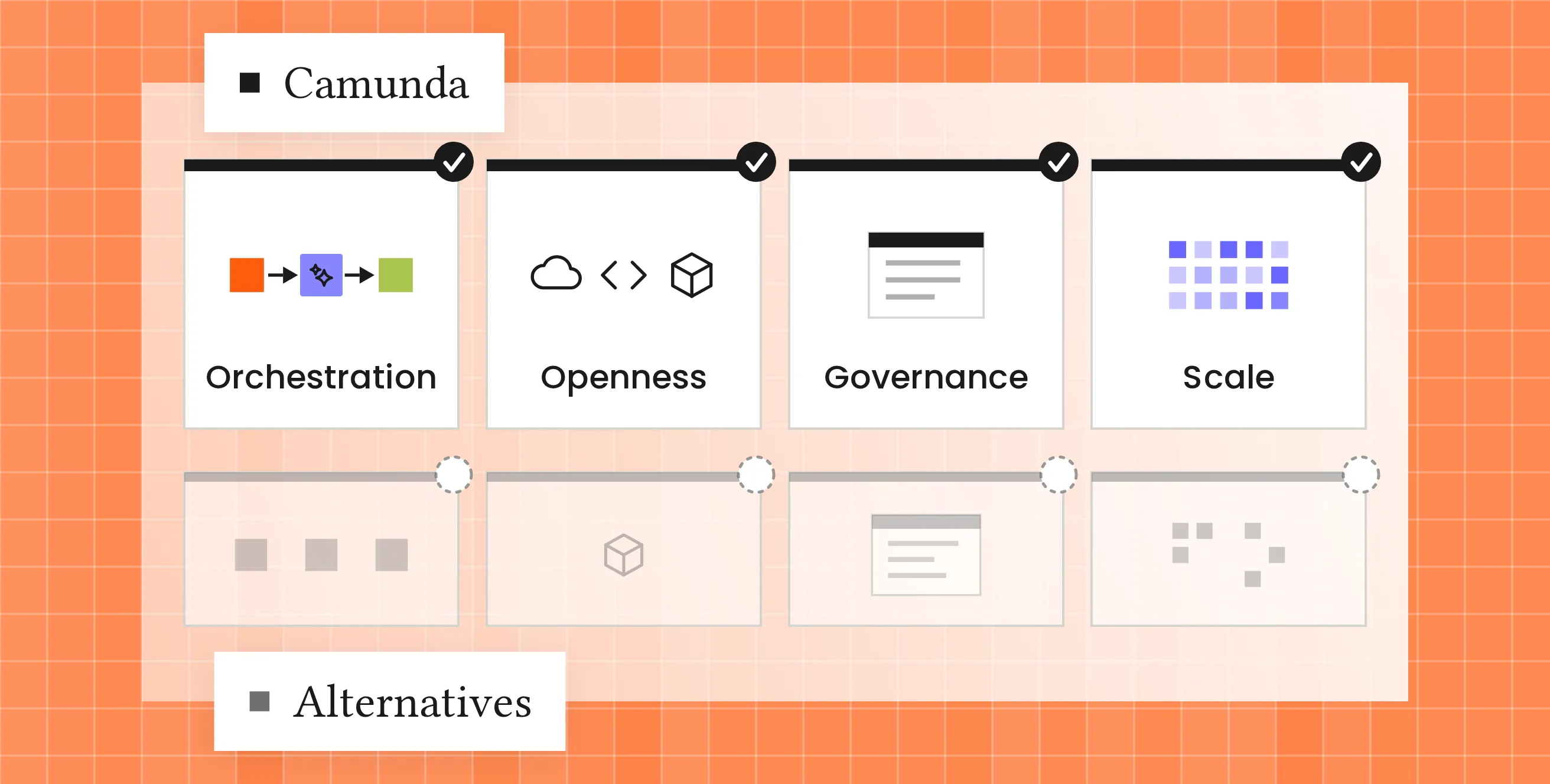
Camunda compared to alternatives
See how Camunda compares
Compare approaches to orchestration, openness, governance, and scale—and learn the critical capabilities to consider when choosing a platform for end-to-end automation.
FAQ
What is a process in agentic orchestration?
A process is the coordination structure connecting humans, AI agents, and systems in one continuous end-to-end flow. It owns the handoffs, maintains state, enforces governance, and provides the audit trail across deterministic and agentic work.
What is BPMN and why does it matter for AI agents?
BPMN is an ISO-standard visual language for modeling and executing processes. Because the model is executable, it can coordinate agents while enforcing governance gates, preserving state, handling timers and failures, and recording decisions. Camunda adds native agentic constructs while retaining compatibility with the standard.
What is the unified model?
The unified model combines deterministic orchestration, agentic reasoning, and human approval in one BPMN process, one runtime, and one audit trail instead of separate systems joined with custom glue code.
How does Camunda handle processes that take days or weeks?
The engine persists state at every step so work can wait hours, days, or months and resume with context intact. Built-in timers handle reminders, escalation, and expiration; automatic retries and compensation help recover cleanly from failures.
Can multiple teams share one Camunda platform?
Yes. In Camunda Hub, each team works in its own workspace and deploys to an environment matched to its policies: a physical tenant with its own data and identity on a shared cluster, or a dedicated cluster. Logical tenants divide either environment further by brand, product line, or customer, all governed from one platform with the same tooling.
Can I change a process without redeploying everything?
Yes. Existing instances can continue on their current version while a new version is deployed. Instance migration can move active cases while preserving execution state. Teams can also use A/B tests, canary releases, and rollback when needed.
Ready to get started?
Talk to our team about the processes that matter most—and how to move more of the work into production.