
Pick the outcome. Camunda orchestrates the work that gets you there.
Loans approved. Claims resolved. Customers onboarded. Services delivered. Camunda coordinates AI agents, people, and systems across the end-to-end processes behind the outcomes your business must deliver.
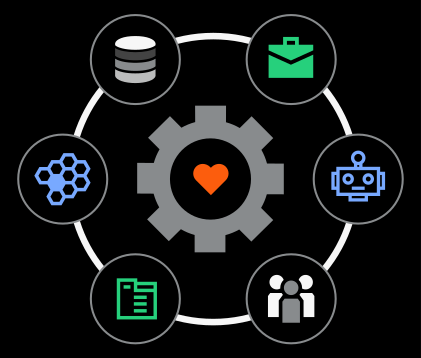
The outcome is end to end. Your automation should be, too.
The processes that define performance rarely live in one system or follow one path. They traverse teams, applications, APIs, legacy technology, and increasingly, AI agents. Point solutions can improve individual tasks while the handoffs between them still create delay, risk, and rework.
Camunda provides a foundational orchestration layer for the entire process. This lets you coordinate work around the business outcome instead of managing a collection of disconnected automations.
One process. Different value for every team.
The same end-to-end process has to work for the people running the business, the teams building it, and the leaders accountable for the result.
For line-of-business leaders
Shorten cycle times, reduce dropped handoffs, see SLA risk earlier, and keep exceptions moving before customers feel the impact.
For IT and enterprise architects
Open BPMN standard, agent-agnostic, vendor-neutral. Coordinate AI agents, enterprise systems, APIs, microservices, and human work without tying the process to one vendor or technology. Pre-built connectors support widely used enterprise systems.
For executive teams
Move AI from pilot to production with audit trails, governance, and visibility tied to the operational outcomes the business already measures. EU AI Act and SOC 2 readiness built in.
Start with the problem you need to solve
Camunda applies the same orchestration foundation across AI agents, human workflows, microservices, APIs, and legacy systems. Explore how Camunda solves the challenges behind your most critical business processes.
Get AI agents to production with governance you can prove
Move beyond isolated chatbots and copilots. Coordinate agents with people, systems, deterministic process logic, human checkpoints, and an auditable process history.
Orchestrate AI agentsSpeed up work that depends on human judgment
Keep approvals, reviews, exceptions, and high-stakes decisions moving by giving people the right tasks, context, deadlines, and AI support inside the end-to-end process.
Orchestrate human workflowsEnd-to-end reliability across every service you ship
Coordinate state, sequencing, failure recovery, and long-running transactions across microservices without burying the business process across individual codebases.
Orchestrate microservicesMake APIs work together from request to outcome
Compose APIs into stateful, long-running flows that can wait for events, recover from failures, and coordinate traditional services alongside AI agents and human decisions.
Orchestrate APIsKeep complex cases moving as the facts change
Coordinate long-running claims, applications, investigations, and other casework where information arrives out of order, exceptions are normal, and human judgment still matters.
Manage complex casesModernize legacy IT without waiting for a big-bang replacement
Orchestrate around mainframes, ERPs, custom applications, modern services, and AI agents so you can modernize one process at a time while the underlying systems keep working.
Modernize legacy ITReplace a legacy BPMS without recreating the lock-in
Move from a closed automation suite to an open orchestration layer for AI agents, systems, microservices, and human work, with a staged path away from the incumbent platform.
Replace legacy BPMSStop maintaining the workflow engine you never meant to build
Move custom process coordination onto a shared orchestration foundation with durable state, timers, failure recovery, auditability, and observability built in.
Replace homegrown workflowsDifferent use cases. One orchestration foundation.
The problem may start with an AI pilot, a human approval, a distributed transaction, a legacy system, or a homegrown workflow engine. The architectural need is the same: coordinate the entire process across every participant while preserving state, control, visibility, and the ability to change.
- AI agents, people, and systems in the same end-to-end process
- Open BPMN-based process logic that stays understandable and portable
- Long-running state, retries, timers, and failure handling built into the orchestration layer
- Governance, auditability, and operational visibility across the complete process
Frequently asked questions
Quick answers for teams evaluating agentic orchestration.
What is agentic orchestration?
Agentic orchestration coordinates AI agents, people, systems, APIs, and services across an end-to-end business process so the work completes reliably, with state, governance, visibility, and auditability carried across the full process.How is Camunda different from RPA, iPaaS, or workflow tools?
RPA automates interactions with user interfaces. iPaaS connects applications and data. Workflow tools typically route tasks. Camunda coordinates those technologies, plus AI agents, APIs, microservices, legacy systems, and human work, as participants in one end-to-end process.Where should we start?
Start with a critical outcome that matters and a process where fragmentation is getting in the way: an AI initiative that needs to reach production, a case process with too many handoffs, a distributed service flow that is hard to operate, or a legacy platform that limits change. The use-cases above show how Camunda applies to each pattern.Can Camunda work with the technology we already have?
Yes. Camunda is designed to orchestrate across existing enterprise systems, APIs, microservices, legacy applications, human tasks, and AI agents. Open standards and reusable integrations let teams modernize the process without requiring every underlying system to change at once.
See what agentic orchestration looks like for your use case
Bring us the process, system, and outcome you are working toward. We’ll show you how Camunda can coordinate the work from end to end.