Trusted by 750+ enterprises to orchestrate the processes that matter
Anatomy of an enterprise agent
Every Camunda agent combines an LLM, tools, a system prompt, and structural guardrails inside a BPMN process. The model can reason and choose what to do next, while orchestration governs how each action executes.
Agent
Set clear boundaries and governance rules for the agent, defining the tools it can use and permitted actions.
Verify
Prove that an agent works before and after it ships
AI agents need reliable validation, but traditional testing fails when responses vary. Camunda Process Test (CPT) runs your process in an isolated Camunda runtime inside your CI pipeline, so you can assert routing paths, guardrails, agent escalations, and other process behavior before production.
CPT generates a test coverage report showing which paths in your process were exercised and which weren’t. Judge assertions score agent reasoning against clear criteria, while non-technical teams validate workflows visually using Play. Verify that your AI decisions and business workflows consistently generate the correct outputs across every path.
From simple task agents to complex multi-agent systems, use the same orchestration foundation to put agents to work across enterprise processes.
Task agent
Acts on systems
Queries databases, calls APIs, updates records, sends communications. The LLM reasons about which tool to invoke and when. Tools are external system connections: any system Camunda can reach.
Tools are
APIs, databases, services, messaging systems
Seen in
Fraud detection, order processing, customer data management
Runnable example
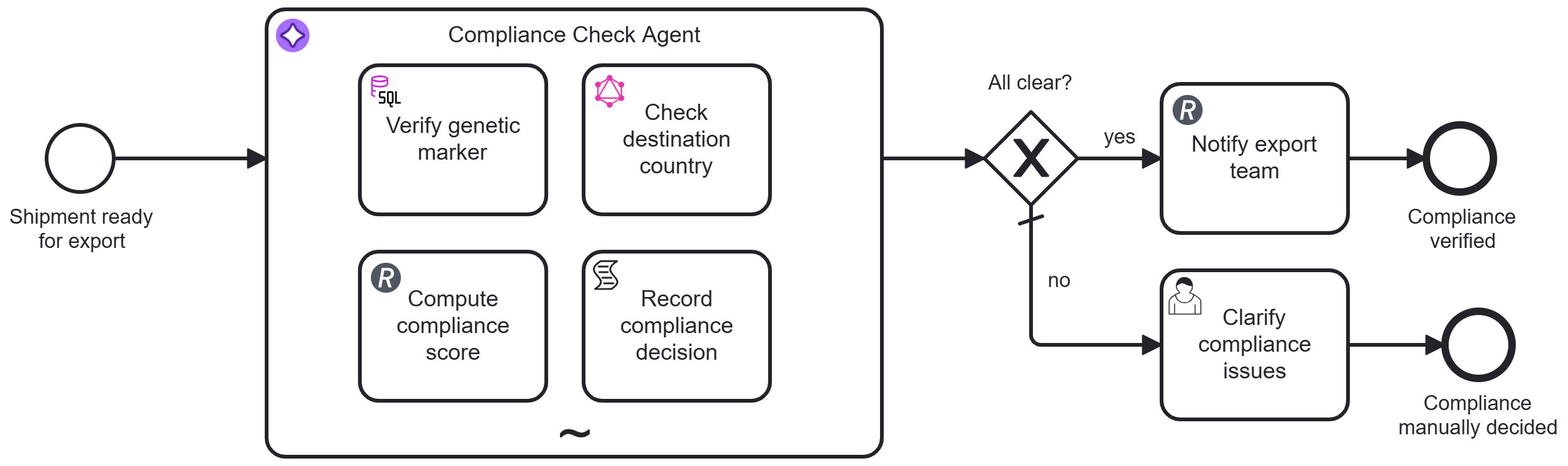
Seed export compliance agent
One agent subprocess, three real tool calls — a SQL lookup, a GraphQL API, and a REST calculation. It reads free-form shipment notes, then clears compliant shipments automatically or hands the rest to a human for review.
Agents that investigate fraud alerts end to end: querying customer data, cross-referencing transaction patterns, selecting the right response path, and escalating to human investigators when the case warrants it. Running inside a structured process with a full audit trail.
Agents that read free-format customer orders — scanned letters, unstructured text — extract transaction data using OCR and on-prem AI, route to human review when confidence is low, and execute automatically when it’s high. 50,000 transactions daily.
Agents that guide customer case journeys — populating context from multiple systems, enriching cases with data before human agents pick them up, and escalating sensitively for vulnerability or bereavement. GenAI inside a structured orchestration layer.
Agents handle the work. Camunda orchestrates the process.
Coordinate AI agents alongside people, decisions, applications, and core systems in one end-to-end process, with visibility and governance from the first request to the final outcome.
Agentic engagement
Where employees and customers interact — end-to-end, conversational, adaptive
Everything you need to run AI agents in production
Give agents room to reason while Camunda provides the orchestration, governance, and resilience that mission-critical processes demand.
Governance by design
Enforce approvals, policy checks, and escalation paths structurally in BPMN so agents cannot bypass critical controls. Route exceptions, low-confidence decisions, and sensitive reviews directly to human colleagues within the same governed workflow.
Control AI Agents
Coordinate the complete end-to-end process journey around your agents while governing how they make decisions and use individual tools. Manage overall workflow progress and granular agent actions in a unified framework.
Open by design
Use Camunda as the orchestration layer across any agent frameworks and use any AI model you choose, ensuring core business process logic remains completely portable and independent of a single provider.
Durable execution
Preserve process state through long-running work, failures, retries, timers, and external events so agentic processes can keep moving.
Built-in task testing
Test individual integration tasks and agentic subprocesses in Modeler before running end-to-end processes.
One model, one audit trail
Run deterministic workflows, AI agents, and human tasks in one BPMN model with visibility across the end-to-end business process.
Track agent performance, usage, and behavior over time
Zoom out from single execution races to monitor company-wide trends. Camunda Optimize provides an agentic control plane dashboard to manage operational performance and reliability.
Token usage analytics
Track trends for token usage across processes to prevent cost overruns and agent drift.
Behavior monitoring
Detect unexpected agent behaviour changes before costs overrun or systems are disrupted.
Agent performance
Measure cycle time, escalation rates, and SLA adherence to know where agents succeed.
Any agent, any model, full control
Camunda orchestrates your operations independently of AI vendors. Combine different LLMs and frameworks across a single process or switch providers anytime without rewriting core process logic. Every agent action, system call, and MCP connection remains fully governed and auditable in one central platform.
Use any LLM or Agent Framework
Select any model, including Anthropic, Amazon Bedrock, or custom LLMs. Coordinate frameworks like LangChain, CrewAI, and AutoGen in one unified process.
Expose processes as MCP tools
Camunda connects to Model Context Protocol (MCP) in both directions. Agents inside Camunda can invoke external MCP tools, while external AI systems can call Camunda’s MCP server to initiate end-to-end business processes, while keeping every step auditable and governed.
Connect any system
Connect enterprise applications, APIs, and systems through the integration layer and make them available to agents as tools.
Prompts can tell an agent what it should do. Orchestration can enforce what it must do. Model approvals, policy checks, human review, and escalation paths are mapped directly into the process so critical controls cannot simply be skipped.
AI agent orchestration governs when agents run, what tools they can access, what happens when they fail or produce unexpected results, and how their decisions are recorded. In Camunda, agents participate directly in BPMN processes alongside deterministic workflows and human tasks.
What is inner orchestration?
Inner orchestration allows the LLM to select what it wants to do next, while the process controls whether or not that action executes and, if it does, how—including required guardrails, policy checks, and human review.
How does Camunda enforce guardrails on AI agents?
Camunda enforces guardrails by making approvals, compliance checks, escalation paths, and other controls part of the BPMN process, rather than relying only on instructions in the system prompt, the process enforces the control before the action executes.
Can Camunda orchestrate agents built with other frameworks?
Yes. Camunda acts as the orchestration layer and can coordinate agents built outside Camunda through open protocols and APIs, allowing different agents, models, people, and systems to participate in the same end-to-end process.