Category

Product

All Camunda blog posts tagged with Product.

Zeebe Helm Profiles

If you are looking to start evaluating Zeebe in your own Kubernetes Cluster or if you are already doing so with our Helm Charts you should take a look at the following GitHub repository which contains a set of configurations (profiles) based on different use cases. Zeebe Helm Profiles are just configurations for the official Zeebe Helm Charts. The idea behind these profiles is to configure Zeebe and surrounding components for different use cases. A common requirement is to evaluate Zeebe into Minikube or Kubernetes KIND, or in a Cloud Provider. For each of these scenarios, you will need to configure the charts in slightly different ways. If you want to run Zeebe on your own laptop, one of the…

By Mauricio Salatino

Three hidden threats of RPA technical debt you might have overlooked

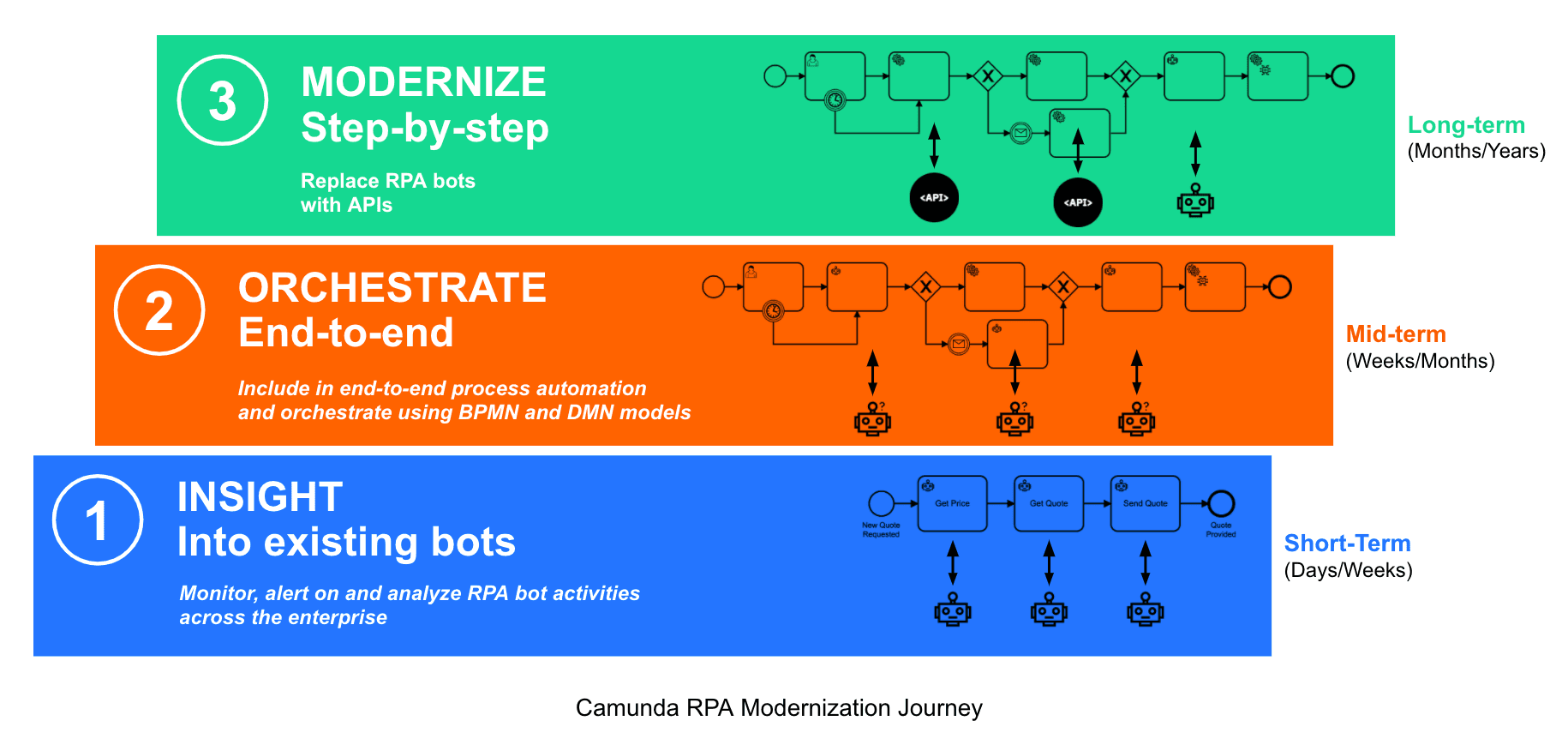
If you’re looking to selectively automate the work of individual components in legacy systems, and help automate processes without a significant time investment — RPA should be on your radar.  Global companies like Deutsche Telekom have already introduced and automated 2,500 individual bots, resulting in savings of more than 100 million Euros. However, relying too heavily on RPA can land you in hot water. Paul Jones, Business Automation Services at NatWest even classifies RPA as technical debt.  So what can you do to avoid this debt? Prevention is the best cure and before jumping on the RPA bandwagon, think carefully about whether you need an RPA solution, or a workflow engine. Losing control of long-running processes The ability to automate…

By Daniel Meyer

Creating an Extraordinary Contributor Experience for Hacktoberfest

Hacktoberfest is coming! And Camunda is participating, with the opportunity to get a sweet limited-edition Camunda Hacktoberfest t-shirt by making just two pull requests to any of our open source projects. We’ve also put together a guide for open source repository maintainers, to empower you to create an extraordinary contributor experience. Creating an Extraordinary Contributor Experience This document is for open source project maintainers who want to increase community contributions to their project. We’ll look at the Contributor Experience and how you can create an Extraordinary Contributor Experience. So You’re a Maintainer You’re an open source project maintainer. You’re probably also a contributor to the project – maybe the only one. Wouldn’t it be great to have other people making…

By Josh Wulf

Using FEEL for Expressions – Part 1

Zeebe supports FEEL v1.11 – the “Friendly Enough Expression Language” – to express dynamic behavior in your processes. You can use FEEL expressions in a number of places in your BPMN models. From the Zeebe documentation: The following attributes of BPMN elements require an expression: Sequence Flow on an Exclusive Gateway: condition Message Catch Event / Receive Task: correlation key Multi-Instance Activity: input collection, output element Input/Output Variable Mappings: source Additionally, the following attributes of BPMN elements can define an expression optionally instead of a static value: Timer Catch Event: timer definition Message Catch Event / Receive Task: message name Service Task: job type, job retries Call Activity: process id Gateway The most obvious place that you use an expression…

By Josh Wulf

Sep 8, 2020

Camunda BPM Runtime 7.14.0-alpha3 Released

We are happy to share the third alpha release of Camunda BPM Runtime 7.14 with you! This release features the following improvements: Improved External Task Fetch and Lock Cleanup of History Cleanup Logs REST API: Fetch Telemetry Configuration Cockpit: Asynchronously Set Variables to Process Instances Cockpit: Plugin Point for Batch Operations Support for WildFly 20 11 Bug Fixes You can Download Camunda for free or Run it with Docker. For a complete list of all improvements, take a look at the release notes. Please also see the list of known issues. If you want to dig in deeper, you can find the source code on GitHub. Improved External Task Fetch and Lock In situations where’re you’re using highly concurrent requests to fetch external tasks (e.g. when you run…

By Camunda Platform Team

Orchestrating Cloud Events with Zeebe

Disclaimer: This blog post is about Cloud-Native software, containers, Cloud Events, and Workflows. It describes a concrete example that you can run yourself using Kubernetes, Helm, and Zeebe. You should be familiar with Kubernetes and Helm to follow along and will learn about Zeebe and CloudEvents on your way. While working with Kubernetes the chances are quite high that you’ll find services written in different languages and using different technologies stacks. CloudEvents (CloudEvents / CloudEvents Specifications) was born to enable these systems to exchange information by describing their events in a standard way, no matter which transports these services are using (HTTP, Messaging AMPQ/JMS, Protobuf, etc).  In such scenarios, where you have events being produced and consumed by different systems, there are common requirements that start to arise when…

By Mauricio Salatino

Announcing Zeebe 0.23.5 and 0.24.2

New patch releases for Zeebe are available now: 0.23.5 and 0.24.2 and contain various bug fixes as well as minor enhancements. You can grab the releases via the usual channels: Docker Hub GitHub Maven Central Zeebe 0.24.2 is fully compatible with 0.23.4 and 0.24.1, as is 0.23.5 with 0.23.4. This means it is possible to perform a rolling upgrade for your existing clusters. For Camunda Cloud users, Zeebe 0.24.2 is already the latest production version, meaning your existing clusters should have been migrated by the time you see this post. Without further ado, here is a list of the notable changes. Zeebe 0.23.5 All bug fixes in 0.23.5 are part of 0.24.2 as well, except one, which was already part…

By Camunda Cloud Team

Try All Features of Camunda