The operating system for your processes
ProcessOS is AI that discovers how you really work, re-engineers your processes for an AI-native world, and continuously improves what you deploy. Automatically.
ProcessOS is currently in closed beta. Sign up to be notified when access opens.
All business processes are legacy
They were designed for a world where AI didn't exist. You can add AI to a legacy process, or you can re-engineer it for the age of AI.
AI added to a legacy process
~20%
faster
The process was designed for humans. Adding AI accelerates the existing steps but doesn't remove the structural constraints.
Re-engineered AI-native process
Months → Days
customer onboarding, transformed end-to-end
Danica re-engineered their customer onboarding with Camunda. A process that took months was reduced to days. Not by automating the old steps, but by redesigning them entirely.
Read the case study →ProcessOS tackles the real reason AI adoption stalls: we can't build tomorrow's processes using only what we know today. Transformation starts with a bold vision of the future.
Lily Wang
Managing Director, Barclays
CamundaCon · May 2026
Watch the keynote
The first public introduction of ProcessOS. Jakob Freund and Daniel Meyer on why organizations that want to become AI-native need to fundamentally re-engineer their processes, and how ProcessOS makes that possible.
What is ProcessOS?
An agentic operating system for your business processes. Four AI agents work across the whole lifecycle: discovering how you actually run today, re-engineering for the outcomes you want, building and deploying, then continuously improving once you're live.
Start with the outcomes
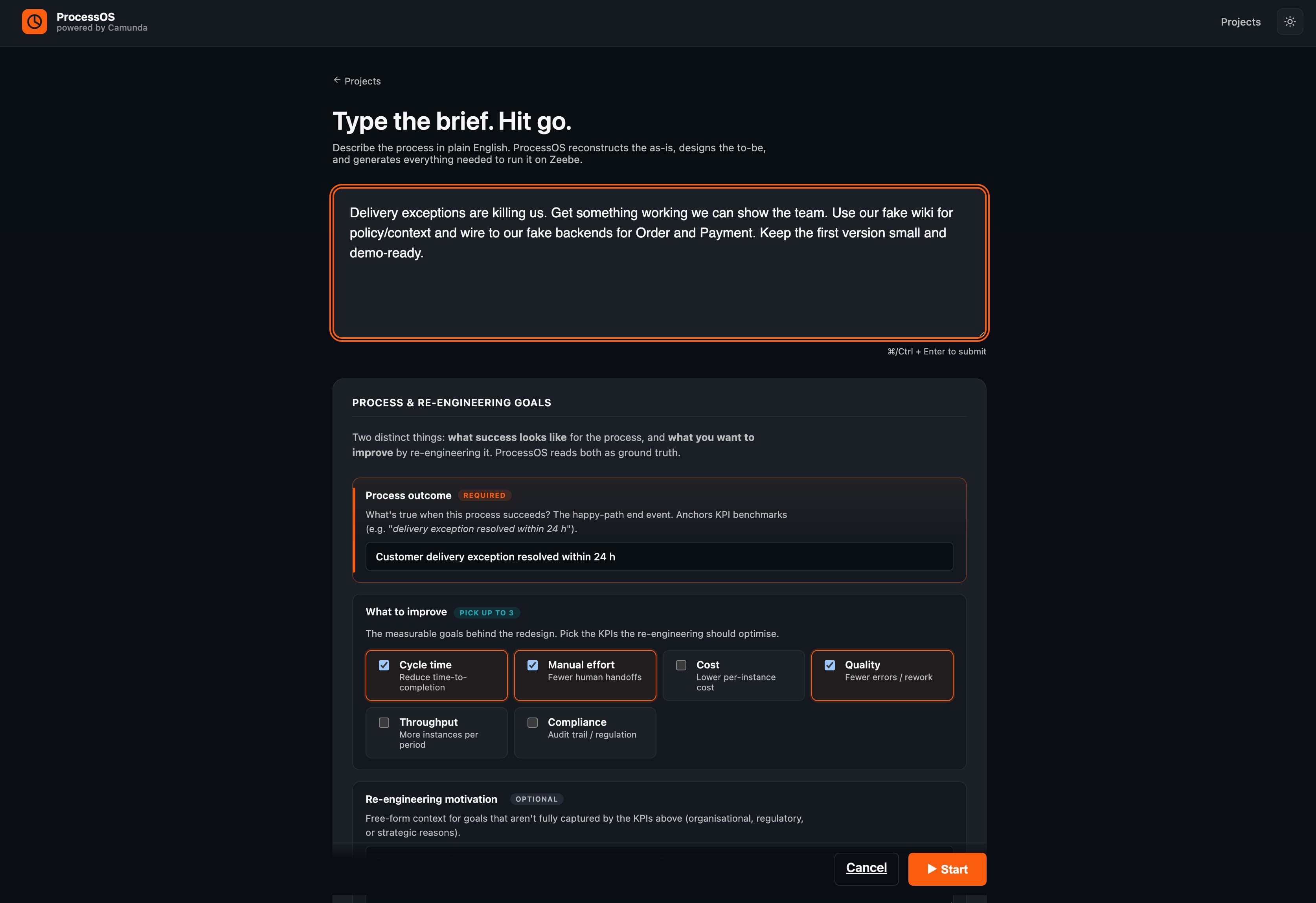
Describe the process in natural language. Define what success looks like: the outcome you're optimizing for and the KPIs that matter. ProcessOS reads both as ground truth, then reconstructs the as-is, designs the to-be, and generates everything needed to run it.
Cut down workshop time.
From kickoff to production in weeks, not quarters
Enterprise process projects have always been slow. Discovery alone takes months: workshops, consultants, documentation. Re-engineering and build add months more. Every new project starts from scratch.
ProcessOS uses AI at every step. Discovery in 1–2 weeks not months. Re-engineering in a week. Build and deploy in 2–4 weeks not quarters. And unlike a consultant, it remembers everything.
- →Organizational memory captures every decision and edge case
- →Catalog makes every connector reusable on the next process
- →The tenth process is dramatically faster than the first
Re-engineering in practice
Two examples where structural redesign, not optimization, produced the result.
Finnova
70–80%
faster customer onboarding
A single onboarding form that took 15–30 minutes, slowed by manual steps and scattered systems, was redesigned end-to-end. The same task now takes minutes. That's not optimization. It's a structurally different process.
Read the story →R-KOM
Near-instant
ticket response time
A fully manual ticket-to-technician workflow was replaced with AI-agentic orchestration. The old process averaged 8 hours to respond. The new one responds in near real-time. The workflow wasn't automated. It was redesigned from the ground up.
Read the case study →How it fits together
How ProcessOS fits into the Camunda platform, how humans and AI share the work, and how the plugin model extends into your existing stack.
Frequently asked questions
What is ProcessOS?
ProcessOS is the intelligence layer of the Camunda platform: an AI system that re-engineers business processes for an AI-native world. It uses four specialized agents to discover how your processes actually run, design what they should become, build and deploy them, and continuously improve them in production. It is not a modeling tool or a monitoring dashboard. It is the layer that makes process transformation fast, repeatable, and self-improving.
What is the difference between adding AI to a process and re-engineering it?
Adding AI to a legacy process speeds up individual steps, but the process was designed around human limitations and those constraints stay. Re-engineering means starting from the outcome you want and designing a process that uses AI natively from the ground up. The results are qualitatively different. Danica re-engineered their customer onboarding with Camunda: a process that took months now takes days. That kind of result is not achievable through optimization alone.
How is this different from process mining?
Process mining discovers what is happening in your operations. ProcessOS discovers what is happening and then acts on it, re-engineering the process around the outcomes you want to achieve, building it, deploying it, and improving it continuously. ProcessOS can use process mining tools like Celonis or MPMX as plugins to enrich the discovery phase, making sure you can leverage all your existing process intelligence investments.
How do architects and developers work with ProcessOS?
There are three modes. First, you can direct the ProcessOS agents directly through the UI, reviewing outputs, approving designs, redirecting the agents as they work. Second, you can use ProcessOS Agent Skills as a plugin in your own coding agent (such as Claude Code), accessing the full range of discovery, design, build, and optimize operations from your own toolchain. Third, you can work manually in the Workspace, using Web Modeler and the Catalog. All three modes write to the same Project Repository.
What is a fitness function?
When you define an outcome goal in ProcessOS, you configure a fitness function: a weighted scoring model across KPIs such as cycle time, resolution rate, cost per case, and compliance rate. ProcessOS uses this function to score process variants during design and to evaluate every proposed improvement before it reaches production. You set the weights based on what matters most in your domain.
How does continuous improvement work?
ProcessOS monitors live process performance against your fitness function. When it identifies a potential improvement, it backtests that change against your historical process data (real cases, real edge cases, real outcomes) and models the projected impact on your score before surfacing a proposal. You review the evidence and approve the change. Nothing reaches production without human sign-off.
What is organizational memory, and how does it compound?
Organizational memory is a knowledge model that ProcessOS builds as it operates in your environment: your systems, integration patterns, operational edge cases, and process decisions. It lives in a git repository private to your organization and is never used to train shared models. Combined with the Catalog of proven connectors and building blocks, it means every process you build makes the next one faster. The tenth process is dramatically faster than the first. Not because the tool improved, but because it knows your business.
When is ProcessOS generally available?
ProcessOS is currently in closed beta. We are running a limited number of engagements during the pilot phase. Sign up to be notified when access opens and to discuss whether your organization is a good fit.
Ready to re-engineer your first process?
Engagements are limited. Tell us about your process and we'll tell you if it's a fit.