
Continuous improvement
Process intelligence enables an ongoing cycle of continuous process improvements through feedback loops and tracking and implemented changes.

Explore the definition, benefits, and use cases of process intelligence
As the saying goes, “You can’t manage what you can’t measure.” That’s why process intelligence is an important foundation for any organization’s continuous business process management and improvement efforts.
Business processes have become more complex. Organizations around the globe are finding that a combination of legacy technologies, multiple point solutions, human work, and diverse endpoints is creating process complexity that prevents a holistic view into business process performance from end to end across customer journeys. Process intelligence helps organizations visualize process performance to improve tasks and processes critical to customer journeys and strategic goals.
Process intelligence, also called business process intelligence, uses data, analytics, and automation tools to monitor, analyze, and optimize the health and performance of business processes.
With process intelligence, organizations have real-time visibility into process execution data and analytical insights that help improve workflows, operate more efficiently, and enhance overall operational performance.
In response to our most recent State of Process Orchestration Survey, leaders told us there is room for improvement in the following areas:
97%
Improving business-critical processes
96%
Defining organizational, value-based metrics to support cost savings, better compliance, and growth
96%
Understanding how processes drive organizational value
Process intelligence helps tackle those challenges.
At the highest level, process intelligence helps organizations understand the value of their end-to-end processes and drive operational excellence through data-driven insights.
When leaders and project stakeholders have visibility into value-based measurements of their process automations and how these process automations perform across the entire customer journey, they are better equipped to identify bottlenecks, inefficiencies, and opportunities for improvement. They are also empowered with information that can help them align and refine business processes to company goals and strategic objectives.
Organizations are benefitting from process intelligence in multiple ways. The main benefits of process intelligence include:
Process intelligence enables an ongoing cycle of continuous process improvements through feedback loops and tracking and implemented changes.

Shared visibility into process data improves collaboration between Business and IT and empowers stakeholders at all levels to quickly respond to issues and contribute to process improvements.

Process intelligence data and insights bring visibility to process inefficiencies, redundancies, and non-value-added tasks, enabling stakeholders to better allocate resources to streamline tasks, processes, workflows, and end-to-end journeys.

Real-time data allows managers to monitor adherence to internal and external policies, regulations, and standards, flag potential issues for action, and create auditable reports.

By optimizing onboarding, service delivery, and other customer-related processes, organizations can improve both customer experiences and employee satisfaction.

Process intelligence brings visibility to data and insights that help leaders target improvements for mission-critical automations. It provides a data-centric foundation for building roadmaps towards greater, strategic business value.
Having visibility into your business processes helps you take ownership of your business outcomes and the actions needed to improve them.
Process intelligence uses multiple capabilities to deliver actionable data and insights. Every automated business process generates process execution data through sources like event logs, transactions, and APIs. Process intelligence applications gather the process data, aggregate it, analyze it, and repackage it into business reporting dashboards that allow users to see the reality of what’s working with a process and what needs improvement.
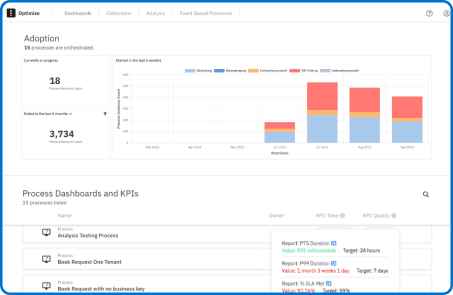
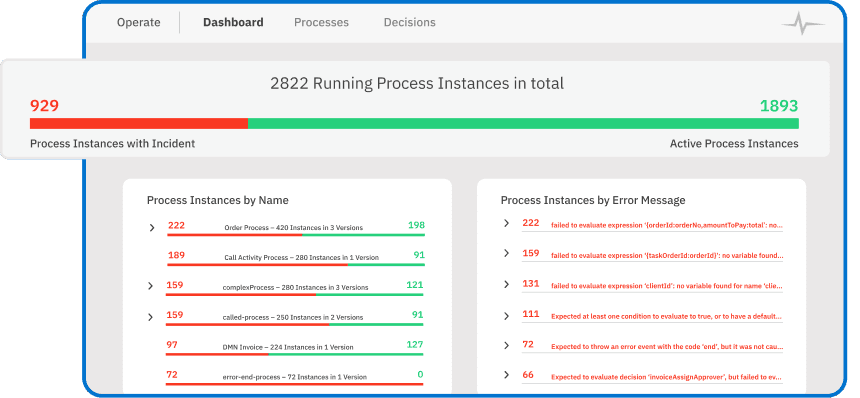
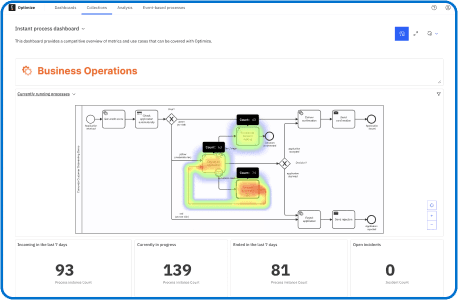
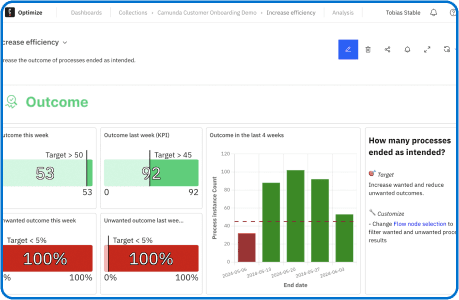
A hallmark of process intelligence tools is the ability to view valuable data at a glance. This is done through descriptive reporting dashboards. Some process intelligence tools allow users to create customized reporting dashboards to more easily track data such as automation rates, Key Performance Indicators (KPIs), and specific organizational goals. Reported data might include timestamps, process flows, user actions, process exceptions, cycle times, throughput, bottlenecks, and process patterns, among other metrics.
Dashboards vary and may include charts, graphs, maps, analyses, alerts, and filters that allow users to quickly and easily understand how processes perform in real-time and over time.
Uses system and event log data and process mapping to reconstruct process flows. It provides an objective view of how a process actually operates compared to planned operation. Process mining tools can monitor processes and generate alerts when processes deviate from their planned operations. It’s also an important component of process intelligence.
Provides a wider scope of capabilities than process mining. It applies technologies like process mining, data analysis, automation, machine learning, and predictive analytics to monitor, analyze, report on, and recommend optimizations for business processes as they run. It can forecast issues for future processes and suggest optimizations before problems are encountered. Process intelligence provides insight into how business processes execute, helping organizations continuously improve their processes over time and supporting strategic decision-making.
Automation
Process Mining
Data Analysis
Machine Learning
Predictive Analytics
While process mining provides a critical foundation by revealing your as-is processes, process intelligence can suggest improvements for the to-be processes that can help you transform your organization and achieve your strategic goals.
Organizations use process intelligence in both broad and targeted ways to drive end-to-end efficiency, improve compliance, and deliver better strategic outcomes. For example, IT teams may use process intelligence to show how business processes are working over time across the enterprise and how systems could be improved. Business leaders may use process intelligence to measure specific application outcomes and look for ways to improve customer journeys.
Process Intelligence and Continuous Improvement – “What’s the value of your work? How can you measure it?”
Establishing, measuring, and reporting against specific KPIs, such as customer wait time and service level agreements (SLAs); creating custom alerts.
Monitoring end-to-end automations and human tasks; reporting on data such as automation rates, process bottlenecks, cycle times, and demand spikes; continuous monitoring and process improvement.
Analyzing historical process performance and non-linear processes; analyzing potential impacts of new implementations to existing processes; using machine learning and analytics to mitigate risk and suggest process opportunities that align with strategic imperatives.
Read how financial services onboarding platform QuickSign uses process intelligence to maintain its high availability, robust processes, and regulatory compliance.
Find out how insurer Wertgarantie uses process intelligence to track KPIs and gain deep insights into its business processes.
See how the United Kingdom's Register Office (UK GRO) uses actionable data from process intelligence to identify and solve service gaps.
Read how Openreach Limited (a subsidiary of British Telecom Group) uses process intelligence to enable rapid innovation.
Process intelligence helps maintain visibility into and control of an enterprise hyperautomation tech stack by analyzing process flows and identifying inefficiencies that could be eliminated or improved through automation. It’s like having an always-on, strategic lens into your IT ecosystem.
The data collected and output created through process intelligence helps IT leaders analyze, understand, troubleshoot, and improve task automation. It also helps IT leaders pinpoint and prioritize which technologies should be replaced. And when integrated with RPA and AI-based systems, IT leaders have the benefit of combining detailed information about every task and automation that is executed as part of a process with intelligence from AI-based tools to better understand the context and interdependencies of each business process. This gives leaders a holistic view of processes across the enterprise and helps accelerate the improvement of workflows.
In the world of low-code projects driven by business teams, your business intelligence needs to be tightly integrated with your processes. Connecting low-code initiatives to existing data warehouses can be clunky, and updating disparate business intelligence reports can be cumbersome.
That’s why process intelligence is valuable — it’s a centralized capability that adds the context traditional business intelligence tools often miss. Process intelligence dashboards don’t just display data; they highlight opportunities for improvement and give stakeholders a clear, visual way to get aligned before launching any optimization efforts.
Process orchestration coordinates the people, systems, devices, and AI for business processes from end to end across an organization to streamline operations and achieve intended outcomes. Because business processes are constantly adapting to market changes, new business needs, and evolving technologies, maintaining a holistic view of performance across all processes is critical for effective management. Process intelligence is the centralized tool that provides the operational insights organizations need to continuously improve.
Understand business impact
Continually optimize processes
Make strategic process orchestration decisions
Camunda makes it easy to add process intelligence insights to your operations using Camunda Optimize, a cloud-native process intelligence platform that gathers and reports on data from Camunda and non-Camunda automation projects.
Use Camunda Optimize as a central analytical tool for viewing and managing business processes. Its open architecture allows you to integrate Optimize’s process intelligence with your existing reporting capabilities to create relevant, custom, shareable insights.
Camunda Optimize empowers you to:
Read the blog post, Improving Process Intelligence with Camunda Optimize, and learn how to build process intelligence reports that keep you on track toward your goals.


