
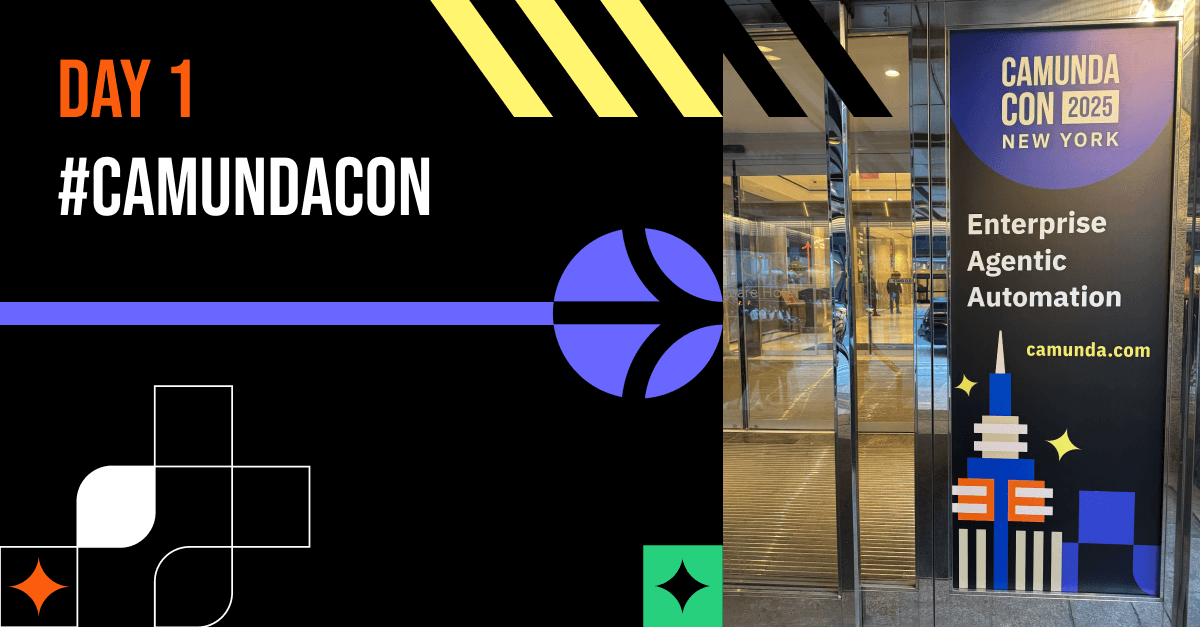
Welcome to CamundaCon 2025 New York!
We hope you’re as excited as we are for CamundaCon 2025 New York, which kicks off online soon! Just like at the previous CamundaCon in Amsterdam, we’ll be bringing you the latest updates from the event live as they’re happening. Be sure to check back frequently as we’ll be updating this post throughout the day.
If you couldn’t join in person in New York, many sessions are streaming live and it’s free to join online—so you can still catch the action! Just register at the link below, check out the agenda and make sure you don’t miss anything (be sure to filter by livestream). We’ll see you there, whether online or in person!
Watch CamundaCon NYC 2025 Videos
The live masterclasses taking place in person in New York are now underway and will be wrapping up shortly. The main event begins with the opening keynote at 11:10am ET / 5:10pm CEST.
We’re about to get started! Get ready everyone, CamundaCon 2025 New York is about to begin!

Hello from around the world to everyone online 👋

Welcome to CamundaCon New York 2025!

Camunda’s Amy Johnston is now welcoming everyone to CamundaCon 2025 New York! Amy explained the traditional Camunda Selfie Screen (tag your selfies with #camundacon and #selfie to join!), the Camunda and sponsor booths, of course how to access the WiFi and Slido for questions. Don’t forget to head to Slido to ask (or just upvote) your own questions!
Opening Keynote by Jakob Freund
Camunda CEO and co-founder Jakob Freund then took the stage and made a confession—he almost didn’t make it to the conference today. And that’s because had to reschedule his flight and attempted to do so by engaging with an AI chatbot.
The problem with AI chatbots today

This screenshot—which shows the agent telling Jakob his flight had been canceled, which was not true—was just one of several he shared depicting a long and frustrating conversation with the chatbot. Ultimately, it was not even able to reschedule his flight, and it told him to call in anyway.
Mushroom agents
This is an example of what Jakob called a “mushroom agent.” These agents are popping up all over the place, and while they may seem to unlock short term value, it ends up creating a value trap. We’ve seen this before with other automation technologies, like RPA. You can’t just throw an agent (or a bot) at a process and expect it to get you very far.

Building trust
The critical problem is one of trust. Jakob pointed out that enterprises are having a major challenge adopting next-era AI, with only 8% actually scaling at an enterprise level and embedding it into core processes. In some ways, trust in AI has actually declined from a year ago, despite it being more powerful. That is one key reason why the airline chatbot was not given the power to actually rebook him.

So how do we build trust? To answer that question, Jakob welcomed Camunda CTO Daniel Meyer to the stage to talk about agentic orchestration. Daniel explained that agentic orchestration is the blending of deterministic (or pre-defined) orchestration, and dynamic (or AI-driven orchestration), combining them in such a way that you can keep strict understandable guardrails in place while still granting the AI valuable autonomy. It’s fully auditable, humans remain in the loop where needed, and the entire process is visible in one place. This is what’s needed to fix the broken customer journey and enable agentic orchestration at the enterprise level. This kind of chatbot can actually rebook your customer.

Daniel went on to explain a lot of other powerful capabilities, including walking through an intriguing financial services example and the importance of Agentic BPMN, which allows you to build, deploy and execute AI agents directly in BPMN with Camunda. He also spoke about Camunda’s existing copilots, from the BPMN Copilot to the FEEL Copilot to the Form Copilot, and outlined an impressive vision to take this further and develop a Camunda Copilot Agent that can help you build agents faster.

Enterprise Agentic Automation
Putting this all together, enterprise-grade agentic orchestration enables what Jakob called Enterprise Agentic Automation. Jakob shared some impressive numbers from customers that have already achieved huge value by implementing Enterprise Agentic Automation through agentic orchestration.

Automating the previously impossible
George Kutnerian, Co-Founder, President & CEO of Wellpointe and Max Young, Founder and Principal of Capital BPM, then joined Jakob to talk about how Wellpointe has benefitted from agentic orchestration already. Wellpointe provides a lot of services for older adults, and George shared a powerful example of how medication orders are now end-to-end automated, with humans looped in only when necessary for emergencies. This yielded 15 minutes per order saved, which George noted is “a lot in our world.” This also improved transparency for customers. Max emphasized that one of the most impressive things about it is that this improvement is completely scalable as Wellpointe grows, and how excited he is for Wellpointe’s future. Be sure to check them out when they present later today.

Going live with AI in a regulated industry like financial services
Ante Plazibat, Head of Emerging Business & Innovation at Finnova, joined Jakob on the stage next. He shared some impressive results from adoption of agentic AI, including a head-spinning 90% reduction in the time it takes to onboard complex new customers. Ante will be presenting tomorrow morning and previewed that he would be sharing a lot about their AI adoption journey and how they adapted it to their needs. Don’t miss that session.

Partnerships that drive value
Next on the stage were Prashant Gaonkar, Global Head of Enterprise Integration and Process Orchestration Practice at Cognizant, and Sameer Gupta, Americas Financial Services AI Leader at EY. Sameer spoke about the importance of deterministic guardrails in a regulated environment like financial services, and how an orchestration layer helps keep AI under control and working well with the many systems needed to complete a financial process. Prashant added how important it is for things to be scalable, to get beyond “agents” and getting to “agentic,” and for the actions taken by your agents to remain explainable along the way.

All in all, this was a fascinating look into the state of agentic AI, and how agentic orchestration can enable enterprise agentic automation. This is a technology that is moving fast, and it was exciting to get a sense of how far things have come and where they might yet go.
But there isn’t much time to ruminate on this just yet, as without further adieu, our next speaker is coming to the stage!
Guest Keynote + Fireside Chat with Gartner

Saikat Ray, VP Analyst at Gartner took the stage next. Saikat began by assuring us that while he was going to talk about AI, he was not going to have a slide of a human shaking hands with a robot (thank you, Saikat). He explained that while AI adoption is growing quickly, trust is still low (as Jakob also noted). In a survey of over 2500 CIOs and IT leaders, only 17% have deployed AI Agents as of 2025. BUT according to other surveys agentic AI might be deployed at 50% of organizations by the end of next year! So while it’s hard to trust today it’s still being adopted rapidly. You can’t afford to sit back and wait, you have to find a way to get this right.

The reality is today that there’s a lot of deterministic workflows that are still needed today, and humans will need to work together alongside bots and agents. In this future, eventually there will be a massive amount of these agents swarming over your enterprise, and fundamentally you need to be able to control them—that means you need orchestration!
Saikat went on to note that customers want consolidation and a central platform that combines multiple capabilities to help enable this. This is what Gartner is highlighting in their emerging new category, Business Orchestration and Automation Technologies (BOAT).

He then wrapped up with five steps to consider prepare for future automation, including determining where you do not need agents (they are expensive, after all), and figuring out how you can build an architecture for orchestrating your agent, human and bot interactions. This was a fascinating session and opened up into a lot of great Q&A from the audience.
Next up is a lunch break, followed by more great sessions in person and online.
Camunda 8 + GenAI: Elevating the Agent Experience

First up on the stage after lunch was Buddhika Hanwella, iBPM Engineering Manager at VodafoneThree, the largest mobile operator in the UK. He opened with a fun fact about NYC: 95% of the city’s water is powered by gravity alone! The point was highlight the power of flow in getting things done.
Buddhika spoke about how seriously VodafoneThree took customer case management, and added that they had recently committed to a “just ask once” high standard and opened new customer care centers. How could they stay true to their mission of a great customer experience, while also improving business outcomes in terms of handling time and IT costs? The answer is a focus on flow.
Over the next few minutes, Buddhika emphsaized nine important considerations for how he and his team have been engineering for flow. This includes infusing generative AI where it can save time, but also critical components like a unified journey structure, guided UI elements, the ability to easily pause/resume cases, observability, event-driven microservices, and more. After considering these points, despite no prior experience with Camunda, it became clear that Camunda 8 was the best choice for achieving this flow.

The new tools for VodafoneThree’s customer agents were designed to be as straightforward as possible. A Camunda-driven UI with minimized clutter, proactive alerts, and guided task completion reduce cognitive load and help direct agents to where they need to be looking. Then the team focused on boosting workflow with generative AI. Using Camunda they were able to apply governance by design and control where GenAI operates and where it doesn’t, and ensure transparency and human control.

Buddhika added that generative AI was not an afterthought in their design, and was woven into the core of the Case workflow. GenAI also helped transform unstructured data by categorizing and tagging emails, and was trained to drive a consistent brand voice. In the future, GenAI will unlock insights from Customer Insights and Outcomes and infuse these into an optimized workflow. Finally, he closed by emphasizing the importance of trust when using generative AI—a running theme through the conference so far. This was a fascinating look at how generative AI was carefully and effectively incorporated into a large enterprise and impressive to see.
ICYMI – On Stage 2
- Transforming Enterprise Systems (SAP, ServiceNow and Salesforce) with Agentic Orchestration: Tobias Conz, Senior Product Manager at Camunda, led this session about how Agentic Orchestration benefits leading enterprise systems. It addresses the commonly known problems of enterprise systems dealing with legacy systems, unexpected disruptions, and the ever-increasing demand for better User Experience. Tobias highlighted Camunda’s integrations to SAP, ServiceNow, and Salesforce, as well as real-world examples of how customers already use them.
Orchestrating Workflows with Camunda 8 on AKS

Murthy Ganti, Director, Software Development – Platforms & AI Accelerator at RBC Clear joined us next on the stage. He confessed that this is the first time he has presented to a large audience on a stage rather than behind a screen, and the applauding audience cheered him on. You got this, Murthy! (He also confessed to the difficulty of being in New York while his hometown MLB team of Toronto team is playing the Yankees in the playoffs. As a Red Sox fan, Murthy, I feel you.).
Whether you’re a developer, a platform engineer or architect, or a business and technology leader, Murthy ensured that his talk had something for you. He then detailed the limitations of legacy architecture (difficult to audit, lots of friction) and the strategic drivers that drove them to transform their architecture with Camunda (like improved customer and developer experience, agility and regulatory compliance). He and his team evaluated both SaaS and Self-Managed and while both had benefits, they opted for the control and flexibility of self-managed. Murthy noted the importance of the production-ready enterprise architecture of Camunda, including cross-region distribution with Zeebe, data consistency and integrity, and enterprise resilience features like zero tolerance for data loss.

Security is a critical component of any enterprise software, and Murthy went into detail on how they implemented a multi-layer security architecture, from identity management to network security to data protection and more. He also explained the importance of monitoring and observability, highlighting the tech stack they use to make it work. This was an informative part of the talk with a lot of good technical data for anyone walking the same journey to dig into.
Murthy then pivoted to a part of his talk called “Camunda in Action, ” focusing on the ability to develop multi-channel interaction patterns, including what he described as “maker/checker workflows.” His point? There are so many use cases where Camunda can optimize and orchestrate the workflow.
He then closed by highlighting the positive developer experience and overall transformative business impact, including some impressive performance metrics like 99.9% availability and 2.5M daily process instances with less than 50ms cross-region latency.

ICYMI – On Stage 2
- Agents In Your Basement: Thomas Gütt, Sales Engineer at Camunda, led this session on the benefits of deploying local AI. Despite the scalability and convenience of cloue-based solutions, there are significant drawbacks to using the cloud, and local AI offers a compelling alternative. Thomas explained how you can adapt AI systems to unique business needs, ensuring alignment with specific workflows and data sensitivities. He explored how local AI empowers enterprises, and demonstrated how Camunda can orchestrate on premise AI workflows, combining robust customization capabilities with seamless integration of local agents.
Shaping the future of process automation at NORD/LB with Camunda and AI agents

Next up, Lana-Sophie Stawowski, Senior Customer Success Manager at Camunda took the stage. She began by introducing Dr. Leander Fiedler, Lead for Automation at NORD/LB and Niall Deehan, Process Alchemist & Technical Evangelist at Camunda, who would be joining her remotely.
Lana begin by highlighting the success of Project Orchesr-AI-te. For this project, Camunda engaged with over 50 customers across the globe and in multiple industries, and rapidly built prototypes using our agentic orchestration features (currently in alpha, to be officially released with Camunda 8.8 next week). The estimated Real-AI-zed value (c-AI-n’t hear that pun enough times 😅) from these prototypes was impressive, with estimated cost reductions between $300K and $2 billion per year.

Leander and Niall then joined the presentation. Leander set the table with some background about NORD/LB, which is a leading German commercial bank with global reach. It has around 3700 employees, over 1000 individual processes and a complex technological landscape in a highly regulated environment.
Leander spoke about the methodology for process orchestration at NORD/LB and their vision for creating a chatbot capable of answering any business related question. While they learned that AI can make banking smarter, it also made processes more complex, and as we’ve heard before today, they quickly understood you can’t just add AI anywhere. Leander explained how they rethought their processes to understand which technology would be most helpful to improving it.
Next up, Niall led us through a demo of the process that NORD/LB built for Project Orchestr-AI-te, which was for the handling of digital mail. Niall walked through the process and then an example letter—with real details but also riddled with missing or unclear information—to see how the AI agent would handle it.

After watching the agent think about it in real time, it provided results for who it thought this letter should go to and why, pulling data from multiple systems to make its decision. The agent made use of its own tools and reasoning to find this difficult-to-sort letter a home, with its reasoning and degree of confidence explained clearly. Pretty cool!
ICYMI – On Stage 2
- Driving U.S. Healthcare Efficiency with Camunda 8: Sridhar Narasimhan, Director and Chief Functional Architect at Cognizant, showcased how Camunda 8 powers scalable automation for a major U.S. healthcare payer. He described how a modular architecture and REST orchestration drove efficiency, with agentic AI on the roadmap to elevate decisioning and SLA intelligence.
That’s all for the livestream!
While we on the livestream get to take the rest of the night off, those in person were treated to a few more excellent sessions:
- Re-engineering Pension Journeys for Speed and Scale with Camunda, by Sam Lewis, Agile Delivery Lead/ Release Train Engineer at Legal & General
- Driving Operational Excellence with Camunda-Powered Exception Management for Financial Services, by Lars Tandrup, Principal at EY
- Automation with Compassion: How Wellpointe is Scaling Rx Processing and Family Communication with Camunda, by Max Young, Principal at Capital BPM, Terry Camerlengo, Director of Technology at Wellpointe and George Kutnerian, Co-Founder, President & CEO at Wellpointe
- A Skeptics Guide to Agentic Orchestration, by Niall Deehan, Process Alchemist & Technical Evangelist at Camunda and Nathan Loding, Developer Advocate at Camunda
Aftershow, Exhibition & Networking
That’s it for today! In-person attendees will soon be off to the reception for snacks, drinks and a chance to talk more with fellow attendees and speakers. Don’t forget to tune in tomorrow, either to the live stream or to the day two live blog (or both!). And for those of you in New York who are brave enough, don’t forget about our traditional morning run with Bernd and the Camunda Team at 6:30am, which will be a relaxed 3.2-mile loop through Central Park 🏃♂️🏃♀️💨.
The conference kicks off again with the keynote from Camunda co-founder and Chief Technologist Bernd Ruecker and Bastian Körber, VP of Product Management at Camunda, at 8:45am ET / 2:45pm CEST—you can check out our live coverage of Day 2 here. Whether in person or online, see you all then!
Watch CamundaCon NYC 2025 VideosRegister for CamundaCon 2026 Amsterdam


