

Camunda ServiceNow Integration

Maximize ServiceNow. Orchestrate Everything.

Use Camunda to orchestrate dynamic workflows beyond what ServiceNow was built for — across systems, teams, and AI agents — while keeping ServiceNow as your system of record.

Camunda ServiceNow Integration

How Camunda Works with ServiceNow

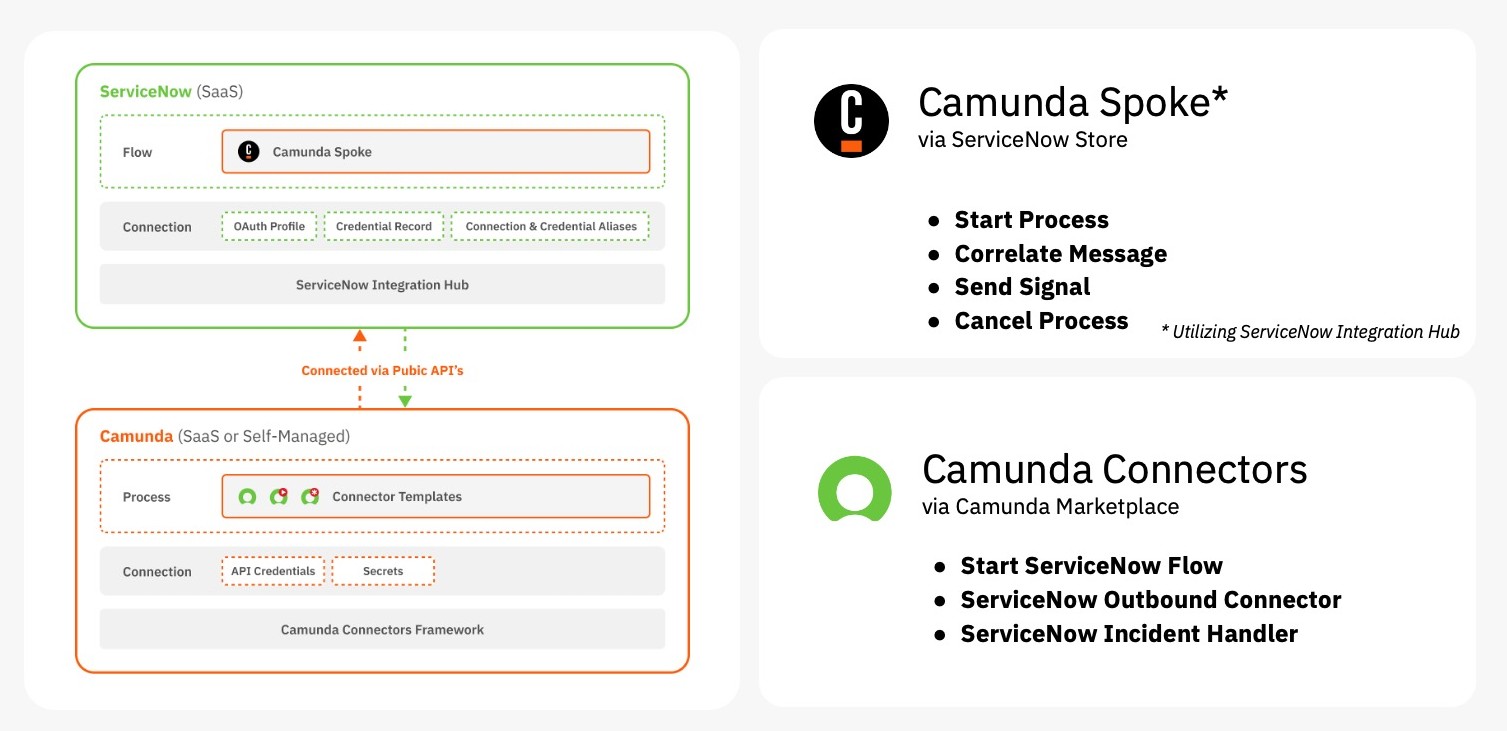
Bidirectional integration and orchestration

Camunda acts as the external orchestration engine that extends ServiceNow's capabilities. Camunda initiates and manages complex, cross-system workflows while ServiceNow remains the authoritative record for all tasks and outcomes. Real-time bidirectional sync ensures that every action taken in Camunda is reflected back in ServiceNow automatically.

"Camunda has helped us manage very complex business processes. Now we are able to run complex decision flows with lots of conditions and branches, and it works reliably with ServiceNow as our system of record."

— Danica, Enterprise Process Architect

How Camunda works with ServiceNow — integration diagram

Maintain ServiceNow as System of Record. Orchestrate with Camunda.

  • End-to-end visibility & governance

    Every workflow step — whether executed in Camunda or an external system — is written back to ServiceNow, giving you a complete audit trail and real-time process visibility without leaving your ITSM platform.

  • Operate and Optimize tracking

    Camunda's process intelligence captures execution data across all connected systems. Use built-in dashboards and heatmaps to identify bottlenecks, measure SLA adherence, and drive continuous improvement — all in the context of your ServiceNow workflows.

  • No-disruption integration

    Camunda connects to ServiceNow via standard REST APIs and pre-built connectors — no ServiceNow customizations, no platform upgrades required. Your existing ServiceNow investment stays intact while Camunda handles the orchestration complexity.

Built for enterprise process orchestration

ServiceNow excels at structured ITSM workflows. Camunda extends those capabilities to cover the dynamic, cross-system, and AI-driven processes that modern enterprises demand.

Where ServiceNow Excels

The Challenge

What Camunda Adds

Intake begins in ServiceNow
Intuitive, user-friendly intake
Request data may be incomplete or inconsistent when users lack full context or system access
Pre-validates, enriches, or auto-fills requests through orchestrated API calls and system checks
Process executes
Stable workflows for common tasks
Complex, long-running processes often span systems, logic rules, and departments
Runs externalized, scalable workflows modeled in BPMN and DMN — no custom code or platform strain
Human task in ServiceNow
Approvals, assignments, and tracking
Delays and silos emerge when approvals span teams, vendors, or disconnected systems
Coordinates handoffs, approvals, and escalations — keeping ServiceNow updated in real time
Exceptions & retries
Clear flows for standard cases
Native retry, timeout, and error handling is limited or manual
Adds automated retries, escalations, and timeouts to keep workflows resilient and moving
Write-back to ServiceNow
System of record for tasks and outcomes
Results from external systems may never return to ServiceNow, creating gaps in visibility
Writes structured results back into ServiceNow to keep records complete, current, and auditable

IT Asset Onboarding

Problem: New employee equipment requests start in ServiceNow but require approvals, provisioning actions, and software licensing from multiple external systems — causing delays and manual handoffs.

Solution: Camunda orchestrates the end-to-end fulfillment workflow: it receives the ServiceNow request, triggers procurement APIs, assigns software licenses, coordinates IT approvals, and schedules delivery — all while writing status updates back to ServiceNow.

Outcome: Onboarding time reduced from days to hours. ServiceNow remains the single system of record. Zero manual follow-up for IT teams.

Agentic Orchestration with Human-in-the-Loop

Problem: AI agents running inside or alongside ServiceNow can act autonomously — but without governance guardrails, they create audit gaps, compliance risk, and unpredictable outcomes.

Solution: Camunda provides the orchestration layer for AI agents: defining when agents act, when humans review, and when decisions must be escalated. Human-in-the-loop steps are modeled in BPMN so every agent action is auditable and reversible.

Outcome: AI-assisted workflows with full governance. Humans stay in control of high-stakes decisions. Complete audit trail for every automated action.

Multi-Party Incident Resolution

Problem: Critical incidents involve internal teams, third-party vendors, and customer SLAs — but ServiceNow's native capabilities struggle to coordinate outside its own ecosystem, leading to communication silos and missed SLAs.

Solution: Camunda orchestrates cross-party incident response: notifying vendors via external APIs, tracking response commitments, escalating on timeout, and writing all updates back to the ServiceNow incident record. BPMN models make the entire flow visible and auditable.

Outcome: SLA compliance improves significantly. ServiceNow remains the central system of record. Incident managers gain real-time visibility across all parties.

Regulated Process Execution

Problem: Regulated industries require every process step to be documented, approved by the right people, and auditable — but enforcing these controls inside ServiceNow alone creates customization debt and upgrade risk.

Solution: Camunda externalizes compliance logic into BPMN and DMN models — separate from ServiceNow customization. Approval gates, four-eyes checks, and regulatory decision rules are modeled explicitly, executed reliably, and updated without touching ServiceNow code.

Outcome: Compliance processes are auditable by design. ServiceNow stays clean and upgradeable. Regulatory changes are handled in Camunda models, not ServiceNow scripts.

Extend the power of ServiceNow and orchestrate everything. Are you ready?