
There are a lot of conversations going on about AI right now, and while the potential is genuinely exciting, getting to impact isn’t easy. Most AI projects currently in the works will end up stalling, and research shows that a great many will be scrapped. The question of how to actually make AI agents work in production—at scale, securely, and with measurable business outcomes—looms large.
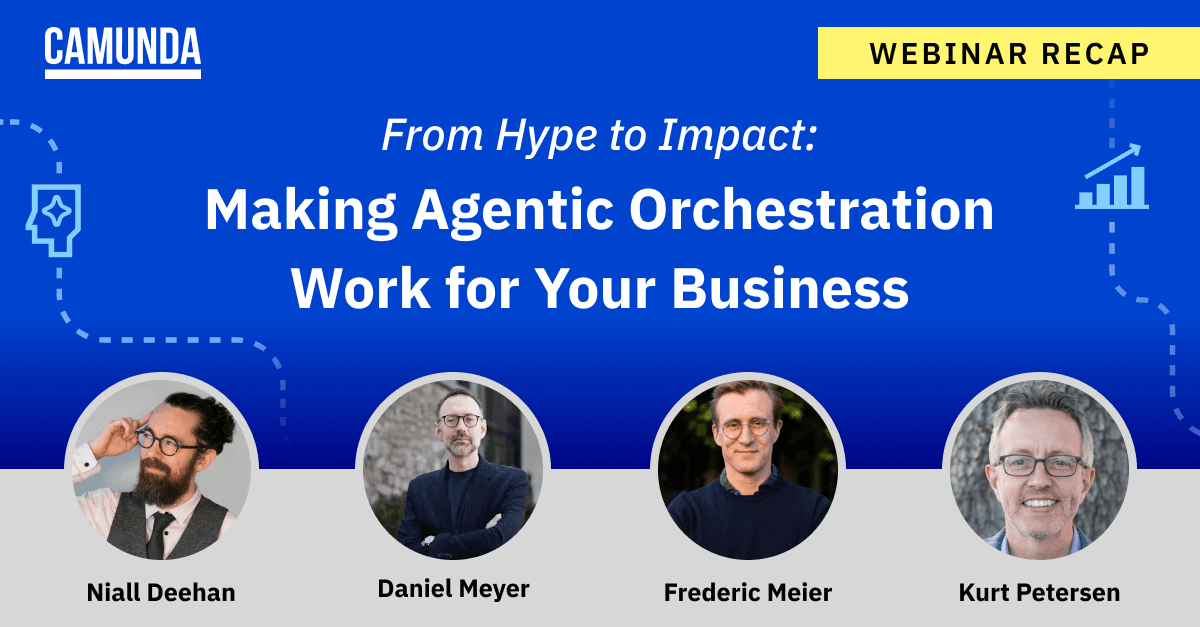
That was the focus of our recent webinar, From Hype to Impact: Making Agentic Orchestration Work for Your Business, where we examined what happens when organizations move from proof of concept to production and start orchestrating real agentic systems. The webinar was led by Daniel Meyer, Camunda CTO, Kurt Peterson, Camunda SVP of Customer Success, Fredermic Meier, Camunda SVP of Sales, and Niall Deehan, Camunda Process Alchemist and Technical Evangelist.
This webinar featured powerful lessons learned from “Project Orchesr-AI-te.” For this project, Camunda collaborated closely with over 50 customers across the globe and in multiple industries rapidly building prototypes using our agentic orchestration features—with many already ready to go into production along with our latest release.
From banking, insurance, healthcare, telecommunications, and beyond, the results show a how agentic orchestration can transforms what was previously impossible to automate into reliable, governable automation that drives measurable business value. And it can do it today.
From prototype to production: What we’ve learned
The goal of this collaborative project was to prove how enterprise teams could integrate AI agents into orchestrated business processes while maintaining the same governance, auditability, and control expected in regulated environments.
Each proof of concept revealed the same pattern of success: when dynamic AI agents operate as part of a deterministic process—bounded by guardrails, enriched by long- and short-term memory, and orchestrated via ad-hoc sub-processes—they can execute complex tasks faster and more accurately than traditional automation approaches.
This approach sits at the intersection of process orchestration and artificial intelligence: agentic orchestration. It’s a model where deterministic process logic governs known, repeatable paths, while dynamic AI agents handle unpredictable scenarios. The orchestration layer acts like a control tower—ensuring visibility, compliance, and traceability across every interaction.
AI agents, BPMN and the ad-hoc sub-process
In Camunda 8, ad-hoc sub-processes make it possible to embed AI-driven decisions directly into existing process models, using the same BPMN modeling that already governs your end-to-end business processes. These ad-hoc subprocesses allow an agent to “think” and act dynamically within a structured process flow—without losing the end-to-end context of the business process.
This capability allows you to incorporate AI within your larger processes and governance, turning AI from an isolated point solution into an orchestrated participant. Agents can analyze data, decide which task to take next, and even collaborate with human participants, all while remaining subject to organizational rules.
In short, ad-hoc sub-processes let architects and process designers experiment with dynamic behavior safely, making it possible to learn from agent performance while maintaining process integrity.
Keystone agentic orchestration use cases
In the presentation, we cover three key agentic orchestration use cases in detail, showing how AI agents can have real business impact quickly when they are orchestrated.
1. Automated technical support—Reducing manual effort by 80%
In a telecommunications environment where hundreds of error codes can appear every minute, human operators were overwhelmed and key issues were getting lost. By introducing an AI agent orchestrated within Camunda, the team automated triage and response.
The agent learns over time—drawing on long-term memory to recognize recurring issues—while process guardrails ensure it requests human approval at critical steps. The result is a dramatic 80% reduction in manual effort, freeing engineers to focus on root-cause analysis rather than repetitive troubleshooting.
Key lessons from this use case:
- Learn deterministic solutions from AI behavior—use what the agent discovers to improve the overall process itself.
- Use AI to solve the cases where you don’t yet have a solution, but use deterministic logic whenever you do (and avoid expensive LLM calls)
- Take advantage of the ability to integrate your agent with custom systems (anything you can orchestrate with Camunda can be part of your agent’s tool set)
2. Human workflow client onboarding—Balancing human judgment and AI speed
Client onboarding often combines high-value human tasks with data-heavy verification. In this example, multiple AI agents worked alongside humans to manage documentation, data validation, and approval sequencing.
The orchestrated design allowed humans to validate only where necessary while agents performed repetitive checks and enrichment steps. The outcome was a 45–60% improvement in process efficiency, along with greater employee satisfaction.
One related proof of concept was prototyped in under two hours and is now delivering more than $300,000 in annual savings, which is one more powerful illustration of how rapidly agentic orchestration can generate ROI.
Lessons learned:
- Protect human time for valuable work by assigning as much as possible to AI agents first.
- Using AI within deterministic flows allows both humans and AI agents to be fully integrated within a single end-to-end process.
- Maintain oversight with both human AI agent checks to validate outcomes and continually improve trust.
3. Trade evaluation and enrichment—Meeting regulatory timelines with 98% fewer delays
In capital markets, trade validation and reconciliation demand precision and speed. Prior to agentic orchestration, one full-time employee could manually review six to ten trades per day, making it extremely challenging to review trades quickly enough to comply with what regulatory T+1 settlement cycles now require.
There were so many variable involved in validating trades that deterministic logic alone couldn’t be used to effectively automate this process, but the team was able to employ AI agents to great effect. Using agentic orchestration, the team deployed AI agents to evaluate trade data dynamically while deterministic logic, implemented through Decision Model and Notation (DMN), enforced strict compliance rules. Along with custom scripts served as additional guardrails, this ensured agents could analyze trade data but never alter the source records directly (which is crucial to build trust with AI, since any imprecision here would be unacceptable).
The overall impact of agentic orchestration here was tremendous: an 86% reduction in effort with employees now able to review 40–60 trades per day, and fully 98% fewer delays past the regulatory deadline.
Takeaways:
- Use deterministic tools like DMN to mitigate AI errors wherever possible.
- Apply guardrails so agents only use the right tools at the right time.
- Keep data and agent behavior independent so that the agent can make decisions but not change the source data—this helps preserve traceability and trust.
Patterns and best practices
Across each case, a few architectural principles emerged as essential to successful enterprise-ready agentic automation:
- Apply guardrails where you need them: Governance can exist both in the system prompt and in the orchestration layer, and these layers work together to constrain behavior.
- Visibility and traceability: Camunda provides full end-to-end observability, so every AI decision can be audited and explained, helping to provide greater understanding as well as compliance with regulations and security requirements.
- Integration by design: Connectors make it easy to integrate any custom system, API, or data service without losing the ability to take advantage of AI agents or orchestration control.
These patterns make it possible to combine agentic AI with deterministic process orchestration, creating an enterprise-ready foundation for innovation that is both scalable and compliant.
Q&A
There was a great Q&A session at the end of the presentation, with a number of important questions raised, including security questions about how Camunda prevents prompt injections and risks from hallucinations, as well how these approaches compare with others like Model Context Protocol (MCP). Be sure to check out the full replay to catch them all.
Learn how to get to impact quickly
Agentic orchestration is not a theoretical approach anymore—it’s a practical approach to scaling AI responsibly across the enterprise. Whether you’re optimizing trade validation, accelerating client onboarding, or automating complex technical operations, the patterns demonstrated here prove that AI can be both dynamic and trustworthy when governed by a strong orchestration layer.
Watch the full webinar replay to see how your peers are making AI agents work in production and explore how Camunda enables enterprise agentic automation that scales—securely, transparently, and with measurable ROI.


