
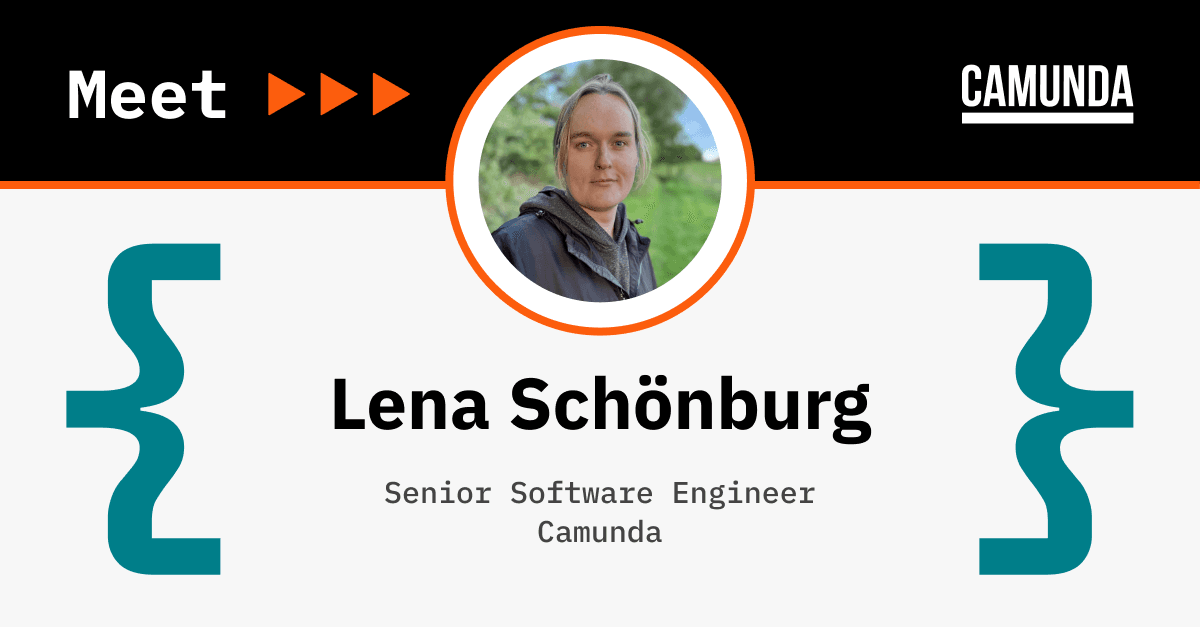
At Camunda, we build products that help customers automate some of the world’s most complex business processes. That sounds simple. It’s not!
Behind the scenes, our engineers are tackling challenges that span distributed systems, long-running workflows, event-driven architecture, and scale across multiple cloud environments. But what sets them apart isn’t just their technical skill, it’s how they think.
In this special “Meet a Camundi” series, we’re spotlighting the engineers behind the platform. You’ll get a window into the problems they’re solving, how they think about system design and debugging, and the mindsets that make them thrive at Camunda.
If you’re the kind of person who loves peeling back the layers of complex systems, who doesn’t wait to be told what to do, and who gets curious about the why, not just the what, you might belong here too!
Read on and find out!
Lena Schönburg


What experiences have shaped your career and led you to where you are today?
Before I could finish university, I started working as a software engineer in a small company doing natural language processing. I had a great mentor who guided me through everything from developing new algorithms to basic system administration and Kubernetes. This was also where I was first working with stream processing and distributed systems. I was immediately hooked and, years later, eventually ended up at Camunda in the Distributed Systems & Performance team. I’m very grateful that I came across such an opportunity and enjoy every day working with my amazing team.
How did you learn about Camunda, and what motivated you to join the team?
Camunda was flying under my radar for a long time. Luckily, I was approached by a recruiter who noted my interest in distributed systems. I started watching tech talks and reading through publicly available code. I realized quickly that Zeebe and the team behind it would be a dream come true for me. Half a year later, I got to meet everyone for the first time at our 2021 Retreat in Croatia, a thrilling and only slightly nerve-wracking experience.
How do you think about observability and debugging in distributed systems?
With distributed systems, good observability becomes a must, otherwise it’s not possible to create a mental model of the system as a whole. Classical debugging is hard or downright impossible, instead we use deterministic property tests and simulations to reproduce bugs or ideally find them before our customers do.
What’s one habit, skill, or mindset that helped you level up as a senior engineer here?
I’m always trying to understand how and why something works in a certain way. That helps me because I learn from others and don’t have to make assumptions that lead to bugs.
If someone’s thinking about joining Camunda, what advice would you give them about working in our codebase and team culture?
Imagine being your own user, and use that as motivation to find simple and elegant solutions.
What excites you the most about your work?

With software in general, but distributed systems in particular, there’s always a degree of chaos involved. It takes discipline, creativity and a lot of iterations to come up with systems that “just work” and become invisible. It’s never done, and sometimes you aren’t even sure it can be done before you start. That’s what I enjoy most about my work and what motivates me to always learn and improve.
Where are you currently based, and how has your experience been working with teammates in a fully remote setup?
I’m currently based near Aachen in Germany, quite close to a lot of forests and nature preserves. I’ve spent most of my career working remotely now, and I couldn’t imagine anything else anymore. What I like the most is that I can blend fully asynchronous communication, video chats and occasional in-person meetings to fit my needs exactly.
What is a project or idea you’ve worked on at Camunda that you’re particularly proud of?
One project that stands out is dynamic scaling. Scaling the numbers of nodes, and soon even the number of partitions, is no small feat and not every distributed system can pull it off. I’m proud of our approach and implementation, and I’m glad that I could contribute to it.
Can you share something about your personal life that colleagues might not know about you?

I’m not sure how many people really don’t know about it by now because I’ll try and tell everyone that I come across but I’m renovating, rebuilding really, a ~100 year old house. After one and a half years of blood, sweat, and tears my partner and I are getting closer to actually moving in again. We have picked up a lot of skills along the way, from basic carpentry to laying brick, that I hope to never have to use again.
Lightning round:
Favorite debugging tool or approach when everything else fails?
- A pen, paper and a long walk! A messy drawing and notes can help a lot, especially when everything else has already failed and you just need a change of perspective.
JVM trick or concept every engineer should know?
- You can use JFR anywhere from basic performance monitoring to troubleshooting problems on customer hardware where you otherwise don’t have access to.
- I’ve found it very useful to learn more about the Java Memory Model, especially as it relates to concurrent programming.
What tech blog/book shaped your thinking the most?
- Not a blog or book but the programming language Clojure and its community shaped me as an engineer. Functional programming and data-oriented programming are powerful tools
Come build with us
The work we do at Camunda isn’t for everyone but if this kind of thinking energizes you, you’ll likely feel right at home.
We’re looking for engineers who think in systems, who get excited by hard problems, and who care deeply about building tools that other developers love to use.
Want to work with people like Lena? Explore our open roles.


