Category

Engineering Excellence

All Camunda blog posts tagged with Engineering Excellence.

How we automatically keep our Documentation Screenshots up to date

When you open the Camunda User Guide, you’ll see that there are many screenshots explaining the different functions and options the product offers. We hope that you, as a user, find those screenshots helpful. But for us as developers, creating and keeping those screenshots up to date has always been a pain. https://unsplash.com/photos/dDppsuM_UpE At the time of writing, the user guide for Camunda Optimize contained 94 screenshots. And with every release we add more functionality, which means the number of screenshots continuously grows. When we change the look of buttons or add a new section to the header, we need to update every screenshot that has a button or header in it. In practice, this meant we were manually recreating every…

By Sebastian Stamm

Git push to deploy to Camunda Cloud

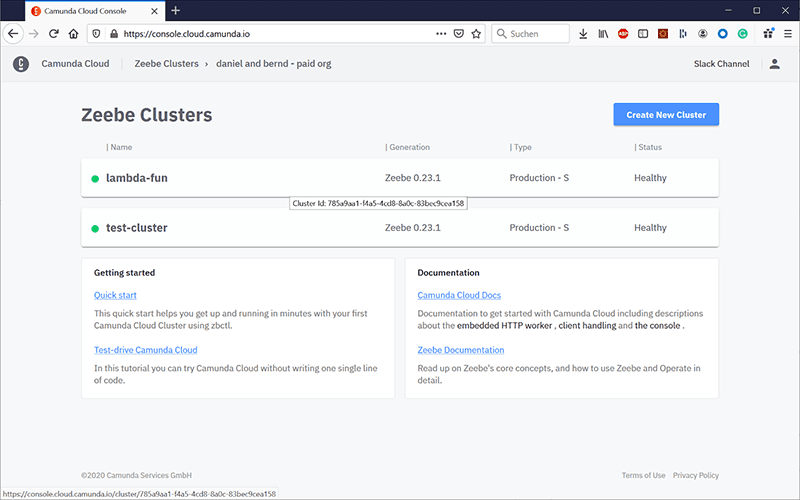
Using the Zeebe Action for GitHub, you can automate your GitHub repo to deploy BPMN models to Camunda Cloud when you push to a specific branch. In this quick tutorial, I show you how to configure your GitHub repo to deploy all BPMN models in the bpmn directory of your repo on a push to master. If you don’t have a Camunda Cloud account yet, you can join the public beta to get one. Create a client in Camunda Cloud Go into your Zeebe cluster in the Camunda Cloud console, and create a new client. You might want to name it “GitHub-Automation” so you know what it is for. Copy the “Connection Info” block by clicking the copy icon in the lower right-hand…

By Josh Wulf

Writing a Zeebe Client in 2020

The last time we wrote about creating a Zeebe Client was in November, 2018 in the article “Generating a Zeebe-Python Client Stub in Less Than An Hour: A gRPC + Zeebe Tutorial“. As of June 18, 2020, we have Zeebe client libraries in Java and Go, maintained by the core Zeebe Engineering team, as well as community-supported clients in C#, Delphi, Node.js, Python, Ruby, and Rust; as well as Workit – a Node.js client that can talk to both Zeebe and Camunda – and a Zeebe GitHub Action. If you are interested in creating a new Zeebe client library in your favorite language, the 2018 article is still a great place to get started. In this article I want to…

By Josh Wulf

Project Layouts, Journeys and Value Propositions: Monitoring & Orchestrating Your Microservices Landscape using Workflow Automation

Back in March, I conducted the webinar: “Monitoring & Orchestrating Your Microservices Landscape using Workflow Automation”. Not only was I overwhelmed by the number of attendees, but we also got a huge list of interesting questions before and, especially, during the webinar. I was able to answer some of these, but ran out of time to answer them all. So I want to answer all open questions in this series of seven blog posts – you can click on the hyperlinks below to navigate to the other entries.

By Bernd Ruecker

Announcing Zeebe Node Client 0.23

The 0.23.2 version of the Zeebe Node Client is out and available via NPM. There was a critical build error in 0.23.0 and 0.23.1. Special thanks to @myfjdthink for reporting it, and @lwille for the Pull Request that fixed it. The complete Change Log is at the end of this post, with the full list of known issues (for the first time in a release – there is one), breaking changes, new features and fixes. In this post, we’ll also feature a few of the major changes in this release in detail. Feature: Zeebe Node is now pure JavaScript Known Issue: Connection Error debouncing Fix: Transparent Reconnection after K8s pod reschedule Feature: Developer-friendly logging Feature: Batch Worker Version 0.23.0 Changelog…

By Josh Wulf

Camunda BPM: User Task Assignment based on a DMN Decision Table

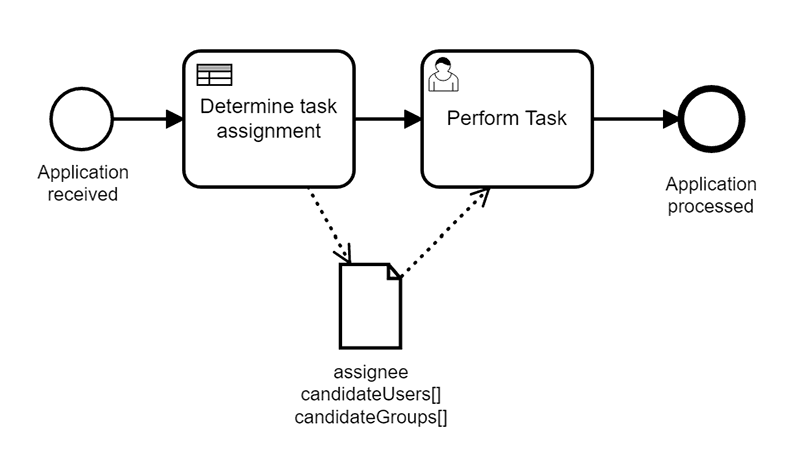
In business processes involving human workflow the task assignment logic can become quite elaborate. For instance the processing of insurance claims, or other variants of approval processes, may require many or complex task assignment rules. The Decision Model and Notation (DMN) decision tables are an excellent tool to manage such rules — outside of code, in a business user-friendly way.

By Robert Emsbach

Try All Features of Camunda