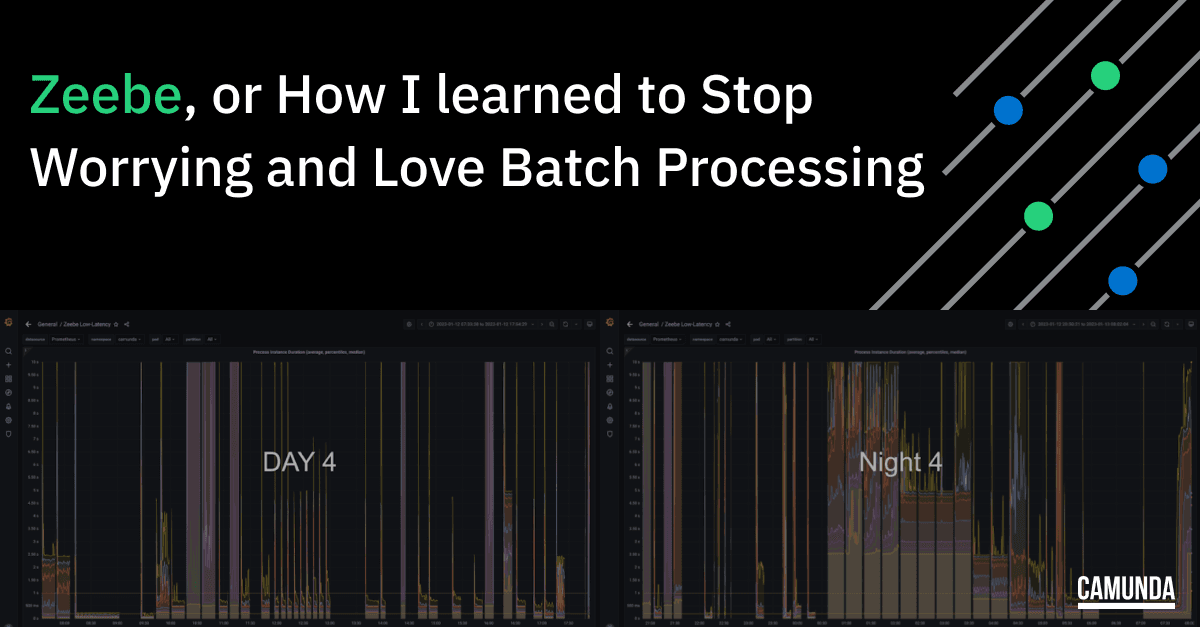


Zbchaos — A new fault injection tool for Zeebe

During Summer Hackdays 2022, I worked on a project called “Zeebe chaos” (zbchaos), a fault injection command-line interface (CLI) tool. This allows us engineers to more easily run chaos experiments against Zeebe, build up confidence in the system’s capabilities, and discover potential weaknesses. Requirements To understand this blog post, it is useful to have a certain understanding of Kubernetes and Zeebe itself. Summer Hackdays: Hackdays are a regular event at Camunda, where people from different departments (engineering, consulting, DevRel, etc.) work together on new ideas, pet projects, and more. Check out previous Summer Hackdays here: Summer Hackdays 2020 Summer Hackdays 2019 Zeebe chaos CLI Working on the Zeebe project is not only about engineering a distributed system or a process…

By Christopher Kujawa

Could Process Orchestration be the “Glue” for the API Economy?

The API economy is taking off, propelled by an explosion of activity across API tools and platforms. According to a 2021 report from Postman, developers reported spending nearly half of their time working on APIs, and 94% of companies planned to increase their investments in APIs in 2022. API-first development is also gaining traction, with an impressive 67% of companies embracing this methodology. Companies like Twilio and Stripe emerged as early winners in this new economy, with the promise of many more to come.  APIs offer organizations an opportunity to tap into best-of-breed software components without having to spend precious time or development resources creating them from scratch. With that said, an often-overlooked aspect of the API economy is how…

By Jakob Freund

Sep 22, 2022

FEEL more confident transforming data

FEEL (Friendly Enough Expression Language) was created by the Object Management Group (OMG) “as part of the DMN standard”. Its goal is to be easy to understand, and at the same time, be full-featured enough to handle decision tables and literal expressions. When business and IT often work together on complex projects, writing expressions in a (relatively) accessible way reduces miscommunications and helps align teams. Camunda uses FEEL to map and transform business process data dynamically. For example, a loan application process pulls a credit score from an API call into a decision table. The decision table automates the next step of the process depending on the rules in the table. The data from the decision automation can then be…

By Shane Ernest

Sep 20, 2022

Are you the next Camunda Champion?

Since the first day I joined Camunda (which is already over four years ago – time really does fly when you are having fun), I was amazed at how many dedicated, passionate, and invested Camunda Community members there are. Numerous times, I have met individuals who spoke with such excitement about Camunda’s technologies and what the community means to them, that you had to believe it even if you would have never heard of Camunda before. Not only are Camunda Community members passionate about the products, many also actively contribute and give back to the community in several ways. Just to name a few examples: they contribute code and help improve Camunda products, organize meetups, answer questions from fellow users…

By Luca Buchholz

Sep 16, 2022

Workflow diagram and pattern examples using BPMN models

There are multiple angles to look at workflows one of which is patterns. The Workflow Patterns initiative differentiates between control, data, and resource perspectives. They are not just focusing on the modeling language as such but have workflow systems in mind too. It’s valuable to have a closer look at those patterns and discuss which parts of it can be shown and even automated in BPMN, and which parts are taken care of in the technical implementation. I have seen BPMN diagrams that try to include every aspect in the diagram itself. This often leads to overloaded BPMN models with a lack of clear transparency of the business flow. Therefore, it is important to focus on all aspects of workflow…

By Nele Uhlemann

Sep 15, 2022

CamundaCon 2022 preview – A conference for all things process orchestration

Our annual process orchestration conference, CamundaCon, is back this October 5-6 with a new hybrid format. Join us online from the comfort of your desk or meet us in person in Berlin, Germany. No matter how you CamundaCon, it will be a fun and insightful event! This year’s agenda is jam-packed with an all-star line-up of experts who will share their experience automating, orchestrating, and improving core business processes. You’ll hear real-world use cases and best practices from companies across all industries that have found innovative ways to deliver better customer experiences through orchestration. Here’s a sneak peek at a few of the sessions you won’t want to miss: Conference highlights: Attend engaging presentations and technical talks from across four…

By Andrea Davis

Sep 15, 2022

Increase your resilience with new regions in Camunda Platform 8 SaaS

We’re excited to announce new regions for Camunda Platform 8 SaaS that further strengthen the resilience, performance, and data requirements for our SaaS customers. Enterprise customers can now choose to create their clusters in a number of regions including Europe West, US Central, US East, and the most recent addition, Australia South East. This provides multiple benefits, such as increasing availability, allowing to set up fail-safes, adhering to regulatory requirements for regional data storage, and reduced latency due to closer physical proximity. Resilience and redundancy in technology are important for all modern organizations and are top of mind for many. Across industries, organizations need a solution that scales effectively and is resilient to provide a good base for process orchestration….

By Annie Talvasto

The CAM project in JIRA is moving to GitHub

For almost 10 years, JIRA has been our development issue tracker for the core components of Camunda Platform 7. About 15,000 tickets later, Camunda’s engineering has grown from one team to a team of teams. Many new projects have used GitHub exclusively as a code repository and an issue tracker from the start. In October, we will move the CAM project to GitHub issues. With this change we are reducing the gap: our community can participate in our development processes with a single account. We achieve a unified approach for managing development issues, making it easier for everyone to participate. We thank everyone who has contributed to our CAM issue tracker and hope that the collaboration continues in our new…

By Thorben Lindhauer

Sep 13, 2022

Camunda Optimize 3.9.0 alpha4 Released

We’re excited to announce a new release of Camunda Optimize. Camunda Optimize provides business activity monitoring for workflows, supporting continuous process improvement by providing transparency into your automated workflows and decisions. Business-friendly reports, dashboards, and alerts make it possible to identify process bottlenecks, improve end-to-end processes, and evaluate the success of your process automation initiative. In the rest of this post, we’ll highlight some of the new capabilities introduced in Optimize 3.9.0 alpha4. What’s new? Process Onboarding UX Whenever the first process instance of a new process definition is deployed, the user will receive an email with an invitation to create a first default dashboard in Optimize. Restrict report and dashboard creation to collections Optimize is structured with entities like…
By Camunda Optimize Team

Try All Features of Camunda