


At CamundaCon 2025 in Amsterdam, senior IT lead Daan Wijfje and solution architect Andrés Lara Buendia explained how Rabobank uses Camunda to orchestrate and scale its financial economic crime (FEC) tech operations. What was a fragmented legacy ecosystem is now a streamlined, data-driven fraud detection engine.
According to Wijfje and Buendia, over €16 billion are laundered each year in the Netherlands, much of it tied to drug trafficking and fraud. Rabobank is highly regulated by the Dutch National Bank, so ensuring compliance also means detecting financial crime at scale. Not a small challenge.
The challenge: orchestrating detection
Rabobank’s FEC operations span everything from transaction monitoring and customer due diligence (CDD) to real-time sanction screening. With more than 8,000 analysts handling 4 billion transactions (processed annually), Rabobank turns to automation to handle the volume and complexity.
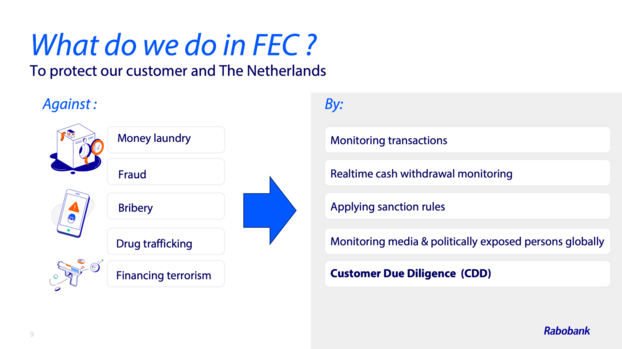
Of course, it’s challenging to orchestrate all the automation required to fight financial crime: applying sanction rules to screening media and detecting drug trafficking and fraud indicators.
The solution: a unified orchestration layer
Before Camunda, Wijfje and Buendia explained that Rabobank’s FEC workflows lived across a few different isolated platforms. Analysts had to cross-reference data manually and spend valuable time on administrative tasks. The inefficiency slowed down investigations and risked missing critical insights.
The team opted for Camunda’s Self-Managed platform, driven by data sovereignty, regulatory compliance, and the need for tight integration with internal systems. As a result, Rabobank has achieved a single orchestration layer that connects four key systems involved in CDD and fraud detection:
- Streamlining operations
- Improving response times
- Reducing manual effort
The impact: a comprehensive risk assessment workflow
To illustrate how Camunda supports fraud detection in action, Wijfje and Buendia walked the audience through a real-world use case. Politically exposed persons (PEPs), like a newly elected mayor, can trigger flags when an unusual deposit hits their bank account, for example. With Camunda’s orchestrated workflow, Rabobank can cover risk assessment, watchlist matching, and potential escalation, reducing investigation time and human error.
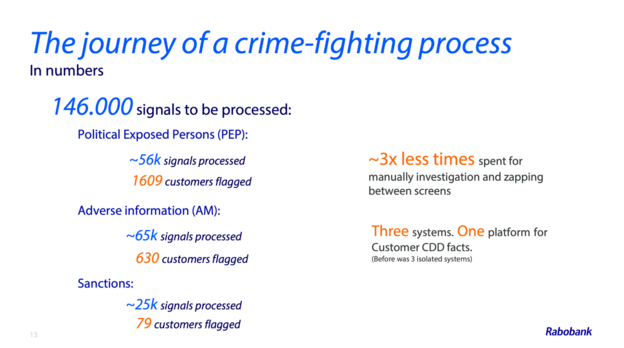
Rabobank’s orchestration layer now handles over 145,000 streaming events across various fraud detection domains. In the last cycle alone:
- 56,000 signals were processed related to PEPs, flagging 1,609 customers.
- 65,000 signals were tied to adverse information (adverse media, or AM), with 630 cases flagged.
- 25,000 sanction-related signals surfaced, resulting in 79 matches.
With Camunda, analysts now spend three times less effort per case, freeing them up to focus on high-value investigations instead of hopping back and forth between screens and disparate accounts.
While Camunda’s Self-Managed version gave Rabobank the flexibility and control it needed, Wijfje and Buendia admitted that it came with a bit of a learning curve, what with securing infrastructure, integrating with internal systems, and ensuring everything runs reliably at scale.
“At the end of the day, you need to be prepared,” Wijfje said. But he credited Camunda’s customer service and dedicated support as contributing to the smooth implementation of Rabobank’s orchestration efforts.
Before they took questions, Wijfje and Buendia highlighted a few key takeaways for their audience:
- Don’t underestimate orchestration. Legacy systems can be modernized without tearing things down to the studs if you put the right orchestration layer in place.
- Centralizing facts matters. Moving from three isolated systems to one shared platform for customer risk information improved decision-making and consistency.
- Focus on business value. Less time spent gathering data means more time spent preventing actual crime.
Next steps for Rabobank
To capitalize on their success so far, Rabobank is already working with Camunda to replatform its risk detection system. They’re also evaluating Camunda as the orchestration layer for a new customer risk rating engine. In the end, Rabobank hopes to achieve a modular, responsive, transparent FEC platform that scales with the bank’s needs and stays ahead of financial crime.
Want to learn more? Watch the full Rabobank session from CamundaCon Amsterdam 2025.