


At Camunda, we build products that help customers automate some of the world’s most complex business processes. That sounds simple. It’s not!
Behind the scenes, our engineers are tackling challenges that span distributed systems, long-running workflows, event-driven architecture, and scale across multiple cloud environments. But what sets them apart isn’t just their technical skill, it’s how they think.
In this special “Meet a Camundi” series, we’re spotlighting the engineers behind the platform. You’ll get a window into the problems they’re solving, how they think about system design and debugging, and the mindsets that make them thrive at Camunda.
If you’re the kind of person who loves peeling back the layers of complex systems, who doesn’t wait to be told what to do, and who gets curious about the why, not just the what, you might belong here too! Read on and find out!
Deepthi Akkoorath

What experiences have shaped your career and led you to where you are today?
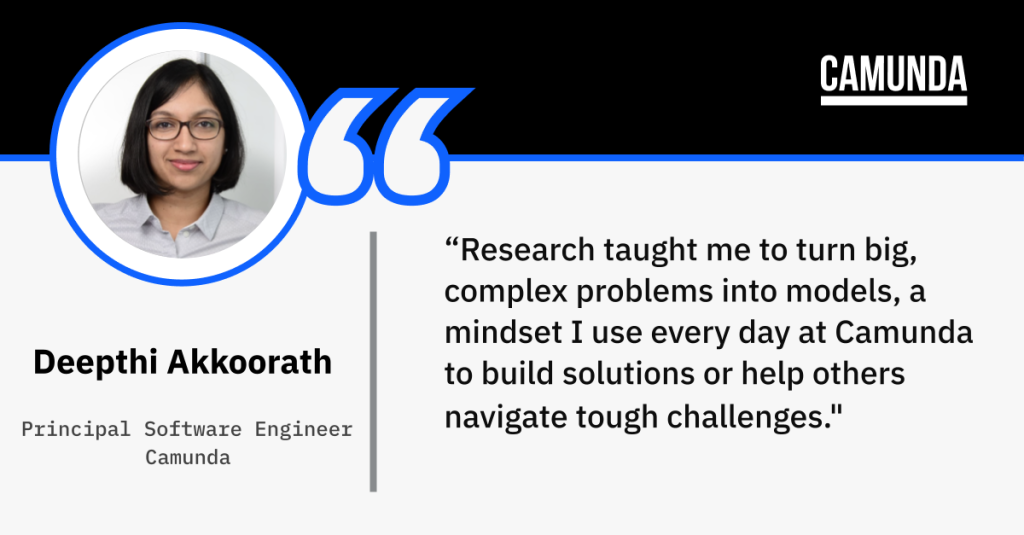
Looking back, one of the most defining parts of my journey started at university. I was lucky to have a great mentor and friends who pushed me to explore beyond what we were taught in class. That curiosity eventually led me to pursue a PhD, where I focused on distributed systems at scale. Doing research taught me how to break down really big, complex problems into models I could actually work with. That mindset has stayed with me and is something I use every day at Camunda, whether I’m building solutions or helping others make sense of challenging problems.
How did you learn about Camunda, and what motivated you to join the team?
I first came across Camunda through a job offer I found on LinkedIn. Since I’ve always wanted to continue working in the distributed systems field, the role immediately caught my attention. After having a conversation with Daniel, the CTO, I became genuinely intrigued by what the team is building at Camunda. The vision and the technical challenges really resonated with me, and I felt that this is not only something I would truly enjoy working on but also an area where I could make meaningful contributions.
How do you approach balancing new feature development with maintaining system reliability in a complex distributed system?
I’d say we balance both by planning time not just for new features but also for reliability work. As a team, we invest in improving test coverage, strengthening automated testing, and prioritizing refactoring to keep code quality high. That way, we can move fast without sacrificing stability and it’s very much a team effort.
Can you share a time when you tackled a challenging debugging or reliability issue? How did you approach it?
I once tackled a bug that could have caused data loss. Fortunately, it was caught before reaching production. Reproducing it was extremely difficult because it only occurred under a very specific sequence of concurrent interactions between nodes, which are inherently unpredictable.
After traditional debugging failed, I built a framework to simulate concurrent operations in a controlled way. This allowed me to reliably reproduce the bug and even uncovered another hidden issue. I then integrated this framework into a randomized testing setup for the core consensus algorithm, which later helped catch other tricky concurrency bugs.
What tools or methods help you stay productive and focused, especially after returning from a break?
At work, we use tools like GitHub project management and Asana to stay on track as a team. Personally, I just keep a simple weekly to-do list, it helps me stay organized and focused on what needs to get done.
How do you collaborate effectively with teammates across remote and async environments?
I collaborate through a mix of async communication, like clear documentation and well-described GitHub issues and sync meetings when deeper discussion is needed. This balance keeps everyone aligned while allowing for flexible working times.
You recently returned to work after maternity leave. What advice would you give to other engineers transitioning back to work after maternity leave or another significant break?
When I returned to work after maternity leave, my first step was catching up on technical changes and ongoing projects so I could contribute confidently. I also realized it was important to give myself grace, I didn’t need to prove my worth right away. Starting with smaller projects can help you regain momentum without feeling overwhelmed. Setting boundaries early helped me avoid burnout, and trusting my skills reminded me that my experience and expertise hadn’t gone anywhere. My advice to anyone returning after a break is to be patient with yourself, communicate openly with your team, and focus on gradual progress rather than perfection.
How do you keep your curiosity alive and continue learning in a fast-evolving tech environment?
By following blogs and research papers. Recently, I haven’t had much time for conferences, but I try to watch tech videos whenever I can to keep learning and exploring new ideas.
What excites you most about your work at Camunda right now?

What excites me most is getting to solve complex technical challenges that make Camunda more scalable and reliable. On top of that, I’m surrounded by really talented and ambitious people who always push for the best, and that energy keeps me motivated to give my best.
Where are you currently based, and how do you balance remote work with team collaboration? What is your favorite thing about working remotely?
I’m based in Berlin. Switching from office to fully remote was tough at first, but now I can’t imagine any other way. Regular calls, team events, and one-on-one chats keep me connected and I love being able to listen to music while I work.
What project or achievement at Camunda are you most proud of?
There are many achievements I’m proud of, but one that stands out is our work on dynamic scaling. What makes it special isn’t just the feature itself, but the framework we built behind it to orchestrate cluster-wide operations in a clear and reliable way. Not only did it unlock dynamic scaling, but it also created a foundation where many other operations could be implemented with little to no effort.
What’s one piece of advice you’d share with engineers early in their careers, especially those interested in distributed systems?
Learn the fundamentals of distributed systems. A little bit of theory goes a long way, it lays the foundation for tackling all the complex problems you’ll face later.
Lightning round
Favorite debugging tool or trick?
My first step is always checking out the logs. It gives a good lot of info to help the root cause.
Tabs or spaces?
Spaces!!!
What’s your engineering superpower?
Turning concurrency into a mental model I can actually reason about. This is especially useful when working on challenging problems or chasing down tricky bugs.
Come build with us
The work we do at Camunda isn’t for everyone, but if this kind of thinking energizes you, you’ll likely feel right at home.
We’re looking for engineers who think in systems, who get excited by hard problems, and who care deeply about building tools that other developers love to use.
Want to work with people like Deepthi? Explore our open roles here.
Start the discussion at forum.camunda.io