


Enterprises are under pressure to deliver faster, smarter, and more autonomous processes. Yet, most automation initiatives stall because agents rely on accurate data to make reliable decisions and take reliable actions.
Most enterprise information lives in documents like claims, invoices, contracts, IDs, and medical reports. These are complex and variable, making them hard for LLMs or agents to interpret. Without structured, validated data, even advanced automation fails.
That’s why Camunda and ABBYY have joined forces—to unlock data locked away in documents and deliver reliable agentic automation.
Analysts agree: Intelligent Document Processing (IDP) is no longer optional, it’s foundational. Forrester notes that “Generative and agentic AI are transforming IDP into a cognitive engine that powers enterprise automation.” While Gartner calls IDP “a strategic enabler for intelligent automation,” and a critical component of intelligent automation strategies, enabling compliance and operational agility. That is why we are thrilled to announce our new partnership and integration with ABBYY, a Leader in 2025 Gartner® Magic Quadrant™ for Intelligent Document Processing Solutions.
This partnership combines Camunda’s agentic orchestration with ABBYY’s advanced document intelligence, creating a powerful synergy that accelerates automation for complex, document-centric processes.
Why this partnership matters
AI agents need trusted, contextual, and actionable information which they can use to make decisions and take actions. Here’s why it matters:
- Better Decisions: Agents rely on data to evaluate context and choose the next best step. Poor data leads to wrong decisions and compliance risks.
- Contextual Autonomy: Reliable data provides confidence scores and validation checks, enabling dynamic, context-aware processes instead of rigid workflows.
- Compliance and Auditability: In regulated industries, every decision must be traceable. Trusted data ensures decisions meet compliance standards and withstand audits.
- Fewer Escalations: Low-quality data forces agents to escalate cases to humans, creating bottlenecks. Trusted data minimizes exceptions and increases straight-through processing.
- Continuous Learning: Agentic systems improve over time. If the underlying data is unreliable, the feedback loop becomes corrupted, leading to systemic errors instead of optimization.
The ABBYY-Camunda advantage
ABBYY and Camunda create an agentic loop for document-heavy processes:
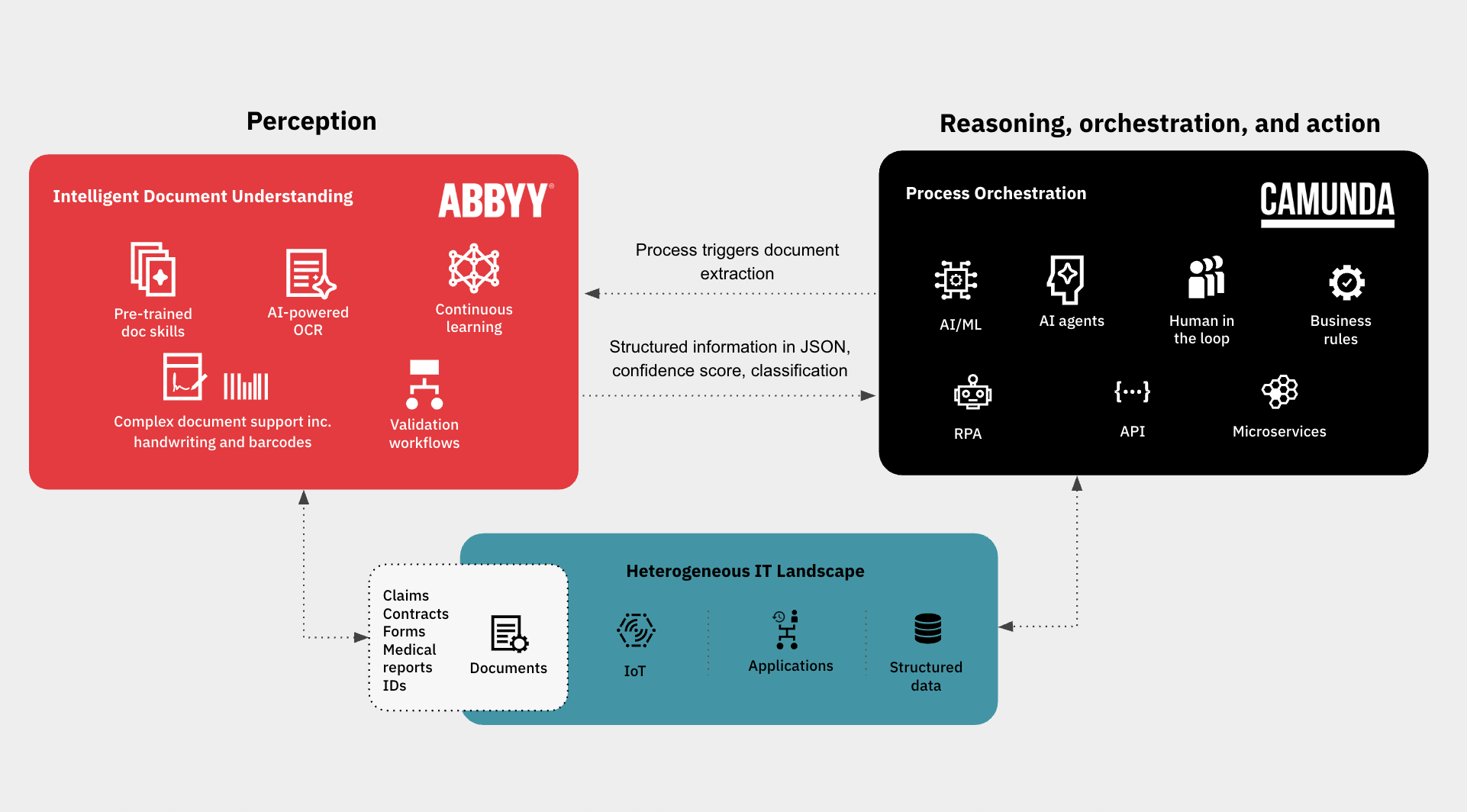
Perception: ABBYY brings best-in-class Document AI—classification, extraction, validation, and human-in-the-loop capabilities.
Reasoning, Orchestration, and Action: Camunda adds composable orchestration, connecting systems, agents, and people into a seamless workflow.
Together, they enable agents to perceive documents, reason with context, and act autonomously.
Use cases this combination solves for
Combining Camunda and ABBYY’s capabilities unlock transformative possibilities across many industries:
- Financial Services: Automate loan origination and claims processing by extracting data from complex forms and orchestrating approval workflows.
- Healthcare: Streamline patient onboarding and insurance verification with intelligent document capture and BPMN-driven orchestration.
- Supply Chain & Logistics: Accelerate invoice processing and compliance checks by combining ABBYY’s OCR and Camunda’s decision automation.
- Public Sector: Digitize regulatory workflows, ensuring transparency and auditability through integrated IDP and BPM.
Insurance claims example
Insurance claims involve diverse documents, like forms, reports, invoices, IDs, and every claim is different. Combining ABBYY–Camunda enables:
- Intake: Camunda triggers the workflow and sends documents to ABBYY
- Perception: ABBYY classifies, extracts, validates, and returns structured data
- Reasoning & Orchestration: Camunda applies DMN rules for policy checks, thresholds, and compliance, then orchestrates next steps across systems and people
- Action: Agents orchestrated by Camunda approve, route, request missing documents, or escalate autonomously
- Human-in-the-Loop: Camunda dynamically involves adjusters only for ambiguous or high-risk cases
- Continuous Learning: Each cycle improves autonomy and reduces manual effort
Business outcomes:
✔ Faster claims processing (days → minutes)
✔ Consistent, auditable decisions
✔ Lower operational costs
✔ Better customer experience
Inside the integration
The ABBYY Vantage Connector, built using Camunda’s Connector Template, makes integration simple and scalable. It offers:
- Native integration in Camunda Modeler
- Secure OAuth 2.0 authentication
- Easy configuration
- Automatic JSON handoff into BPMN workflows
- Support for multi-page documents and error handling
Available on both Camunda Marketplace and ABBYY Marketplace, organizations can start using it in minutes:
- ABBYY Marketplace: Vantage Skills, sample workflows, JSON schemas, and accelerator guidance
- Camunda Marketplace: Official connector, ready for BPMN/DMN integration
Ready to learn more?
Explore our joint solution resources (Camunda Marketplace and ABBYY Marketplace) or contact us for a demonstration of the joint capabilities.