


In a financial landscape defined by regulation, complexity, and accelerating expectations, NORD/LB has been on a multiyear journey to modernize business process automation across this leading commercial German bank. At CamundaCon 2025 in New York City, Dr. Leander Fiedler, lead for automation at NORD/LB, shared how the bank is reshaping its operating model using process orchestration and, increasingly, agentic AI.
For a bank with more than a thousand processes and a diverse portfolio spanning corporate customers, structured finance, commercial real estate, and retail banking, automation is a necessity. But as Fiedler noted, “AI makes banking smarter—and processes more complex.”
The bank’s emerging strategy blends deterministic control with dynamic intelligence, reflecting Camunda’s vision for agentic orchestration: a unified model where AI agents, humans, and systems work together safely, visibly, and at scale.
Did you miss CamundaCon New York? You can catch all the recordings here.
Understanding the landscape
Fiedler briefly explained the environment NORD/LB operates in:
- 120 billion euros of assets
- 3,700 employees
- Branches across Germany, London, New York City
- Partially owned by federal German states, so tight compliance regulations
- Over 1,000 documented processes for its many products
The complexity created a familiar challenge: automation existed, but it was fragmented across departments and technologies: API management, robotic process automation, enterprise application integration, intelligent document processing, machine learning for analyzing unstructured data…
Across NORD/LB, different business units implemented task-specific tools, leading to “automation islands.” Efficiency might increase in one part of the process, but visibility and end-to-end transparency suffered overall.
“So, we can’t just add AI to everything,” Fiedler said. “Just adding chatbots to an existing process just creates a big ball of mud.”

From task automation to true orchestration
Without orchestrating the full process, NORD/LB would have to combat risk, brittleness, and inconsistent customer experiences. To deal with this tangle, Fiedler suggested that the key is rethinking processes from end to end, as if they were designed from scratch with today’s knowledge.
“We see assistive AI happening, we see predictive AI,” he said. “It’s important to consider where to put these in the process and how to use AI effectively where it is used best.”
Increasing AI readiness across processes is an essential step in ensuring that AI is smoothly inserted where it can help best. For example, Fiedler highlighted simplifying and digitalizing processes wherever possible.
For NORD/LB, Camunda became the architectural backbone connecting its diverse technologies: API management, document processing, machine learning, digital channels, RPA, and cloud infrastructure.

Reimagining digital mail with agentic AI
“We do have a concrete example of this,” Fiedler said, “and I’m really excited to show it.” NORD/LB redesigned its digital mail processing workflow from scratch. The essential task was historically manual, handling over 4,500 pieces of mail each month.

While 75% of the mail could be automated with rules, the remaining 25% still required human expertise due to edge cases such as ambiguous customer names or missing IDs. To tackle that 25%, NORD/LB used Camunda to redesign the digital mail box with an eye for reducing manual activity while still preserving knowledge.
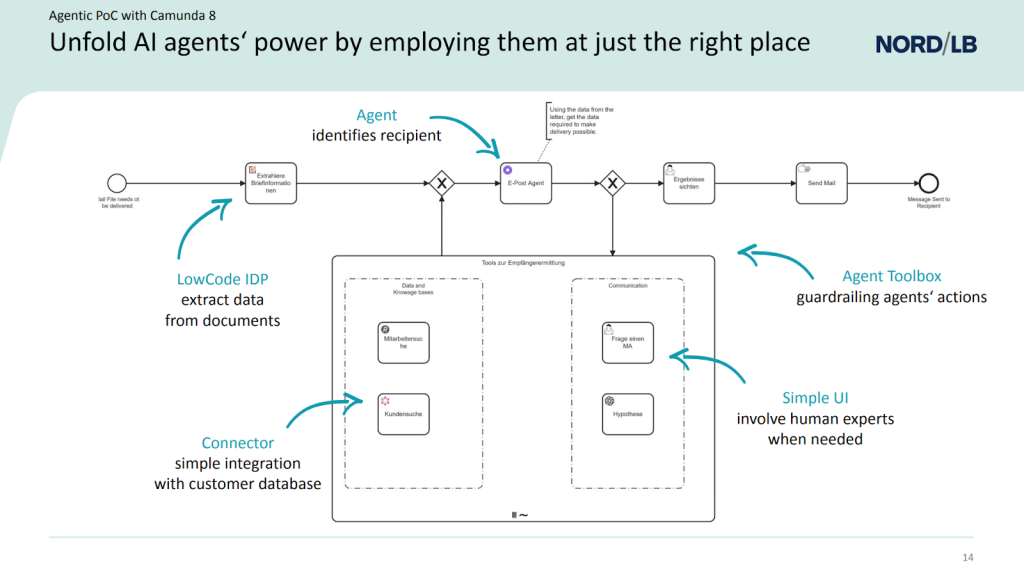
Using the following tools, NORD/LB worked up a textbook example of agentic orchestration:
- Low-code IDP for data extraction
- A dedicated AI agent to identify the correct recipient
- A connector layer to query the customer database
- A simple human-in-the-loop UI for exceptions
- Agent guardrails using an agent toolbox (see slide 14, below)
The AI agent performs dynamic reasoning to identify a possible recipient. Deterministic BPMN controls flow, guardrails, and policy. The process is fully stateful, ensuring auditability and safe recovery. Finally, humans intervene only when needed. Exactly the blend of deterministic and dynamic orchestration that Camunda emphasizes.
Camunda offers governance, observability, flexibility, scalability
NORD/LB’s use of Camunda shows an intentional shift toward trusted autonomy. This enables the bank to give AI more responsibility but within a framework of statefulness, auditability, and human alignment. In that way, they can stay true to their four foundational principles:
- Governance
- Observability
- Flexibility
- Scalability
By embracing agentic orchestration with Camunda, NORD/LB is operationalizing AI end to end across its business processes rather than simply slotting it into isolated uses. The benefits are already being seen:
- Increased process transparency end to end
- Reduced technical debt from legacy automation
- Higher resilience
- Safer AI adoption
- Streamlined operations
- Smarter decision-making
- Measurable business value
In a sector where compliance is critical and complexity is unavoidable, NORD/LB shows how to move AI agents from promise to production—safely, visibly, and at scale.
Start the discussion at forum.camunda.io