
Camunda Platform
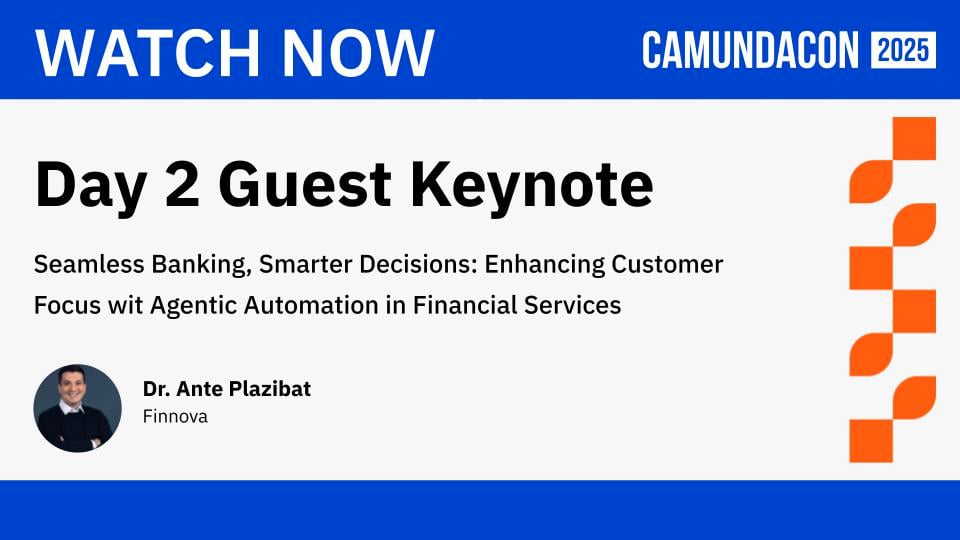
Finnova AG is a Swiss company that provides innovative, high-performance core banking solutions and platforms for the banking and financial services industry. In response to a rapidly evolving industry driven by increased digital expectations and regulatory demands, Finnova is developing ways to use AI and agentic orchestration to support a combination of deterministic and dynamic business processes to improve operational efficiency, compliance, and experiences for employees and customers.
Today’s customers expect more personalized experiences from their banks. At the same time, banks are being challenged by growing competition from fintechs and neobanks. Personalized customer experiences are one way banks can differentiate their brand. However, Finnova found that customer relationship managers have less time for customer interactions and customer care because they are spending valuable time searching for information (35%) or completing administrative tasks (35%). Only 20% of a relationship manager’s time was spent in direct contact with customers.
Finnova’s vision is to invert this dynamic. “The way conventional processes are built today, the bank process is more important than the customer need,” explains Dr. Ante Plazibat, Head Business Architecture & Innovation at Finnova. “We want to turn the relationship around to have customer needs become the center of focus, not banking processes.”
But achieving this vision means rethinking how banks orchestrate, execute, and adapt structured (deterministic) and unstructured (dynamic) processes. To improve the focus on customer intimacy, Finnova is testing ways to use AI and agentic orchestration to automate these processes in combination so that customer needs remain in the foreground of every customer engagement.

Finnova’s goal is to design AI-enabled services that are agnostic, meaning: any employee in any role in the bank can use them; customers can use them as self-service; and the services align with the EU Artificial Intelligence Act.
As a proof of concept, Finnova developed a multi-layered AI strategy to automate routine tasks, enrich customer experiences, and bring back-office capabilities to the front office. At the center of this architecture is Camunda’s process orchestration and automation platform, which serves as the orchestration engine for agentic AI services that combine large language models (LLMs), process automation, and human-in-the-loop oversight.
Finnova’s solution includes three, core AI-enabled services:
These services are planned to interact with a Camunda-orchestrated Agentic Assistant Service that automates end-to-end business processes such as onboarding and product setup. By design, the Agentic Assistant Service can reference the core AI services when finding and accessing information and invoke defined toolsets within ad-hoc BPMN processes to autonomously execute tasks based on the context of the customer interaction. For example, ID verification and background checks are two tasks that an agent might autonomously initiate as part of a larger business process. The Agentic Assistant Service operates with human-in-the-loop oversight and control, allowing the agent to work autonomously but defer to human input when needed, reinforcing both trust and compliance.
To support these complex process interactions, Finnova’s team is analyzing ways to redesign their enterprise process architecture. One way to achieve a greater level of efficiency is to extract the business logic from front-end applications and non-transactional mid-layer business services. The team found that decoupling business logic from applications and services provides better context for the processes executed in the orchestration layer, which sits in the middle of Finnova’s enterprise architecture. Decoupling this logic also provides more context for the architecture’s foundational core layer, enabling agents to work better.
Camunda was selected for its open, flexible architecture and ability to orchestrate complex, AI-powered workflows across distributed systems. Finnova was already using Camunda for deterministic BPMN processes. Building on what existed and extending Camunda’s capability to more dynamic agentic use cases made sense both technically and strategically.
Camunda enables Finnova to:
“The paradigm shift with agentic AI is that the agent can read customer needs better and understand them compared to a junior relationship manager,” says Ante. “The LLM executes the whole action using the toolset, and if it somehow does not know the next step or the right decision, it asks the human. That is the human-in-the-loop principle, and that is exactly what Camunda does.”
With Camunda orchestrating AI and agentic services, Finnova is eliminating routine tasks for customer relationship managers. As Ante describes,“It is so much faster. By taking this approach, the relationship manager can fully focus on the customer and their needs. That is the key benefit.”
Finnova’s proof of concept shows that orchestrating and automating agents to interface with deterministic and dynamic business processes can improve end-to-end process efficiency, deliver better customer experiences, and support higher compliance standards. Most importantly, relationship managers are spending more time advising customers and less time on routine tasks that are now handled by the agent.
Additional expected improvements from Finnova’s proof of concept include:
Finnova’s agentic orchestration proof of concept is proving successful. To take advantage of the full value of agentic AI, the team continues to update the enterprise architecture to create one single source of truth that enables different channels and actors—employees, agents, customer self-service—to use a bank’s business processes.
“We have shown that this approach works,” says Ante, “but we also have to do some homework to implement AI at scale and unleash its full potential…What we have to do is get all the business logic on the mid-layer so that the agent can then read our fully formalized process and automatically extract all the relevant information it needs for processes, guardrails, etc..”
Ante’s overall assessment based on their proof of concept is that “AI is here to stay. It’s important to look at the long-term architecture and vision. We are creating value now with semantic search that assists relationship managers. Next year, we hope to go live with our Agentic Assistant Service. The main point is: The greater the value, the more your architecture has to evolve.”