



The escalating tidal wave of documents
Organizations are drowning in a tidal wave of paperwork. Contracts, invoices, and onboarding forms are swells of unstructured data that now dominate your most critical processes. Each document is a potential goldmine, yet its value stays buried because unstructured content doesn’t cooperate with rules-based automation.
Traditional automation tools fall short when it comes to dealing with the data and insights in these unstructured documents. And you definitely don’t want to bog down your talented staff with the task of hand-keying this document information which is both expensive, error-prone, and demotivating to your talented knowledge workers.
That’s why Camunda provides integrated intelligent document processing (IDP) as a native capability within our agentic orchestration and automation platform to turn document chaos into orchestrated, data-driven action. Camunda’s native IDP classifies incoming documents, extracts the fields and the data you care about with machine-learning precision, and hands clean data to the next task in line. This happens all inside the same engine that’s already orchestrating your microservices, human tasks, and legacy systems.
By converting this wave of documents into structured, auditable data, Camunda gives you end-to-end orchestration with crystal-clear visibility and ironclad audit trails, so you can scale automation confidently without ever compromising transparency or developer freedom.
Document processing as a core process capability
Including documents as an integral part of your process orchestration enables you to power your workflows with new insights. Not to mention, that document integration is key to case management, compliance, and the customer experience.
What if you need to verify someone’s identity or review figures in supporting documents for a loan? With IDP from Camunda, obtaining and processing these important documents is a core process orchestration function. With Camunda, documents are first-class citizens in orchestration models. This enables process designers to model workflows that can make decisions based on document contents all while staying within a unified BPMN framework.
What is Camunda’s native IDP and how it works
Here’s how Camunda’s built-in IDP with document handling shows up when you pop the hood:
- Smart intake & traffic control – Capture any file, store it, and route it to the right lane the moment it lands.
- AI-grade field harvesting – Let ML models lift names, numbers, and other information so humans never have to squint at PDFs again.
- Plug-and-play intelligence – Snap in your favorite LLMs or bespoke ML models via connectors; keep the learning loop entirely your own.
- Zeebe-powered flow control – Event-driven invocations and long-running workflows give every document a clear, auditable life cycle.
These capabilities are the key to allowing documents to flow seamlessly through your business processes. For example, an insurance claim can be submitted along with supporting documentation including items like a police report and repair estimates. The contents of that supporting information can be ingested, and its contents extracted to allow dynamic routing, based on the entire process context which is orchestrated by Camunda.
The use cases are endless and span all industries applications including:
- Loan applications
- Claims processing
- Regulatory compliance
- Manufacturing service orders
- Engineering change orders
And Camunda remains open allowing you to select the best LLM for data extraction for each document type using natural language.
Agentic orchestration and document handling
No, this isn’t Optical Character Recognition or Zonal OCR, this is so much more. This is using natural language processing to find information in unstructured, or structured, documents and putting it to use immediately.
Camunda’s agentic orchestration model brings even greater flexibility into how you can take advantage of IDP in your business processes. Using BPMN ad-hoc sub-processes, agent behaviors dynamically select and execute document-related tasks at runtime—like reviewing supporting documentation to verify information or even trigger a compliance check.
Some key features found when combining agentic orchestration and document handling include:
- Ad-hoc sub-processes for dynamic document task composition
- Agent planning loops that can reevaluate available document actions after each task
- Multi-agent coordination (e.g., fraud detection, customer communication)
This enables processes to adapt in real-time based on document content, external context, and system feedback.
Why does this matter?
When you integrate IDP in your orchestrated processes, you can impact your organization in so many ways.
- Faster throughput – With intelligent document processing, you can automate document intake, extraction, and routing of critical information to the right people where the data is needed.
- Greater accuracy – When your documents are processed intelligently, human error in data entry and classification are reduced and information is more accurate.
- Enhanced compliance – With full traceability of document-driven decisions, you achieve better compliance over your processes and full auditability.
Real-world applications
Companies in every industry are using Camunda’s IDP to accelerate their transformation efforts. Let’s look at a few examples.
- Financial services: An excellent use of intelligent document processing is automating onboarding in financial services along with Know Your Customer (KYC) documentation. By using IDP to process incoming support financial documents, financial institutions can free up their skilled employees to do higher impact activities within the organization. Learn how financial services provider SüdLeasing is using IDP to process hundreds of documents a week today, saving time and improving the customer experience..
- Insurance: Orchestrating claims processes from document intake to settlement with IDP streamlines your claims processing. IDP can match information from police reports, repair estimates, and photographs to support your claims process. See how leading insurance agency Provinzial is minimizing processing time and maximizing developer efficiency with IDP right now.
- Public sector: The public sector has a multitude of procedures and processes required on an everyday basis. With IDP handling the processing of all types of applications (licensing, temporary assistance, business registrations, etc.), your compliance paperwork is processed at scale and with minimal human error while streamlining your operations.
These use cases highlight Camunda’s ability to adapt to regulated, document-intensive workflows while enabling agility and intelligence.
Getting started with Camunda IDP
Before you get started with Camunda IDP, here’s a little more background information on how it works and how you can use it with a simple example.
Loan onboarding example
As mentioned, with loan onboarding there are usually significant financial documents and other data required to confirm income and the ability to pay back a loan. This might be in the forms of bank statements, income tax verification, identification documents, and more. Using IDP, you can act on the information found in these documents to make decisions faster and with more accuracy.
For example, data in your documents can be used to verify identity and salary information by reviewing and comparing document data as shown in the below in an agentic orchestrated loan approval process. Here documents are processed to confirm all requested items are included.

If there are no missing documents, data extracted during the “Process Loan Documents” sub-process, shown below, is verified against previously inputted information before the process can continue.

As detailed below, each IDP connector extracts the pertinent data from the documents provided and assigns them to the correct process variable. As mentioned, this is not OCR, the LLM is searching the entire document for information that would match the prompt provided when configuring your IDP application in Camunda.

The IDP application and how it works
How does all this magic happen? It all starts with the IDP application.
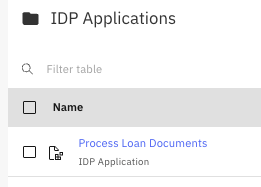
Once you have created the IDP application, you create document extractions for your various document types where you configure the fields and the extraction prompts by selecting some representative documents.


Once you have configured the field names and the extraction prompts, you need to select your extraction model to use for the extraction and test your extraction.

Once tested and validated, you publish your document extraction which creates the connector to be used in your process model.

It’s that simple. You now have access to document extractions that can be used collectively or independently to add IDP to your BPMN models. We encourage you to check on more details about how these extractions work by reviewing our documentation.
Use it in a process
Take a look at the sample loan onboarding process below.
Like this interactive embedded model? You can build one too: sign up for free today
Of course, we need to feed our document extraction connectors some documents, so in this example process, we have the applicant upload supporting documents for the loan on the initial form.

In our process, these documents are passed to the appropriate extraction and data is gathered using the prompts and stored in the proper process variables.
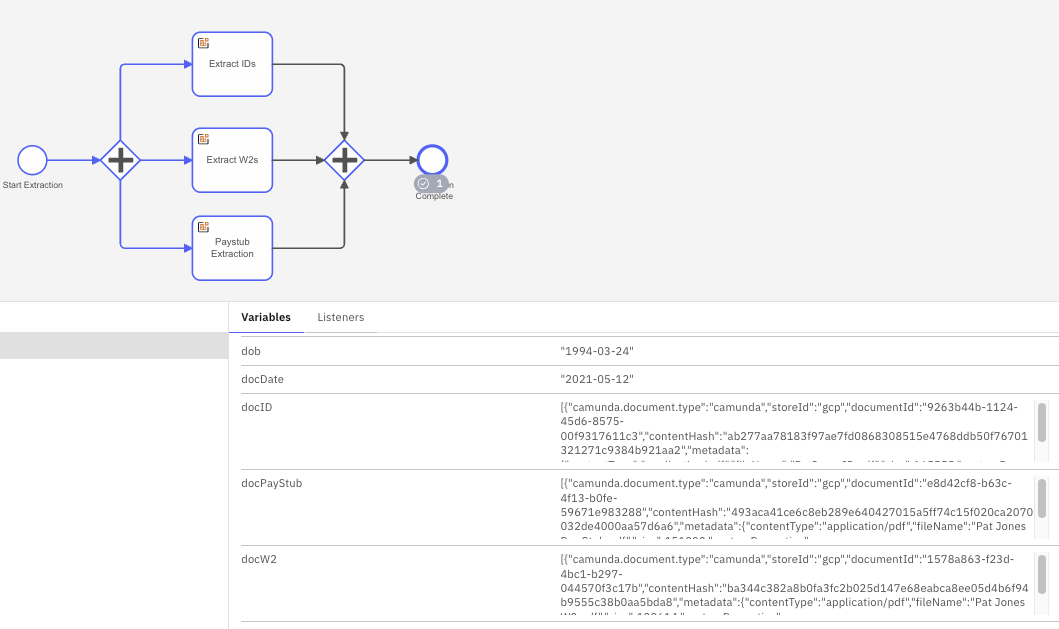
Below, you can see the Result variables (idDocResults, payStubDocResults, and w2DocResults) and each of the variables associated with the data extracted.

The table below summarizes this data showing how the variables are related and then stored in the appropriate process field.
| Parent Result variable | Process field | Value extracted |
idDocResults | idExpirationDate | JANUARY 2027 |
idName | Pat Jones | |
idNumber | ABC-12345 | |
payStubDocResults | totalGross | 1,251.09 |
w2DocResults | federalTax | 7,200 |
employeeName | Pat Jones | |
employerID | 11-778888 | |
totalWages | 85,000 |
Then these variables can be used within your process orchestration to streamline your process. But, don’t take my word for it—check out this video to see it in action.
Let’s face it … IDP is not just a feature—it’s a capability that should be woven into your process architecture.
A foundation for the future
In the era of AI-powered automation, intelligent document processing is foundational. With Camunda, organizations can orchestrate not only tasks and systems, but also the unstructured information that drives business. This elevates document handling from an operational hurdle to a strategic differentiator.
Camunda doesn’t just process documents—it turns them into orchestrated, goal-driven outcomes. That’s the future of automation. And it’s here now.
Try it today
Camunda IDP is available today with Camunda 8.7, so be sure to upgrade to the latest version to start using it now. If you’re new to Camunda, you can get started for free.
Start the discussion at forum.camunda.io