



Most agentic AI projects stall at pilot, not because the models aren’t capable, but because there is not yet an architecture available that provides the guardrails to deploy agents to business critical processes without risk.
Camunda 8.8 addresses this directly by introducing standards-based, enterprise-grade agents to design and run high-value processes by blending deterministic flows together with dynamic agents to achieve productivity gains that were once out of reach. With Camunda, core processes such as customer onboarding or fraud investigation now have the ability for agents to autonomously respond in real time with the guardrails needed to manage risk and ensure compliance.
“Camunda’s proven strength in orchestration made it possible for us to build an advanced medication order management system that delivers consistent, yet personalized and compassionate customer experiences–at scale. It’s that same orchestration strength–now coupled with agentic capabilities within the governance we require–that has us excited to unlock even greater efficiency and innovation as we develop transformative care delivery models.”
— George Kutnerian, Co-Founder, President & CEO of Wellpointe Inc
The key to trusted AI agents at enterprise scale
Camunda’s agentic orchestration lets you apply the best of both worlds in the same process, designing agents for multistep processes or discrete tasks. It empowers you to fine-tune how much autonomy to give an agent, enforce governance where necessary, and leverage AI where it adds the most value. With agentic orchestration, you can safely introduce agents into core business processes with confidence that they’ll act as designed.
As the global standard for visualizing processes, Business Process Model and Notation (BPMN) is the perfect way to design agent behavior for trust and autonomy. We’ve extended BPMN further to support even the most advanced deterministic and dynamic workflow patterns. We call this agentic BPMN. It enables you to build AI agents with BPMN; connect them to your preferred LLM (even your own); and deploy and execute them on Camunda.
The power lies in the open standard itself. You’ve always been able to design detailed, linear processes with it. Now that Camunda supports agentic BPMN and LLMs have matured to better support core business processes, you’re able to build agents with embedded guardrails.
Having both deterministic and dynamic flows run in a single engine enables you to handle the entire spectrum of business processes: the straightforward, pre-defined work that automation excels at—along with this new, agentic way of working that thrives on non-linear work based on context. Together you can dial autonomy up or down depending on your needs.
Core capabilities for scaling AI agents
Camunda 8.8 provides the foundation for orchestrating trusted agents at scale.
The new AI Agent connector allows agents to operate autonomously within your end-to-end process and integrate with a variety of LLM providers such as Azure OpenAI or AWS Bedrock. Organizations can choose the right model for each use case while optimizing for speed and cost.
The new connector enables you to build agents that focus on single-goal actions such as summarizing data, validating the actions of a dynamic process against procedures, normalizing unpredictable data for further processing, or double-checking the outputs of systems or people. It’s as easy as adding a BPMN task that directly connects the context of the process with your favorite LLM. The result: agents that can take initiative while staying aligned with business rules and oversight.

The connector also enables you to expand orchestration beyond individual tasks into dynamic process execution. You can build a complex agent that evaluates context, selects tools, and holds state between actions—all governable and auditable through agentic BPMN, down to the reasoning behind why tools were invoked, in what order, and with what outcome. Connecting an LLM to a Camunda agent ensures that their toolset can be fully customized, enabling visibility while supporting complex processes such as client verification, troubleshooting, and approvals—all while maintaining transparency.

Multi-agent orchestration
Camunda can also orchestrate agents you build in Camunda, as well as custom or external ones—even acting as a “parent agent” to coordinate multiple agents at once. Through multi-agent orchestration, Camunda enables agents to plan collaboratively, delegate work, and react in real time. A central agent can synchronize activity across specialist agents from any provider—such as Microsoft Copilot, Salesforce, or agents you develop in Camunda.
Unlike other agentic solutions that become opaque as complexity increases, Camunda holds process state and preserves continuity, enabling larger toolsets, greater scale, and full visibility as processes gain complexity. Enterprises can scale autonomy with confidence, knowing that every interaction is transparent, logged, and resilient—accelerating adoption without losing visibility or control.

Use case: Trade verification
Let’s ground these new features to a use case that we’ll return to throughout this post.
Trade verifications demand speed, accuracy, and compliance. Some agents offload manual work by validating transaction data, while others coordinate exception handling, watchlist analysis, and settlement sequencing. Multi-agent orchestration lets these focused agents operate within a bounded context, while an overarching parent agent performs complex contextual orchestration of child agents so every transaction is processed accurately, compliantly, and with full governance.
Enterprise-grade flexibility and visibility
Complex, end-to-end processes often require specialized agents working together. Camunda’s approach lets you orchestrate multi-agent interactions.
Multilayer approach for endless flexibility
Openness and composability are an important part of what our customers love about us. Our multilayer approach lets business and IT design the process, define tools and set guardrails for how agents behave. Meanwhile, developers can use whichever framework – such as Langchain or Crew.AI – to extend and further customize the agent. Because of our unique agentic BPMN approach, you’re able to add agents to your core processes while ensuring transparency and governance needed to create trust.
With support for multi-agent communication protocols through the Camunda MCP client integration, agents and processes can auto-discover and invoke enterprise systems with full context. This unlocks more advanced coordination patterns while maintaining the governance and transparency enterprises require.
With Camunda, every agent action is modeled, logged, and auditable. That means enterprises can increase autonomy without losing visibility or control.
Use case: Trade verification
Back to the trade verification use case: because of Camunda’s multilayer approach, business users can define compliance rules and risk thresholds, while developers can extend agent logic to integrate custom risk models or domain-specific checks. With MCP support, agents can auto-discover and invoke market data feeds or core banking systems to ensure every trade is validated against real-time information.
Enterprise-grade productivity without compromise
Speed without oversight is risky. Oversight without speed is a bottleneck. With Camunda 8.8’s productivity enhancements, enterprises no longer have to choose; they can move fast and stay in control.
To support agentic orchestration at scale, agents also need the ability to learn, recall and adapt over time. This memory turns agent interactions from isolated tasks into continuous, context-aware processes delivering true business value.
Memory management for complex processes
Enterprise processes often span days or weeks with complex context requirements.
Composable short-term memory supports feedback loops. Agents can store conversational context as external references to handle follow-up questions without losing context or impacting process performance.
Retrieval-augmented generation (RAG) in the AI Agent connector brings long-term knowledge. Agents can learn from past decisions, customer data, domain expertise, or organizational data to improve accuracy and performance. Every interaction stored improves the agent’s behavior and ability to serve customers and employees.
With Camunda 8.8, you can use the new Embeddings Vector Database connector to connect to multiple vector stores, including Amazon Managed OpenSearch and Elasticsearch, so you have the freedom of choice for long-term memory storage.

Leveraging these capabilities together, you’re able to move agents into end-to-end processes and multi-agent architectures — where multiple, specialized agents can collaborate to plan, reason, and act autonomously with trust.
Generate FEEL to transform data
AI and processes both thrive on data, but they are difficult to combine with AI outputs and business rules. FEEL helps overcome this challenge, but can be complex to write correctly.
Camunda 8.8 introduces FEEL (Friendly Enough Expression Language) capabilities in Copilot within Web Modeler. Users can describe decision logic in plain language, and Copilot generates valid FEEL expressions, fixes errors, and explains syntax.
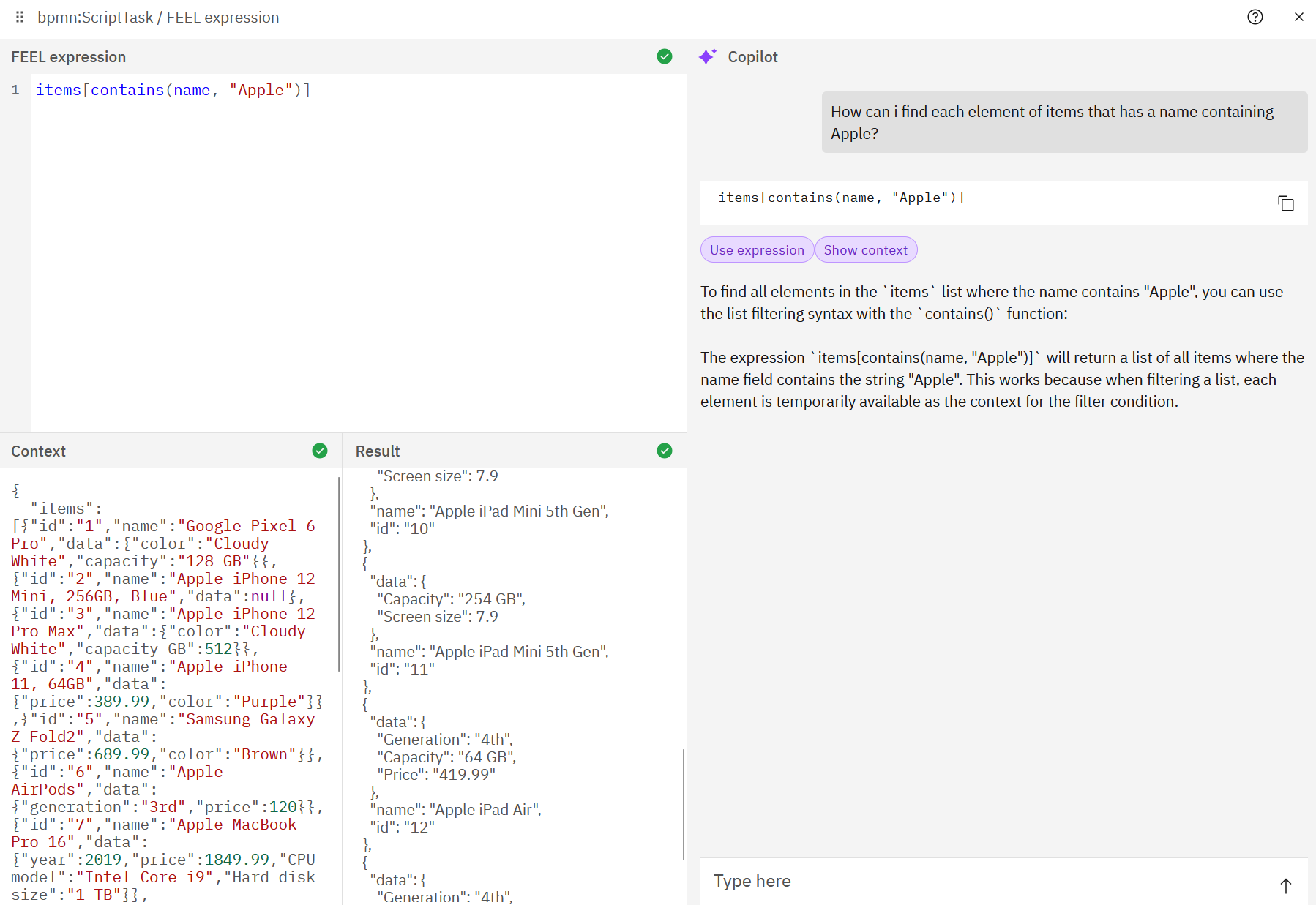
When modeling processes that include AI agent tasks, Copilot can generate and validate the FEEL expressions needed to interact with the agent’s inputs and outputs. This makes it easy to incorporate agent-generated insights into downstream business rules or decisions.
Together, FEEL Copilot and AI agents enable seamless, AI-driven process automation. Copilot simplifies the creation of auditable logic, while agents deliver dynamic, intelligent task execution. The result is faster design, testing, and scaling of agents; cutting expression-writing time to minutes, while ensuring clear governance and the guardrails needed to unify business intent with AI autonomy.
Use case: Trade verification
The addition of short-term memory helps an agent maintain context throughout the lifecycle of a single trade, critical for multi-day settlement windows. Long term memory (RAG) allows agents to learn from past transactions, recalling exceptions and applying prior outcomes to improve future verifications. FEEL Copilot further simplifies and accelerates the creation of auditable logic and compliance rules, ensuring oversight keeps pace.
Secure, scalable enterprise-grade architecture
Enterprise adoption of agentic orchestration requires a holistic platform that’s secure, scalable, and resilient by design. With Camunda 8.8, we’re delivering features for simplified deployment, improved security, and more to ensure organizations can orchestrate people, systems, and AI agents with confidence:
Simplified deployment to speed production
The new Orchestration Cluster consolidates Zeebe, Operate, Tasklist, and Identity into a single application, simplifying configuration, management, and monitoring. This streamlined deployment approach consolidates compute resources, enabling both horizontal and vertical scaling while maintaining high availability and disaster recovery across the Camunda platform. For Camunda 7 users, this new architecture also creates an easier migration path to Camunda 8, since it more closely aligns with C7’s architecture than earlier versions of Camunda 8.
The Camunda Exporter streamlines the data pipeline by replacing previously separate exporter/importer logic to improve performance, reduce storage consumption, and simplify installation. Additionally, Camunda 8.8 introduces a single, unified Orchestration Cluster API that replaces component APIs to simplify onboarding and accelerate the development process. It makes it easy to access resources with a consistent experience while ensuring all endpoints are secure with authentication and fine-grained resource authorization.
Together, these improvements make onboarding, deployment, and ongoing management much faster and more efficient, whether for new projects or migration from earlier Camunda versions.
Stay in control of authentication with less overhead
Security and governance are strengthened with a new Identity service that delivers enterprise-grade authentication and fine-grained authorization across both self-managed and SaaS environments.
By supporting seamless OIDC integration (and decoupling from Keycloak), following the principle of least privilege, role-based access control, and flexible mapping, organizations gain the flexibility to centrally or locally manage identity, scale and secure clusters independently, and enforce precise access policies with confidence. Together, these enhancements reduce operational overhead while ensuring advanced security and governance requirements are consistently met.
Cut process testing times in half
Camunda 8.8 makes testing and debugging faster, easier, and more reliable, so teams can deliver with confidence and adopt a more test-driven approach to process development for improved results. With low-code process testing in Web Modeler, developers and low-code users can quickly create and share lightweight, versioned scenarios that cut regression testing time in half, improve governance, and enable collaboration across business and IT teams.
For developers, the task testing feature provides in-context debugging and immediate feedback on individual tasks without running the full process, right where you model; reducing context switching and accelerating iteration. And, the new Camunda Process Test Library, our next-generation testing framework, offers powerful testing capabilities for developers and fully aligns with the latest Camunda 8 features, enabling comprehensive testing of BPMN processes, connectors, user tasks, and more.
Together, these capabilities help teams shift testing earlier in the lifecycle and embrace test-driven development practices; improving process reliability before scaling into production.
Use case: Trade verification
Camunda’s unified orchestration cluster and fine-grained identity controls enable millions of trades per day to be processed securely, while high availability and disaster recovery features help to ensure business continuity and auditability at all times.
And so much more
Beyond production-ready enterprise agentic orchestration and end-to-end process orchestration and automation enhancement features we’ve described above, we’ve also released so much more including deeper intelligent document processing capabilities, a new element and connector templates, an AI agent blueprint and step-by-step guide, a ServiceNow integration, a Camunda 7 to Camunda 8 data migrator and so many other exciting features.
Learn more from our team
Join our product management team on October 22 at 11 AM ET for a live webinar featuring demos and insights into how Camunda 8.8 helps you design trusted AI agents, orchestrate multi-agent processes, and scale with enterprise-ready security and performance.
Ready to start using agentic BPMN to build enterprise-grade agents? Explore our “Step-by-Step Guide to AI Task Agents in Camunda“ blog and the accompanying Camunda AI Agent Builder Tutorial. Or, jump start your efforts and follow this AI Agent Chat Quick Start Blueprint to build a working example in just minutes. You can get your teams started using Camunda 8.8’s agentic features today with a free trial.
Start the discussion at forum.camunda.io