



Welcome to the second blog in our series around designing AI agents in Camunda. In this blog we will be addressing how to use a single AI Agent Task connector alone for implementing agentic AI in your Camunda process.
Be sure to read our initial blog in the series which introduces the two connectors and three different patterns for designing AI agents in Camunda before reading this one.
Pattern 1: AI Agent Task connector alone
Description: This pattern is a single AI Agent Task connector task that calls an LLM once with no extra tool involved.
Strong use cases: You would use this pattern when a single response is all you need. It is great for a wide range of tasks, but works well for classification, summarization, or drafting a first-pass message or description. It is a strong option for the “LLM-as-a-function” use case.
Poor use cases: You wouldn’t want to use this pattern in a process that needs live data, policy checks, retrieval, or follow‑on actions; such as looking up a customer, asking a human expert, comparing policy rules, or creating a support ticket. For those requirements, you would want to use an agent with tools or an ad‑hoc sub‑process that can call connectors, DMN tables, and retrieval-augmented generation (RAG).
Strengths: The strength of this pattern is speed. It is straightforward to model and maintain, easily plugs into existing flows, and keeps the diagram lean. With this pattern, you get the fastest time-to-value with minimal coding, costs, and risk. There is also limited governance risk because the process isn’t calling other systems.
Weaknesses: The trade-off with this pattern is limited autonomy and less granular audit. There is no internal tool loop, so any governance beyond basic input and output must be modeled around the task.
AI Agent Task connector example usage
Summarize data for RAG query
In this example, a single AI Agent Task connector is used to generate a summary of actions taken in previous steps. The outcome is to create a search query for a subsequent step to search long term memory (RAG). In this case, the generated query is created with a limited number of characters.
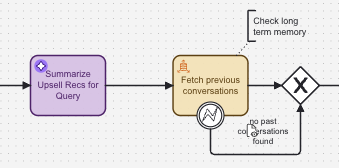
The system prompt is very clear for its request of the LLM as shown in red below.

The user prompt is a variable from a previous task, recsForUpsell which could be lengthy content. Here’s an example of the value for one process instance for this example.
## Recommended Additional Coverage Opportunities\n\nBased on the recent changes to your policy, here are some valuable coverage options to consider:\n\n### **Life Insurance for New Driver**\n- With the addition of Professor Higgins as a new driver, consider life insurance coverage to protect your family's financial security\n- Competitive rates available for drivers in their late 20s\n- Term life options starting as low as $20/month\n\n### **Homeowners Insurance**\n- Since you've updated your address to Key Largo, FL, now is the perfect time to review homeowners insurance options\n- Florida coastal properties require specialized coverage for hurricane and flood protection\n- Bundle discounts available when combining auto and home insurance\n- Additional savings of up to 15% when bundling multiple policies\n\n### **Umbrella Policy**\n- With multiple drivers and vehicles, an umbrella policy provides extra liability protection\n- Protects assets beyond standard auto coverage limits\n- Affordable coverage starting around $200/year for $1M in additional protection\n\n### **Gap Insurance**\n- For your new Tesla, consider gap insurance to cover the difference between actual cash value and loan balance\n- Particularly valuable for newer, high-value electric vehicles\n\nContact us today to discuss these options and maximize your savings!This is then summarized by the AI agent task into something very simple under 199 characters as indicated by the system prompt.
Coverage new driver: life insurance. Home: specialized hurricane/flood protection. Umbrella policy for extra liability. Gap insurance for new car. Bundle policies for savings up to 15%.This short summary is used to make the call to see if any previous conversations were held with this customer in the past.
Summary and variable population for human task
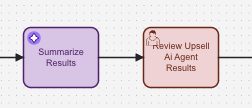
In the following excerpt from a BPMN model, we have used a single AI Agent Task connector to summarize results from something then using that summary in a human task for review.
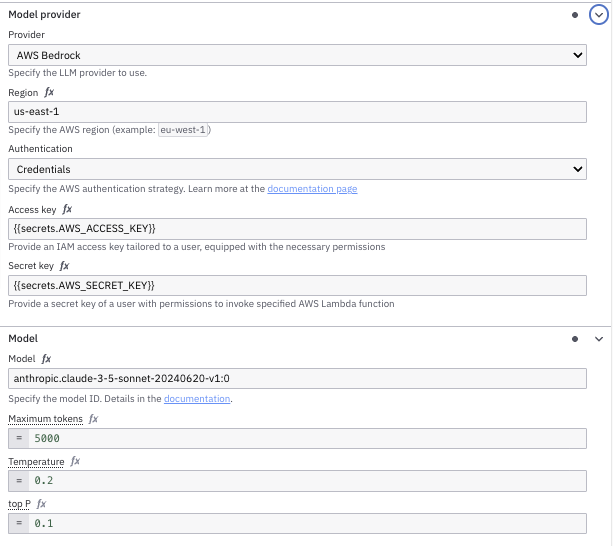
You need to determine which model provider and model is best for your requirements and configure that at the connector level. When using AWS Bedrock as a model provider, you can also set additional parameters that are provided, including selecting the LLM, which is Claude in this case.
Then you need to provide the system prompt. This task has a simple system prompt that just explains to the LLM that they are to summarize the results that were taken from a previous agent that are stored in the process variablestring(agent.content.conversation.messages).

The result is stored in an array llmsummary as indicated below.

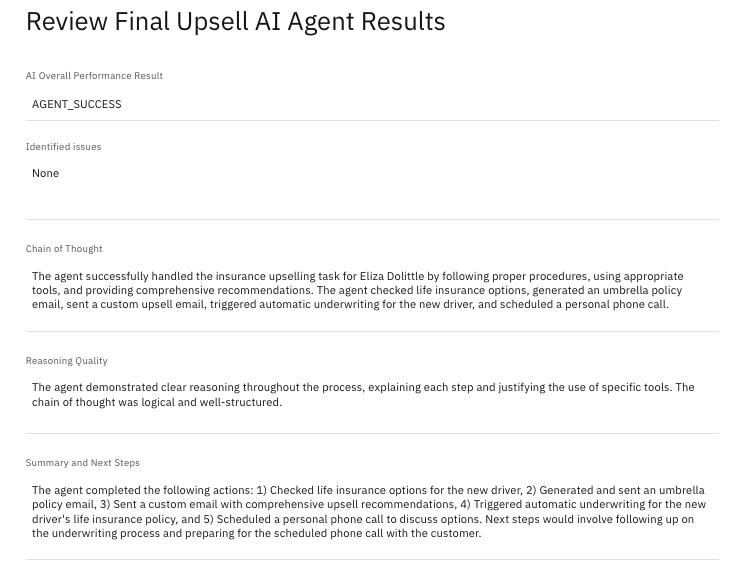
The result is displayed in a form for a user task similar to that shown below.
Understanding when to use the single AI Agent Task connector
The examples show how a single AI Agent Task can be used to generate summaries with a simple element dropped into the proper sequence in your BPMN process. This pattern is a great option when you need to summarize or generalize something quickly.
Next up
Be sure to take a look at our next blog in the series, which takes on the next pattern, the AI Agent Task connector with an ad-hoc sub-process loop.
Start the discussion at forum.camunda.io