


The mission of any enterprise that incorporates AI into its processes is to free up human time and expertise to focus on the work that really matters. For VodafoneThree, that work is servicing their customers. That’s why VodafoneThree orchestrates guided case management journeys with Camunda and embedded GenAI to handle repetitive tasks.
The platform now empowers agents to focus on delivering superior customer experiences while reducing handling time and speeding up system updates.
“When information flows seamlessly and intelligently,” says Buddhika Hanwella, VodafoneThree’s iBPM engineering manager, “work gets done.” During his talk at CamundaCon 2025 in New York, Hanwella discussed how his team used Camunda and generative AI to streamline VodafoneThree’s case management system that handles over 27 million customers in the UK.
Did you miss CamundaCon New York? You can catch all the recordings here.
Caring for both customers and employees
Earlier in 2025, VodafoneThree launched the Just Ask Once Promise: Vodafone customers just have to log into an app on their mobile phone to log a query, and a dedicated agent will take care of it. “The customer can carry on with their day,” Hanwella says, “no chasing for updates.” To support this, VodafoneThree has opened two brand-new customer care centers in Sheffield and Belfast, in addition to existing care centers in Stoke and Glasgow.
Hanwella’s team was asked to build a brand-new customer case management system to support this new endeavor and the new centers. “Before we started,” Hanwella says, “we wanted to put the care agent experience front and center of this platform.”
Vodafone’s care agents come from all walks of life, he said, and not everyone has a lot of hands-on experience. So the system has to provide a good experience for the agents themselves.
“Now, we have many self-serve channels and automated journeys in VodafoneThree, which we’re immensely proud of,” Hanwella says. But in some case journeys, only the human touch will do, as in the case of bereavement, financial vulnerability, or someone who just wants someone to listen and help. For those moments, technology’s role is to enable empathy at scale, ensuring that the agent has the context, data, and support they need to help the customer quickly and compassionately.
Redefining flow in case management
As with any large transformation project, there were of course business outcomes Hanwella’s team needed to achieve:
- To reduce the average handling time
- To reduce the total cost of ownership
- To be agile enough to make changes seamlessly and with minimal disruption
“But how do we stay true to our mission while still achieving these outcomes?” Hanwella asked.
They decided to focus on flow: having clarity in motion. When the process, the people, and the goals align, users are empowered to make better decisions and create better customer interactions.
“When information flows intelligently and seamlessly, work gets done.” –Buddhika Hanwella, iBPM engineering manager at VodafoneThree
Hanwella wanted to ensure that workflows were intelligent, orchestrated, and above all human. After putting together some guidelines, Hanwella’s team split VodafoneThree’s case journeys into three distinct stages:
- Case creation
- Validation management
- Closure
Each stage should have the same look and feel; after all, familiarity drives efficiency.
Additionally, VodafoneThree wanted to use generative AI to populate as much of the data as possible so agents could focus on managing cases and closure rather than filling out fields in a UI. It was important to use elements that enabled users to visualize progress and direction.
When cases are created, they’re enriched with as much data as possible upfront, so agents can spend more time focusing on the management and resolution of each case.
To achieve this fluidity, VodafoneThree built their new platform using event-driven microservices architecture. This enables non-blocking parallel processing, allowing agents to carry on working while tasks finish seamlessly in the background.
Ensuring observability
Observability into workflow is important for any large-scale orchestration, so VodafoneThree wanted to ensure that was built into the core of their new case management system. With more visibility, agents can spot problems early on before they become a disruption.
Another introduction was cache searching, to bring relevant data closer to agents and take the load off company databases and save on compute. Finally, the plan is to perform a progressive migration where cases are phased out on the existing platform and new cases begin on the new platform, helping to minimize disruption.
Taking a smart risk with Camunda
To accomplish all of these goals in a nondisruptive manner, VodafoneThree needed a strong orchestration and automation engine. “That’s why we chose Camunda,” Hanwella said. “Now this is a big deal for us. This is the first time we’re using Camunda, so it was a risky decision, but we believe it’s the right one.”
“How do we go and put all this together? First, we needed a strong workflow engine, and that’s why we chose Camunda.” – Buddhika Hanwella
With any large enterprise software, the investment can be significant, but what VodafoneThree wanted to focus on was, does it enable growth? Can the software scale on their platform? What is the cost per transaction over time?
One of the benefits of being in a large enterprise, Hanwella suggested, is having many talented engineering teams and assets to leverage. Why reinvent the wheel? With Camunda’s open standards, it easily integrated with VodafoneThree’s architecture, enabling them to focus on what they’re best at: case orchestration.
“As I mentioned, observability is so important for us,” Hanwella said, “and that’s why Camunda’s Optimize was something that caught our eye.” It allowed his team to spot bottlenecks in processes and take action before those bottlenecks became real issues.
Building for change
Under the hood of its new case management platform, VodafoneThree uses a layered multi-tenant architecture, engineered to be ready for generative AI.
“GenAI is evolving at such a rapid pace,” Hanwella said. “It was important for us that we engineered for change and got the foundations right.”
At the core of the layered architecture is the business logic layer. Here, Camunda drives case flows, escalations, and SLAs.
On top of that is the application logic layer, consisting of microservices that power all core application logic. This enables independent scaling of individual services.
Next is the presentation layer that delivers the UI. “We use the same web assets as our customer website,” Hanwella explained. They’ve also introduced a data access layer, where a NoSQL database allows for flexibility with case data structure; and a service mesh, to ensure better observability and communication security between services. Containerized deployment ensures consistency and portability between environments.

“Now this is a very simplified view of our core architecture,” Hanwella pointed out. “We use an in-house cloud platform, and most of the components you see here are given to us as templates through Terraform. All we have to do is plug in the parameters and deploy those components.”
Overall, the case management platform is completely driven by pipelines, zero touch, and infrastructure as code.
The dotted line depicts where they spent the most engineering time. Camunda, the microservices, and the frontend application all sit within a cluster. Around all this is a security plane that implements a zero-trust policy.
Designing for usability
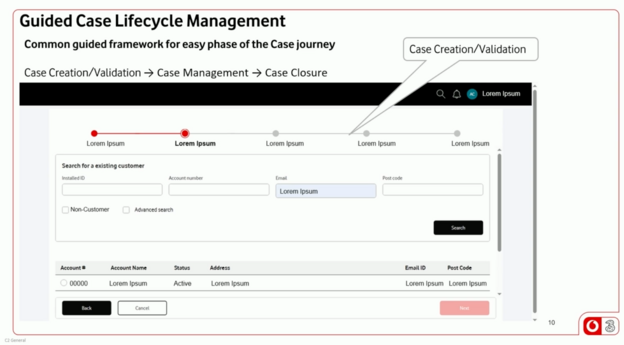
The Case Creation/Validation interface of the platform is where agents spend most of their time managing cases through to closure. The centralized workspace is maximized, with information around it kept minimal, only surfacing information as needed. It is completely driven by Camunda, giving things like proactive alerts. The UI is kept quite simple, reducing cognitive load for agents. The framework is built with accessibility in mind, so everything is clear and reusable, though new components can be created if needed.
“We’re also working on a guided task framework,” Hanwella said, “to guide our agents on the current task and what’s coming next.” The goal is simple: keep agents focused on making progress rather than navigating screens.
Engineering for trust
Hanwella moved on to discuss how VodafoneThree is putting genAI to work within the new case management system. “If you don’t prioritize trust and your users are second-guessing the output of genAI, you erode the very benefits you’re trying to get out of it in the first place.” In light of that, he suggested, prioritize trust over everything else.
VodafoneThree uses Camunda to set guardrails as to where genAI can operate and where it can’t. Camunda also implements fallbacks so that if genAI doesn’t respond in a timely manner, agents can carry on working manually if necessary.
It’s easy to forget, Hanwella pointed out, that genAI is resource intensive and can be quite costly. “So we only call it when needed through Camunda.” Camunda’s agentic orchestration allows you to blend deterministic and dynamic processes in one model, making it easy to run more cost-effective deterministic processes whenever possible directly alongside any dynamic processes.
Also, transparency and bias mitigation are important. “If you can’t explain the output of generative AI,” Hanwella said, “you seriously need to consider constraining its use or removing it altogether.”
At VodafoneThree, human agents are ultimately in control. They can either override or accept genAI output. The AI agent can also check its own responses, having been provided with a baseline human response to compare its output against. There are also heuristic checks built into VodafoneThree’s API cores so that the API can sense-check its output, like looking for timestamps and case summaries.
Finally, the question was, “Are we really ready to implement generative AI into a highly regulated part of the business?”
VodafoneThree took a cautious approach, enabling genAI to complete as much of the laborious manual labor for agents as possible, like case summarization, categorization, and triage. GenAI is particularly good at being able to bring structure to unstructured data, for example taking data from an email and populating fields.
As far as the future goes, Hanwella admits that it’s evolving so rapidly, it’s tough to know what will need to evolve next—one of the reasons it was so important to engineer for change and why VodafoneThree reached for Camunda’s orchestration expertise.
Start the discussion at forum.camunda.io