


If you work in a highly regulated industry, like financial services, healthcare, or insurance, you’re constantly balancing two competing priorities:
- Modernizing and automating complex, end-to-end processes
- Protecting sensitive data and complying with strict regulations
Every time a process touches personally identifiable information (PII) or protected health information (PHI), the number of systems, teams, and vendors that can see that data grows. Risk grows with it.
The Skyflow Connector is designed to help break that trade-off. It lets you orchestrate business processes with Camunda while keeping sensitive data protected by tokenization and de‑identification through Skyflow’s data privacy platform.
The problem: Too much sensitive data in cleartext
In a typical regulated organization, critical processes (for example, customer onboarding and KYC, claims handling, prior authorization, credit decisioning and collections) span dozens of systems and teams. Over time, sensitive data has been copied and integrated into core systems of record, CRM and case management tools, analytics and data lakes, and more. This leads to familiar pain points like:
- Rising compliance scope because more systems fall under GDPR, PCI DSS, HIPAA or local regulations
- Slower change because every new integration or cloud service triggers security reviews and data protection work
- Higher breach impact since incidents are harder to contain because sensitive data has been spread widely
The question now becomes, how can we orchestrate processes end-to-end, without pushing cleartext sensitive data everywhere?
The solution: Orchestrate the process, not the cleartext
Camunda is used to orchestrate complex, long-running processes across people, systems, AI agents, and automation tools. Skyflow is built to protect and govern sensitive data using tokenization and de‑identification.
The Skyflow Connector enables Camunda to manage the end-to-end process across different tasks (including handoffs) and SLAs, while also guaranteeing auditability. Skyflow handles data privacy, identifying sensitive fields and replacing them with tokens, then safely reidentifying them when necessary.
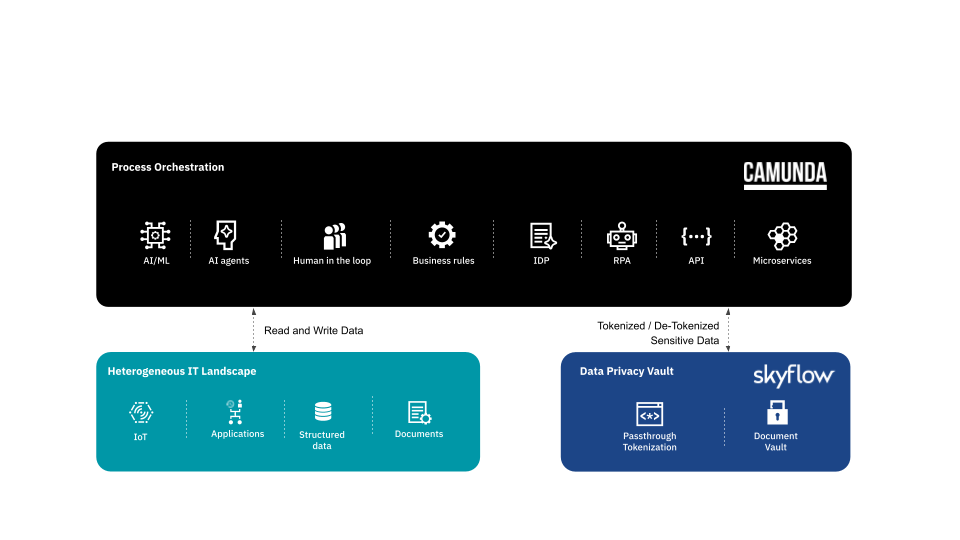
In practice, that means your process can:
- De‑identify sensitive data (tokenization) as soon as it enters the workflow. The process sends selected fields (for example, name, SSN, account number) to Skyflow. Skyflows sensitive data and replaces it with tokens.
- The Camunda process continues with tokenized data instead of raw PII/PHI, through downstream systems and integrations.
- Reidentify (revealing where permitted) only at carefully controlled moments where real values are truly needed (for example, generating regulated documents or writing back to a system of record). At specific steps, the process can request the original values back from Skyflow. This is used sparingly—for example, to populate a final notice, fulfill a regulatory request, or update a compliant system of record.
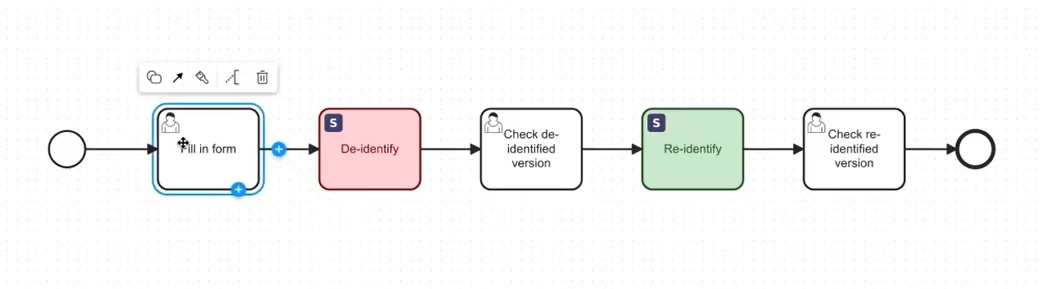
Inside Camunda, this is a reusable Camunda 8 outbound connector with an element template for Camunda Modeler. The connector can be dropped onto a BPMN‑modeled process and configured on a service task, just like other connectors for REST, messaging, or AI services. This ensures that modelers can reuse the connector across many use cases without rebuilding it from scratch each time.
For technical teams, the full implementation details and configuration options are available in the Camunda Marketplace Listing.
Benefits for regulated organizations
Let’s take a look at a few specific benefits your organization can realize from the Skyflow Connector.
Shrink your sensitive data footprint
By deidentifying data early in the process, you reduce the number of systems that ever see cleartext PII/PHI. Many downstream services can operate entirely on tokens:
- CRM and case tools can track customers and cases using tokens.
- Analytics platforms can analyze volumes and flows without holding raw identifiers.
- Third-party vendors can work with minimized data that’s safe to share.
This directly reduces compliance scope and simplifies security reviews for new integrations and cloud services.
Improve compliance and audit readiness
Instead of scattering bespoke masking and redaction code across different applications, data protection becomes:
- Centralized in Skyflow’s platform.
- Visible in your BPMN models: you can literally see where data is deidentified or reidentified.
- Consistent across processes, products, and geographies.
When regulators, auditors, or internal risk teams ask, “Where is this data exposed?” you can point to Skyflow policies and logs and Camunda’s end-to-end process models and history.
Accelerate modernization and cloud adoption
Sensitive data often blocks teams from moving workloads to the cloud, introducing new SaaS applications, and experimenting with AI or new automation tools.
With Camunda orchestrating the process and Skyflow protecting the data, you can:
- Keep the most sensitive details in a controlled vault.
- Orchestrate modern cloud services using tokens.
- Adopt new technologies without dramatically expanding your cleartext data footprint.
Enable safer AI and analytics use cases
As organizations roll out AI and advanced analytics, sensitive information like PII should be protected when part of AI workflows. With tokenization in place, many analyses can run on tokens and nonsensitive attributes. Only a minority of carefully controlled use cases require reidentification. This makes it easier to say yes to innovation, while still honoring privacy and regulatory requirements.
Concrete use cases with Camunda and Skyflow
Below are some practical scenarios where Camunda customers could use the Camunda Skyflow Connector to unlock value quickly.
KYC and customer onboarding (financial services)
Banks/fintechs use Camunda to orchestrate onboarding steps such as data collection, ID checks, sanctions screening, system writes, and communications. KYC requires handling sensitive PII (IDs, SSNs, addresses), which often spreads across systems, increasing regulatory exposure.
The connector helps with:
- Early tokenization of sensitive fields via Skyflow
- Reidentifying data when necessary when necessary with only a few regulated steps
- Field level control over who sees what and when. As long as the user requesting the information has permission to see it in the context that they are requesting, they will be able to do so.
Business impact includes:
- Reduced PII footprint
- Faster compliance reviews
- Stronger regulatory posture
Healthcare claims and prior authorization
Insurers/providers use Camunda to coordinate intake, EMRs, claims engines, and utilization reviews. PHI is regulated (HIPAA), and cloud workflows increase scrutiny over PHI movement.
The connector helps with:
- Tokenizing PHI after intake
- Running most workflow logic and integrations on tokenized data
- Ensuring that only legally required systems receive reidentified PHI.
Business impact includes:
- Easier cloud adoption
- Clear PHI boundaries
- Improved auditability
Insurance claims and first notice of loss (FNOL)
Camunda orchestrates FNOL, adjuster coordination, partner interactions, and settlement steps. Sensitive policyholder data flows through many partners and legacy systems.
The connector helps with:
- Early deidentification of policyholder and payment data
- Ensuring that partners and non-core systems work with tokens
- Ensuring that reidentification happens only for required outputs (settlements, regulatory reports)
Business impact includes:
- Lower data exposure
- Safer third‑party collaboration
- Better regulatory alignment
SaaS platforms serving regulated enterprises
A SaaS platform uses Camunda for multi‑tenant orchestration, including regulated customers. Handling customers’ sensitive data slows enterprise sales and increases compliance obligations.
The connector helps with:
- Applying early deidentification in regulated tenants’ workflows
- Governing sensitive data in Skyflow thanks to SaaS platform working primarily with tokens
- Customers using their own Skyflow vaults
Business impact includes:
- Stronger enterprise security story
- Smoother onboarding
- Differentiated privacy‑first services
How to get started
If you see similar challenges in your organization, here’s a simple path forward:
- Identify a single high-value, high-sensitivity process. For example:
- Customer onboarding
- A specific claims journey
- A high-risk internal workflow
- Map where sensitive data flows today.
- Which systems see cleartext?
- Which ones could work with tokens instead?
- Introduce Camunda + Skyflow at key points.
- Use Camunda to orchestrate the end-to-end flow.
- Add the Skyflow Connector where data enters the process to deidentify and at a small number of well-justified points to reidentify.
- Leverage existing documentation and examples like:
By combining Camunda’s end-to-end orchestration with Skyflow’s data privacy capabilities, regulated organizations can automate more of their most sensitive workflows—without compromising on governance or control. You get the agility to modernize and adopt new technologies, while giving risk and compliance teams a clear, defensible architecture they can trust.