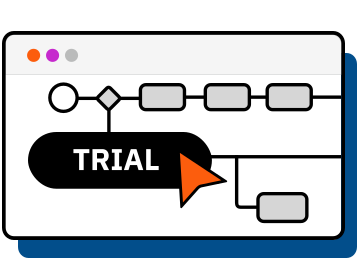



Nearly every carrier today is running agentic AI pilots. Typically, these pilots are contained within an existing platform suite that can offer a small productivity boosts. The promise of agentic AI lies in completely reimagining the operating model to deliver transformative value.
Easier said than done. The problem is not the technology or the data science team. The problem is lacking a layer that weaves AI agents into your claims handlers, underwriters, and core systems, where they can add meaningful improvements. Without that layer, agents remain isolated or fragmented, trusted only for small personal productivity improvements instead of driving measurable outcomes in regulated operations.
This layer, agentic orchestration, blends deterministic process control with dynamic AI agent behavior. In this way, agents operate safely inside the processes that are high stakes and also high value. For example, AIRisk Enterprise Agentic Blueprint states that carriers using orchestration-first approaches report 60-80% faster claims processing and 20-35% reductions in claims leakage
Agentic orchestration is so critical to AI agent implementation that Gartner predicts 60% of organizations will adopt independent AI agent orchestration platforms separate from their core application suites by 2030.
What we mean by agentic orchestration
Agentic orchestration is a method to coordinate humans, systems, and AI agents across end-to-end insurance processes. You can dial up or down the level of autonomy by modeling the process and establishing tools and proper guardrails for how an agent behaves to achieve a goal.
The secret to smooth orchestration is having the dynamic, agentic-driven actions blended together with deterministic processes in a single model. That way, you can add them into core processes with a level of trust required for regulated operations.
Agentic operating models for insurance
Camunda’s framing is straightforward: Build agents for trusted autonomy. The platform emphasis is:
- Orchestration
- Visibility
- Control
- Auditability
These key areas of focus enable you to move beyond pilots or localized gains and rewire your operating model for an agentic future.
Agentic claims triage and investigations
Triage and investigations are messy. There’s a variety of evidence to assess, and interpretation can shift depending on the caseworker. To solve this, agentic orchestration lets you build a single, transparent end-to-end model in which deterministic steps coexist with an LLM-powered agent to assess, plan, and achieve a goal within a guardrailed process.
This is helpful when you have high volume, variable complexity, and leakage risk that becomes more challenging where unstructured documents and narratives (e.g., first-notice-of-loss (FNOL) descriptions, police reports, adjuster notes repair estimates) drive the necessary steps.
Agents read such documentation to identify third-party responsibility signals. They can:
- Flag potential subrogation or fraud opportunities that adjusters miss because they are managing other complex cases.
- Propose next-best actions such as requesting documentation from the claimant or routing to a human specialist if a risk threshold is breached.
- Summarize medical narratives and calculate exposure ranges based on similar historical outcomes.
Measuring the success of your AI agent doesn’t require reinventing the wheel. You should still measure common KPIs like:
- Percentage of eligible claims flagged for subrogation
- Recovery cycle time
- Claims leakage reduction
- How compliant each claim is
Agentic underwriting with full audit trail
Life, health, and disability underwriting slows down where evidence arrives in pieces and interpretation varies by underwriter. That friction inflates cycle time and hides risk in unstructured narratives.
Add a siloed AI agent for a single task, and you make a small gain. With agentic orchestration, you run one underwriting flow. Deterministic parts of the process—ordering rules, vendor integrations, SLAs, and escalations—have an AI agent embedded to support the casework.
According to Celent, this capability reduces underwriter turnaround times from days to minutes while improving consistency and auditability.
In practice, agents ingest APS/EHR extracts, labs, and prescription histories, then extract structured risk factors from narratives. They standardize how impairments, medications, and timelines appear in the case file. They also detect gaps early. If the evidence set is incomplete or conflicting, the agent recommends additional requirements before the underwriter touches the case, reducing avoidable back-and-forth loops.
Decision authority stays explicit. Underwriters set risk class and pricing outcomes. Medical directors handle complex impairment combinations. Compliance and model risk management govern data access, permissible recommendations, logging, and exception routes. You should define hard stops—case types the agent can never auto-route or prefill—by product, jurisdiction, or sensitivity.
Measure success of your agentic orchestration with familiar metrics:
- Track straight-through processing rate for low-complexity segments, application-to-decision cycle time, and underwriter capacity per FTE.
- Add a requirement for accuracy to ensure you ordered the right evidence upfront.
- Use appeal and contestability rates as proxies for the quality of the agent’s handling of this complex knowledge work.
If quality degrades, assess where the impact lies and work backward to appropriately correct the course of agentic actions and outputs.
Agentic policy servicing and endorsement workflows
Servicing rarely fails because the work is complex. It fails because the work spans systems, authority limits, and handoffs. Endorsements, beneficiary changes, reinstatements, and billing inquiries often trigger rework when intent is unclear or calculations and disclosures are inconsistent. You need a model that improves speed without sacrificing correctness.
Agentic orchestration lets you run servicing consistently from end to end. You have deterministic steps to enforce:
- Coverage rules
- Authority thresholds
- Premium calculations
- Disclosures
Agents handle unstructured intake, case assembly, and can even make changes to policy if within guardrails. They can reconcile policy data across core systems, interpret free-text requests, classify transaction type, and route work through the right path. They can also precheck eligibility and rules before a representative invests time in work that will be rejected later. For financial-impact endorsements, agents can prepare inputs for pro rata calculations and flag edge conditions that often lead to billing corrections. They can draft and communicate directly with customers while requiring human review for higher-risk transactions.
Humans remain accountable where customer impact and regulatory risk concentrate. Agentic service reps approve routine transactions within authority and confirm intent when required. Human underwriting approves changes that alter risk profile or require rerating beyond clear thresholds. Because your agent lives inside your core process, you’re able to track every single decision or action that an agent—or its human coworker—makes from start to finish.
In conclusion
Remember: even with agentic operations, you still measure outcomes with operational KPIs you already rely on:
- Track first contact resolution and the share of transactions completed without handbacks.
- Watch handle time by transaction type, but validate improvements against error and rework rates.
- Add SLA adherence and backlog age to expose constraints.
- Connect cost per transaction to fewer handoffs and fewer corrections—and interpret customer satisfaction alongside quality and compliance signals.
Stay tuned for part two in our series about finding solutions with agentic orchestration for insurance industry goals in 2026.