
Build production-ready AI agents that orchestrate complex business processes
Move beyond AI experimentation with enterprise agentic automation: trusted AI agents that deliver value faster without adding technical debt.

Don’t stop at prototypes
Taking AI agent prototypes into production requires robust capabilities for memory, reliability, and control. Camunda combines AI autonomy with powerful business process orchestration and automation so you can build and deploy agents that are stateful, observable, and ready for the real world.
Build agents that deliver real results
Camunda agents bring AI-driven decision-making into production with the reliability of enterprise process orchestration. They can plan, act, and reflect autonomously while staying fully observable, governed, and integrated with your existing systems. With Camunda, you can design agents that reason over complex data, collaborate with other agents, and include humans in critical steps, all within a single, executable business process model. The result is intelligent automation that scales confidently from prototype to production.
Design durable agents for real use cases
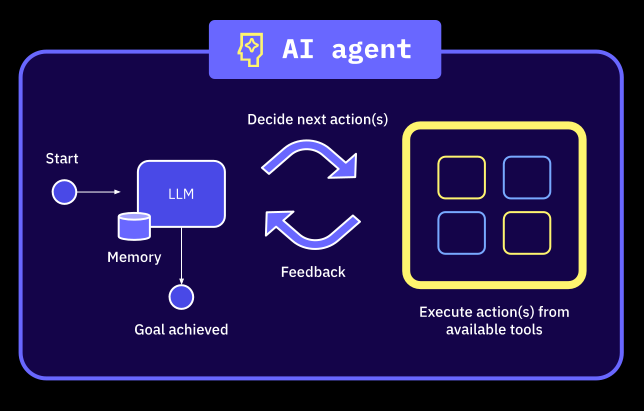
Agents in Camunda can persist state across hours, days, or weeks. Short-term memory ensures agents maintain context across multiple planning loops, while long-term memory persists results, goals, and observations as process data for reuse and reflection. Agents can be paused, resumed, or migrated without losing state.
Camunda integrates easily with retrieval-augmented generation (RAG), data, and API layers. Use pre-built connectors (or build your own) to access corporate data stores, vector databases, and external reasoning tools. Each tool invocation becomes part of the process trace, allowing you to analyze, optimize, and control token usage, cost, and latency over time.

Model cognitive loops for powerful agents
Model cognitive loops such as planning, action, and reflection and call LLMs such as OpenAI, Google Gemini, and Anthropic Claude through pre-built connectors or custom APIs. Design processes where an agent plans next steps, performs actions, and evaluates outcomes in a continuous reasoning cycle. Deterministic guardrails, such as business rules and decision tables, ensure every loop operates safely within defined parameters.
Camunda enables you to visualize, audit, and adjust each step of an agent’s cognition to improve accuracy, reliability, and speed, making it easy to refine agent performance over time, add new data sources or tools, and integrate human validation where needed. Each loop remains transparent and traceable.

Enable multi-agent communication
Agents can respond to real-world events or collaborate with other agents through message correlation and event triggers. Model complex multi-agent patterns where agents pursue shared goals while maintaining isolation, state, and auditability. Pre-built connectors for Model Context Protocol (MCP) and Agent-to-Agent (A2A) communication enable structured coordination between agents, systems, and data sources.
Camunda treats every interaction as part of an orchestrated process. You can define how and when agents communicate, exchange context, and hand off work. Each message and decision is recorded in the process history, creating an auditable chain of responsibility. This approach enables you to scale from one agent to hundreds without losing control or visibility: perfect for building resilient multi-agent systems that adapt dynamically to enterprise-scale workloads.

Keep humans in the loop
Camunda’s native human task modeling allows you to design approval gates, escalation paths, and manual overrides that ensure AI agents operate within enterprise guardrails and compliance boundaries, even while reasoning autonomously. Pre-built connectors for Slack, Microsoft Teams, and email make it easy to hook into corporate communication tools.
In production, this human-in-the-loop capability is critical for trust and compliance. Configure clear boundaries between autonomous actions and human oversight, ensuring the right level of review for sensitive or high-stakes decisions.
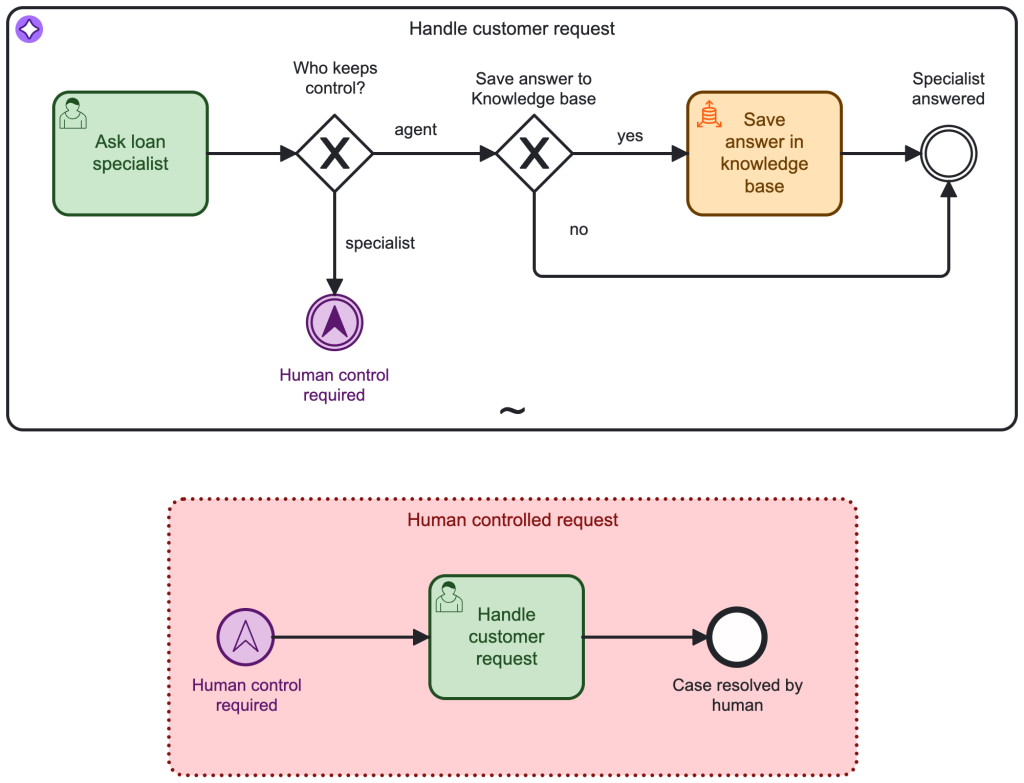
Camunda implements enterprise agentic automation in Business Process Model and Notation (BPMN), an open standard for visually modeling and executing business processes. BPMN enables developers and business stakeholders to design, understand, and automate complex logic in a shared, executable diagram.
Benefits of agentic BPMN
Visual logic that runs in production: BPMN lets you design an AI agent’s reasoning, reflection, and decision flow in a single diagram that is executable. There is no disconnect between design and runtime behavior.
Explicit control and autonomy: You can define where the agent acts independently and where deterministic steps, business rules, or human approvals apply. BPMN makes autonomy boundaries visible and enforceable.
Event-driven coordination: BPMN’s native event modeling allows AI agents to react to real-time triggers, collaborate with other agents, and synchronize across systems without requiring you to write custom code.
Integrated memory and state management: Because BPMN processes are long-running and stateful, agents can retain short-term and long-term memory throughout multiple reasoning loops and planning cycles.
Governance and transparency: BPMN provides a clear visual record of every decision and interaction, enabling full auditability, compliance, and explainability, which are key requirements for deploying AI in production.
“Since Camunda adoption, we’ve seen significantly increased solution stability, decreased development and maintenance costs, easier cooperation between business analysts and developers, usage of the Camunda toolkit daily, and increased motivation inside the team.”
Piotr Oktaba, Self Service Process Lead
SDC
Camunda versus other agent builders
| Feature | Other agent builders | Camunda |
|---|---|---|
| Execution environment | Runs as scripts or DAGs in a developer runtime | Runs natively inside Zeebe, Camunda’s cloud-native workflow engine; durable, observable, and scalable |
| State and persistence | In-memory or ephemeral; limited ability to recover state | Fully stateful, with persistent and replayable execution logs that support long-running reasoning loops |
| Event-driven architecture | Often handled manually or through library callbacks | Native event correlation, asynchronous execution, and message handling for reliable coordination |
| Autonomy control | All-or-nothing AI execution, with limited process logic | Deterministic and dynamic execution combined; autonomy where safe, control where required |
| Human-in-the-loop modeling | Possible through custom code or external triggers | Modeled directly in BPMN with built-in user tasks, approvals, and escalation paths |
| Integration | Limited to SDKs or custom API calls | Marketplace of reusable connectors for OpenAI, Google Gemini, Hugging Face, and more |
| Observability and monitoring | Minimal or manual logging | Full process visibility with audit logs, metrics, dashboards, and incident tracking |
| Scalability | Constrained by runtime and environment limits | Horizontally scalable across thousands of concurrent agents and process instances |
| Modularity and reuse | Subgraphs or ad-hoc scripts; difficult to maintain | Reusable BPMN sub-processes, templates, and connectors for rapid development |
| Governance and compliance | Manual oversight and guardrails coded per project | BPMN-based controls for human approval, rollback, and version governance |
| Production readiness | Prototype-oriented and hard to maintain at scale | Enterprise-grade reliability with SLAs, change management, and full auditability |
Building better agents with Camunda and BPMN
AI agents operate at their best when they have clear task boundaries, explicit handoffs, and proper supervision. Senior Developer Advocate Niall Deehan is here to show you how to build more reliable and trustworthy AI agents in Camunda using seven powerful patterns and BPMN (Business Process Model and Notation).

Learn more about agentic BPMN
The architecture of Camunda agents
Camunda agents run on a composable, event-driven architecture built for scale, transparency, and control. Each agent combines BPMN modeling, AI reasoning, and durable process orchestration inside Zeebe, Camunda’s cloud-native workflow engine.
Ad-hoc sub-process at the core
Each agent operates inside a BPMN ad-hoc sub-process that defines its available tools and reasoning steps. This gives you fine-grained control over what the agent can do and when.
AI Agent connector
The connector links the process to an LLM such as OpenAI, Google Gemini, or Anthropic Claude. It enables planning, action, and reflection loops where the model selects tools, performs tasks, and evaluates outcomes.
Durable state and memory
Agents persist short-term context within prompts and long-term memory in Camunda document storage or a Vector Database connector. Zeebe ensures every step is logged, recoverable, and replayable for full reliability.
Event-driven coordination
Agents communicate using BPMN message correlation or through protocols such as MCP and A2A. This allows complex multi-agent collaboration while maintaining isolation and auditability.
Guardrails and governance
Apply patterns such as the “guardrail sandwich” (pairing autonomous agents with validation agents or human checkpoints) to ensure compliance and control. Prompts can be versioned and rolled back at any time.

Resources to get started
Why developers choose Camunda
Build with open standards: Model reasoning, orchestration, and automation using BPMN and DMN, globally recognized open standards that promote transparency and collaboration between technical and business teams.
Blend AI with automation: Connect LLMs, APIs, humans, and systems in one continuous process. Combine deterministic logic with dynamic, AI-driven behavior to build intelligent agents that remain governable and compliant.
Integrate everything: Use prebuilt connectors for technologies such as Kafka, AWS, Salesforce, SAP, and OpenAI, or build your own with a lightweight SDK. Camunda’s composable architecture allows you to bring any system into the orchestration layer.
Gain full visibility and control: Built-in monitoring, incident handling, and performance dashboards make it easy to track process health, detect bottlenecks, and optimize continuously. Everything is auditable and observable by design.
Deploy anywhere: Run on Camunda SaaS or Self-Managed clusters with full flexibility. Camunda’s API-first design and cloud-native workflow engine make it easy to integrate into any architecture or DevOps pipeline.
Scale intelligently: Zeebe provides horizontal scalability for thousands of concurrent processes and agents, ensuring consistent performance even at enterprise scale.
Develop fast, operate safely: Reuse process building blocks, simulate process behavior before deployment, and update models without interrupting in-flight instances. Camunda enables rapid iteration with the reliability that enterprises demand.
Stay in control of complexity: Camunda helps you avoid black-box automation. Developers can orchestrate across multiple technologies while maintaining clean separation of concerns and long-term maintainability.
Frequently Asked Questions
What is an AI agent in Camunda?
An AI agent in Camunda is an autonomous software process built and orchestrated using BPMN. It can plan, act, and reflect across systems and data sources while maintaining governance, auditability, and human oversight. Agents in Camunda can execute long-running reasoning loops, respond to events, and coordinate with other agents using the same workflow engine.
How does Camunda help developers build enterprise-grade AI agents?
Camunda provides an open, composable platform that blends deterministic process logic with dynamic, AI-driven decision-making. Developers use BPMN to model reasoning loops, integrate LLMs such as OpenAI and Google Gemini, and connect APIs and humans into the same executable flow. The result is a production-ready orchestration layer for scalable, governed AI agents.
Why is BPMN a good fit for building AI agents?
Business Process Model and Notation (BPMN) lets developers visually design and execute the reasoning and decision flow of an AI agent. It combines logic, data handling, and event coordination in one shared model. With BPMN, agents can manage both structured and adaptive behaviors, making them transparent, auditable, and easy to extend across enterprise systems.
Can Camunda AI agents remember context or maintain state?
Yes. Camunda’s workflow engine, Zeebe, is stateful by design. Agents can persist short-term memory (context across reasoning loops) and long-term memory (stored results or observations) over hours, days, or weeks. Every state change is logged, allowing full replay and recovery without losing context.
How does Camunda handle human-in-the-loop interactions?
Human tasks are modeled directly in BPMN as part of the same process as the AI agent. Developers can include approvals, escalations, or manual overrides in any step. This ensures that AI agents operate under explicit human and business guardrails, maintaining transparency and compliance.
Can Camunda orchestrate multiple agents or tools?
Yes. Camunda supports event-driven, multi-agent patterns where agents communicate and coordinate through message correlation and triggers. Developers can also use connectors for Model Context Protocol (MCP) and Agent-to-Agent (A2A) communication to synchronize work across different AI systems and APIs.
How is Camunda different from other AI agent builders?
Most agent builders are designed for rapid experimentation or small-scale use. Camunda focuses on production orchestration. It offers persistent state management, process-level observability, human-in-the-loop support, and full governance. These capabilities allow teams to safely deploy and scale AI agents in complex enterprise environments.
What languages or frameworks can I use with Camunda?
Camunda is language-agnostic and API-first. Developers can use REST, gRPC, Java, JavaScript, or Python to interact with the engine, while BPMN models define the orchestration logic. Connectors simplify integration with platforms such as OpenAI, Google Gemini, and Hugging Face.
