
The Process Orchestration Handbook
Building a foundation for agentic orchestration at enterprise scale
Introduction
Processes are the algorithms that determine how an organization runs. They define how teams work together, how the organization works with partners and suppliers, and how it delivers value to its customers.
More and more, IT and business leaders are recognizing that in order to deliver better customer experiences, keep up with competitors, streamline operations, and improve their bottom line, they must automate the processes that are core to their business.
This is the digital transformation imperative: Embrace automation today or go out of business tomorrow.
of organizations have seen increased business growth due to process automation over the past year
plan to increase their automation investment by 10% or more
of respondents said that automation initiatives cannot keep pace with the rate of change in their organization
According to the 2025 State of Process Orchestration & Automation Report, which surveyed 800 senior IT decision makers, business decision makers, and enterprise software architects, 87% of organizations have seen increased business growth due to process automation over the past year, and 83% plan to increase their automation investment by 10% or more. However, 72% of respondents said that automation initiatives cannot keep pace with the rate of change in their organization.
At the same time, agentic AI is reshaping the way organizations operate and scale, while CEOs are demanding results from technical leadership. They don’t want to fund experiments with agents; they want to see ROI. However, rapid change can lead to technical debt, fragile solutions, and expensive upkeep. The need to move fast is forcing AI agents into already-disjointed business processes.
For organizations that are successfully delivering or unlocking additional value through automation and AI, a key success factor is process orchestration. The benefits of process orchestration are well-recognized; it can deliver better customer and employee experiences, higher efficiency and faster decision-making, and better process integration and reuse.
This guide will:
- Define process orchestration and agentic orchestration to explain why they are important
- Discuss common automation challenges that are solved by orchestration
- Help you understand what you need for successful orchestration
“The biggest ROI with Camunda has been our process timing. We've seen a reduction of about 50% in our process orchestration timings across our operational teams, which has been wicked.”
Sam Lewis
Transformation Delivery Lead, Legal & General
What is process orchestration?
Process orchestration is a technology that coordinates the various moving parts of a business process, and sometimes even ties multiple processes together. Process orchestration helps organizations work with the people, systems, and devices they already have while achieving even the most ambitious goals around end-to-end process automation.
Process orchestration, task automation, and process automation are related, but they’re not the same.
- Task automation is the use of technology to automatically perform certain tasks without human intervention.
- Process orchestration is the coordination of the tasks that make up a process, both automated and manual.
- Process automation is a mix of process orchestration and task automation that automates a process, where the degree of automation can vary.
Process orchestration is often compared to the role of a conductor in an orchestra, who makes sure everyone performs at the right time—they tell the musicians when each instrument needs to play to ensure that the song sounds as it should. The process orchestrator is the “conductor” of a process, coordinating and managing the interactions and dependencies of all the tasks in the process, whether they’re human or automated.
Understanding deterministic, dynamic, and agentic orchestration
When assessing process orchestration solutions, it’s important to understand how automation has evolved alongside machine learning (ML) and artificial intelligence (AI), particularly the use of AI agents. An AI agent is an autonomous software program that can achieve a goal without needing step-by-step instructions. It uses a large language model (LLM), real-time contextual data, and a variety of tools to accomplish one or more tasks in pursuit of its goal.
Most process orchestration is deterministic, meaning that it uses predefined logic to execute a process. Deterministic orchestration is predefined, auditable, and ideal for structured processes with clearly defined steps and outcomes.
AI/ML technology can add a dynamic aspect to deterministic processes. Dynamic orchestration leverages AI agents to determine the next steps to take as a process is being executed. It introduces flexibility by allowing agents to adapt to real-time context.
Agentic orchestration blends these approaches by allowing deterministic process logic to govern known, repeatable paths while delegating unpredictable paths to AI agents that are embedded within the process. To implement true agentic orchestration, teams create this blend using features that are native to the process orchestration platform; not a separate system or tool. This native blend ensures that the integrity and context of the business process are maintained while combining the precision of deterministic design with the adaptability of dynamic actions.
Many organizations are looking to agentic orchestration as a way to increase the level of automation in areas where it wasn’t possible before; for example, complex case management scenarios such as insurance claim fraud investigation, customer complaint resolution, and trade reconciliation in financial services. However, AI agents are a relatively new technology and government regulations around AI are evolving. Therefore, it’s important to select a process orchestration solution that will enforce guardrails around AI agents and enable teams to monitor and audit them, all within the context of business processes.
Let’s look at an example
Let’s look at a scenario where process orchestration could have prevented a poor customer experience.
After hours of research, Kate, a first-time homebuyer, starts a mortgage application using her bank’s mobile app. She completes the initial know-your-customer (KYC) process by uploading her ID and taking a selfie for biometric verification.
An AI agent validates her identity and reviews her finances, but flags her application for additional verification due to a recent job change. Kate uploads the requested financial documents and receives a conditional pre-approval based on herdebt-to-income ratio, spending habits, and credit score.
Excited but cautious, Kate schedules an in-person meeting with a mortgage advisor. At the bank branch, she learns that while her advisor can see her application, the extra due diligence isn’t complete. The bank’s compliance team has flagged her application for manual review, creating a backlog that prevents the advisor from proceeding. Meanwhile, market volatility has prompted the risk management team to adjust lending criteria and rates using a separate system, potentially impacting Kate’s pre-approved terms.
Kate leaves the branch frustrated, unaware her application is caught between disconnected systems and departments.
Automation challenges impact customer experiences
As you can see in the example, Kate’s experience was far from ideal and potentially damaged the relationship and her loyalty to the bank. This was due to delays caused by siloed automation.
Most organizations have adopted a wide variety of tools and technologies to automate every aspect of the business. This includes solutions for customer relationship management (CRM), enterprise resource planning (ERP), robotic process automation (RPA), IT service management (ITSM), and more. Many of these solutions can deliver quick wins for the business because they automate tasks that were previously done manually. However, when they’re pushed beyond their intended capabilities or implemented in a disjointed way, they trap value in silos.
The problem of trapped automation value only increases with the use of disjointed AI tools, many of which are still experimental. Each tool addresses a narrow piece of a much larger journey, delivering short-term productivity boosts for individuals and teams, but failing to drive enterprise-wide impact.
For example:
- IT and business teams are exploring chatbots and copilots that are built into CRM, ERP, and ITSM platforms
- Automation teams are testing out AI-powered bots provided by their RPA products
- Software developers are testing agent frameworks from emerging AI-native startups
- Enterprise architects are investigating nascent multi-agent communication protocols such as MCP and A2A
The use of disjointed automation and AI tools causes technical and organizational debt, with a diminishing return on investment. It leads to multiple challenges.
Broken end-to-end automation
The foundational challenge is broken end-to-end automation. Because siloed automations are not integrated with one another, the end-to-end business process is not fully automated. As you saw in the example above, disjointed automations break the customer journey, creating friction that directly erodes revenue, market share, and long-term customer loyalty.
AI agents, automated tasks, and human oversight remain disconnected, resulting in inconsistency and trust gaps that block transformational change. Plus, fragmented AI agents tend to multiply overhead and make processes harder to evolve, dragging down velocity and delaying time-to-market.
Lack of understanding and trust
Broken end-to-end automation leads to a lack of understanding because it means that processes are not fully visible and key metrics are hard to track. Without a complete understanding of processes and how they are performing, teams can’t determine where increased automation or investments in AI will deliver the highest-value returns for the business, making it nearly impossible to prove the ROI of AI pilot projects.
A lack of understanding also leads to a lack of trust in agentic AI that blocks transformative outcomes. The rapidly evolving AI market is flooded with prebuilt agents that are black boxes, providing little to no transparency around the tools and large language models (LLMs) they use. They lack the extensive visibility and governance that organizations (and regulatory bodies) require. Because of this, leaders remain reluctant to use agents in core business processes; the risk remains too high, especially in heavily regulated industries.
Lack of flexibility and scalability
Without an understanding of end-to-end business processes, organizations lack flexibility needed to scale them and evolve them over time. Updating a process becomes a difficult and time-consuming task because it potentially affects many different systems, especially if the process’s logic isn’t abstracted away from the tools and services that execute the tasks that make up the process.
Flexibility and scalability issues often stem from monolithic automation platforms—and even some process automation tools and integration platforms as a service (iPaaS). These solutions are provided as a tightly integrated set of components that cannot be unbundled. They promise that you can use one product to automate all parts of business processes; but in reality, their closed architecture approach locks organizations in, reduces deployment options, makes change management more difficult, and hinders integration with other IT systems.
A lack of flexibility can significantly slow down time-to-market, hurting business agility and stifling innovation.
Which processes benefit from orchestration
The processes that benefit most from orchestration are core business processes—the ones that build and sell an organization’s products and services. However, any process that has these qualities can be improved through effective orchestration:
Endpoint diversity
The process involves many different process endpoints
Process complexity
The process’ logic is more complex than a simple sequence of steps
Processes with diverse endpoints
When looking at a process from the business’ point of view—that is, where business owners consider the process to start and end—it’s common to have business-critical processes that span many people, systems, AI agents, and physical devices. These are known as process endpoints. According to the 2025 State of Process Orchestration & Automation Report, organizations average 50 endpoints across their business processes; a number that has grown by approximately 19% over the past five years.
Every process consists of tasks which are executed by endpoints. Process orchestration coordinates the execution of tasks across all different types of endpoints in a single process model. The more diverse the types of endpoints are, the harder it can be to integrate them into a single end-to-end process model; for example, niche technical skills might be needed to integrate a legacy system or a proprietary enterprise application.
In addition, process endpoints often change over time. For example, a team might replace RPA bots with API calls, or start using AI agents to automate some case management tasks that were previously handled by knowledge workers. A properly implemented process orchestration layer accommodates change by abstracting process logic away from the endpoints that execute the tasks that make up the process.


Processes with complex logic
Coordinating the execution of tasks across different types of endpointsrequires process logic, which is rarely a straightforward sequence of steps.This is especially true of long-running processes; that is, those that run for hours, days, or even weeks. In the 2025 State of Process Orchestration & Automation Report, 78% of respondents said that complex workflow patterns and/or long-running processes increase their team’s difficulty in automating processes from end to end.
Core business processes are often complex andlong-running, requiring logic known as advanced workflow patterns. Examples include:
- Compensation: Rolling back a business transaction in case of problems, or restoring business consistency
- Dynamic parallel execution: Executing multiple tasks or entire process branches in parallel, where the number of branches is determined in real time
- Time-based escalation: Automatically escalating overdue tasks to an automated task or to a knowledge worker
- Message correlation: Correlating messages from external systems with the correct process instance
- Exception handling: Handling errors and unexpected situations such as an unresponsive external system or malformed process data
Many automation tools that support basic process execution cannot implement these types of patterns, which often leads to developers building workarounds that lead to technical debt.
The need for orchestration is driving automation market convergence
The market segment known as business process management, business process automation, or digital process automation, has always been made up of products that take a process-first approach to automation. As process automation has become a key enabler of digital transformation, some of these products have gone beyond their origins automating straightforward, repeatable back-office workflows to include the types of orchestration capabilities that are needed to run core business processes.
In addition, vendors with backgrounds in other markets have added process capabilities to their products. For example:
- Robotic process automation (RPA) started as a technology that could screen-scrape the graphical user interfaces of legacy applications so users could automate repetitive tasks (usually around data entry). However, RPA vendors quickly started adding capabilities for basic workflow automation, including the ability to add custom code to workflows so developers can connect to modern applications that communicate via APIs.
- Low-code application development platforms (LCAPs) originated as tools that enable people who aren’t professional software developers to build simple applications with a GUI and basic data I/O and manipulation capabilities. However, most LCAPs now also include some level of workflow automation, allowing users to synchronize data with their enterprise tools and even trigger customer-facing actions such as sending emails.
- Integration platforms as a service (iPaaS) address the need to move, copy, synchronize, and manipulate data as it flows between many different systems. Many iPaaS tools started by providing point-to-point integration between various tools, but the need for a workflow or process that connects those integrations quickly became obvious. Today, some iPaaS vendors have added support for process modeling and execution, with some even supporting the BPMN standard.
Industry analyst firm Gartner has recognized this market convergence by defining a new market segment called Business Orchestration and Automation Technologies (BOAT). The “O” in BOAT is intentional; it goes beyond just automation to recognize that orchestration is critical for end-to-end business processes because orchestration alone addresses the automation challenges described above.
Similarly, analyst firm Forrester has identified a market segment called Adaptive Process Orchestration (APO). In addition to reflecting automation market convergence, APO recognizes that platforms with process capabilities are evolving through the use of AI agents that can combine deterministic and dynamic process control flows to meet business goals, perform complex tasks, and make autonomous decisions.
Overcoming automation challenges with process orchestration
Process orchestration eliminates silos of trapped value by enabling teams to coordinate the tasks that make up an end-to-end business process in a single process flow. As described earlier, the use of disjointed automation and AI tools leads to challenges such as:
- Broken end-to-end automation: Because siloed automations are not integrated with one another, the end-to-end business process is not fully automated.
- Lack of understanding and trust: Processes are not fully visible, key metrics are hard to track, ROI is impossible to prove, and leaders are reluctant to use AI agents in core business processes.
- Lack of flexibility: Changing and evolving processes is difficult and time-consuming, hurting business agility and stifling innovation.
Let’s look at ways that process orchestration can help organizations overcome these challenges.
Mending broken end-to-end automation
Mending broken end-to-end automation requires:
Alignment between IT and business stakeholders to ensure there are no communication gaps or misunderstandings around a process’ business goal and how the process works in the real world
Orchestration of the tasks in an end-to-end process that breaks down silos caused by endpoint diversity and process complexity
Let’s look at ways that process orchestration can help organizations overcome these challenges.

Gaining IT/business alignment
Bridging the gap between IT and the business is a challenge for every organization, especially with process automation playing a key role in digital transformation. Business and IT stakeholders often have different goals, incentives, and priorities, and these differences tend to slow down communication, prevent alignment on project priorities, and cause implementation errors.
Despite this challenge, designing, operating, and improving complex end-to-end processes requires collaboration between technical and non-technical stakeholders. The Business Process Model and Notation (BPMN) and Decision Model and Notation (DMN) standards provide a common language that all users can speak, so nothing is lost in translation between business requirements and technical implementation. As visual representations of processes and decisions (also known as business rules), BPMN process models and DMN decision tables help all stakeholders gain a shared understanding of how their processes work from start to finish, ensuring that the process being built meets business requirements.
Plus, a process orchestration solution such as Camunda executes BPMN and DMN directly, so the models that stakeholders build together are exactly what is executed when the process goes to production.
Orchestrating processes across endpoints
End-to-end process orchestration coordinates both automated and manual tasks in a business process no matter how many people, systems, AI agents, or devices are involved and no matter how complex the process logic is.
Many automation platforms, including Camunda, include prebuilt connectors for popular tools and technologies.These can range from protocols such as REST and SOAP, to enterprise applications such as SAP and Salesforce, to team communication and productivity tools such as Slack and Microsoft Office. Camunda’s connectors are built in a way that provides a multilayer coding experience for all types of users:
The connector SDK enables professional software developers to build connectors from scratch, includinglow-level API access to Camunda’s workflow engine, Zeebe
Protocol connectors implement popular integration protocols such as HTTP REST, SOAP, and GraphQL, making them ideal for low-code developers to build on top of
Configurable connector templates enable low-code and citizen developer to define connector templates in JSON, offering a balance of ease of use and customization
Out-of-the-box connectors for popular tools and services, which citizen developers can use as-is or copy and customize for their needs
The BPMN standard enables teams to abstract process logic away from the endpoints that execute the tasks that make up the process. This abstraction makes it much easier to change endpoints without impacting the process logic, and to change the process logic itself. Organizations can roll out process improvements, regulatory compliance updates, and competitive new offerings much faster. Because process logic is visible to everyone and not buried in code, business stakeholders can actively participate in implementing process changes.
In addition, as processes change over time, Camunda Operate offers a way to update the process model without interrupting running processes. Process instance migration allows teams to move active processes to a new version of a BPMN process model with guidance and guardrails that prevent the new model from causing process interruptionsor failures.
Establishing understanding and trust

To orchestrate business processes effectively—especially those involving AI agents—all process stakeholders must be able to visualize and measure them. The BPMN standard:
- Enables teams to collaboratively build a visual process model that facilitates understanding of the process from start to finish
- Provides them with a transparent way to build AI agents directly into their processes (no context switching to an external agent builder)
- Facilitates a seamless blend of deterministic process execution with AI-powered decision-making to de-risk innovation and speed up AI adoption
Collaborating with a one model approach
As a common language for all process stakeholders, BPMN and DMN represent a shared understanding of how a process works and exactly how it will be executed (including all of the AI agents and endpoints that are involved). Camunda takes this shared understanding beyond the design phase by using a “one model approach” for process creation, management, and measurement. The BPMN process model visualization that IT and business stakeholders build in Camunda Modeler is the same visualization they see when monitoring processes in Camunda Operate and when analyzing processes in Camunda Optimize.
The consistent use of a visual process model ensures that the business process context is always clear, making it easier for non-technical users to participate in the complete lifecycle of process creation, execution, and improvement. The business context also helps teams prove the ROI of AI projects beyond minor efficiency gains by connecting process to outcome.
Building transparent agents with flexible control
While AI agents are most powerful when they have a degree of autonomy so they can take action and decide what happens next, this autonomy introduces an element of risk that makes leaders reluctant to use agents in core processes. There are two ways to establish trust in AI agents so the organization can start benefiting from them.
First, teams need a way to build hyper-transparent agents, to control where they fit into a process, and to define how much autonomy they have. Camunda provides this through a BPMN-based approach to agent design. Process designers build agents in the same modeling environment where they design processes and decision tables, with an easy drag-and-drop way to add tools to the agent. Important information such as the AI model that the agent will use, how many times the agent will retry a task, and when and how the agent will escalate when it needs help are all configurable and visible.
Second, teams need a way to blend deterministic, BPMN-controlled process execution with dynamic, AI-powered decision-making. This blend ensures that the organization can maintain as much control as needed while taking advantage of agentic AI—and makes it easy to increase or decrease the amount of AI over time. Camunda allows process designers to create deterministic logic around and inside agents, providing a high level of flexibility for their implementation.

Making processes flexible and scalable
To ensure that the organization can adapt to changing business needs, teams need the flexibility to adapt core business processes without weeks or months of turnaround time.
Enabling flexibility through composable architecture
A composable process orchestration and automation architecture is the solution to a lack of flexibility in business processes. Instead of relying on monolithic software products or a rigid infrastructure with many brittle dependencies, a composable architecture encourages the use and reuse of interchangeable, interoperable components that organizations can easily assemble, reconfigure, and scale according to their business needs.
Flexibility is the core benefit of composable architecture and truly underlines all other benefits. With a composable architecture, organizations can adapt to changing business needs and technical requirements without overhauling their entire tech stack. Instead, teams working on business processes can add, remove, and swap individual tools or services as needed.
Other benefits of composable architecture include:
- Business agility: Flexibility and agility go hand-in-hand. Many organizations deal with competitors launching new products and rolling out promotional offers; market disruptors that are delivering new features lightning-fast; and changing regulatory requirements that require compliance on a specific timeline. Organizations need to be able to adapt in a matter of days or weeks, not months or years.
- Cost management: By leveraging reusable components, teams can reduce development and maintenance costs. Composable architecture is well-suited for the integration of reusable components and out-of-the-box solutions.
It provides much more granular visibility into costs than a monolithic automation platform can provide. - Preparation for the future: Technology evolves rapidly. Composable architecture enables organizations to more easily experiment with new products and services and make them part of the full tech stack after they prove their worth.
Scaling up with high performance and resilience
Customer expectations around digital experiences are rising every day. They want fast, smooth, highly personalized experiences from organizations they trust. This even holds true during times when an organization might be experiencing huge demand; for example, online retailers during holiday shopping seasons or tax preparers during peak US income tax season.
Camunda’s cloud-native workflow and decision engine, Zeebe, is designed for unlimited scalability, high performance, and high resilience. Unlike traditional workflow engines, Zeebe doesn’t maintain data about running processes in a central database, an architectural design that eventually leads to a performance bottleneck. Instead, Zeebe uses event-streaming technology to deliver high throughput while protecting process data through replication. Zeebe has a distributed architecture that’s designed to scale in a predictable way, so teams always know how much processing power is required to support the anticipated process load.
Ensure business is always on with Zeebe
- Unmatched process performance: Zeebe uses efficient persistence algorithms on disk and event streaming technology to deliver unmatched performance for even the most demanding business processes.
- Blazing fast and reliable: Thanks to high performance computing strategies such as the single writer principle, Zeebe is blazing fast and avoids database locking problems that cause process bottlenecks.
- Scalable and resilient: Technology evolves rapidly. Composable architecture enables organizations to more easily experiment with new products and services and make them part of the full tech stack after they prove their worth.
Process orchestration is the foundation of agentic AI success
As AI/ML technologies advance, more and more organizations will leverage AI agents to handle exceptions and unstructured scenarios in business processes; to scale their capacity to serve customers without proportional headcount growth; and to deliver more personalized customer experiences. Agentic orchestration that blends deterministic process logic with dynamic, AI-driven behavior provides a safe and effective way to benefit from agents while maintaining control of processes and managing process execution costs.
End-to-end process orchestration provides a backbone that enables agentic AI success by:
- Supporting advanced workflow patterns such as parallel execution, automated escalations, message correlation, exception handling, and more
- Embedding AI to enable dynamic orchestration that goes beyond orchestrating
AI tools and services to include the ability for AI agents to orchestrate processes - Ensuring AI agents can orchestrate processes in a way that complies with regulations, that involves humans when necessary, that doesn’t endanger the business, and that keeps customers’ data safe
- Enabling teams to add any endpoint to their processes without restricting their process design choices or the tools they use
Camunda’s approach to agentic orchestration
Camunda provides best-in-class process orchestration to serve as a foundation for agentic orchestration. Using Camunda, teams can embed AI agents directly into process models using BPMN, allowing agents to decide what happens next based on goals, context, and available tools. Teams can even mix-and-match Camunda agents with agents from other providers in the same process model. This creates processes that can adapt in real time without sacrificing the structure, governance, or auditability that BPMN provides.
Unlike platforms that bolt AI onto processes as isolated tasks, Camunda treats agents as first-class citizens of the process. This means that AI agents are executed by the same workflow engine as the rest of the process, with full visibility into their actions, inputs, and outcomes. Whether a process follows a predefined path or defers to an AI agent for decision-making, everything is executed within a shared orchestration environment.
Blend deterministic and dynamic orchestration
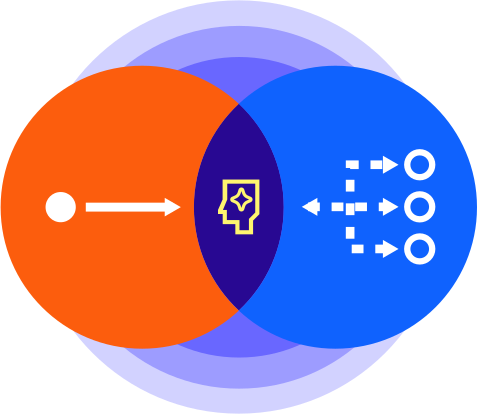
- Blend deterministic processes with dynamic agents in a single process model. Agents inherit the same advanced workflow patterns as deterministic workflows: compensation, dynamic parallel execution, time-based escalation, message correlation, exception handling, and so on.
- Model agents with BPMN to unlock advanced scenarios. Escalate to a human and then return control to the agent or pause an agent for hours, days, or weeks and then resume exactly where it left off when the customer replies.
- Gain access to a full set of BPMN capabilities, advanced workflow patterns, task automation capabilities, and connectors to use as tools that can be dragged and dropped into an agent.
- Drop agents within agents for complex multi-agent orchestration scenarios, all modeled in BPMN for better visibility, collaboration, monitoring, and reporting.
- Throttle agent autonomy up or down as needed by quickly swapping agents or human escalation points into and out of processes.
- Decide where, when, and which long-term memory is accessed within a process to give agents the context they need to deliver consistent results. Access multiple memory stores anywhere in a process and write to memory so the process gets smarter with time.
- Build agents in the same user interface and toolset as processes and decisions. No context switching to bolted-on agent builders or limited access to connectors that integrate external systems.
- Monitor and report with customizable alerts, reports, and dashboards that deliver holistic visibility—including all AI agents—into each process.
Unify the end-to-end business process
- Build a single visual model for all end-to-end processes. What teams build is what they run, monitor, and optimize. All people, systems, devices, and agents are connected, with process data shared across all endpoints of the process instance.
- Visualize even the most complex processes using the advanced capabilities of BPMN to bring standardization and transparency to process flows. Complex patterns such as compensation are visible and help to achieve faster maintenance cycles.
- Separate business logic from technology choices. Change out any agent, AI model, business rule, or new technology without downtime, even for in-flight processes.
- Use governed process assets to reinforce a focus on the “build once, reuse everywhere” mindset and quickly onboard new teams and processes.
- Keep operations running smoothly under increasing demand. Processes can execute in seconds or years at any scale. Camunda’s cloud-native workflow engine, Zeebe, is infinitely scalable and includes failover and resilience built in.
- Help developers keep on pace. Teams can build with their favorite tools; no specialized skills or proprietary lock in. Everything simply works and fits into the organization’s software development lifecycle.
Embed guardrails and transparency for scaled ROI
- Gain auditability and traceability of every action and decision whether it’s executed by a person, an AI agent, or an automation. Ensure policy adherence and compliance with regulatory requirements.
- Implement escalation triggers to enforce service level agreements and adapt them as needed without rebuilding the whole process model.
- Enforce a standardized way for processes and agents to connect to data with connector templates to deliver consistent customer experiences and reduce maintenance overhead.
- Unify process monitoring and reporting with the one model approach that improves collaboration across all stakeholders and reduces
time-to-production.
Conclusion
Process orchestration isn’t just a technology; it’s the connective tissue of modern enterprise automation. As organizations look to AI to increase efficiencies, the ability to blend deterministic and dynamic process orchestration becomes critical to success. Camunda’s approach to agentic orchestration enables teams to operationalize AI within a secure, governed process architecture, giving organizations the confidence to innovate at scale.
With Camunda, you can:
- Connect customer journeys from end to end to unlock significantly more value from any technology and prove ROI
- Blend deterministic and dynamic processes to unlock agentic AI’s full potential and create better customer and employee experiences
- De-risk innovation and deploy faster to stay ahead of competitors and technology change—without interrupting the business
FAQ
What is process orchestration?
Process orchestration coordinates all the moving parts of a business process—people, systems, AI agents, and devices—and can even tie multiple processes together. The goal is end‑to‑end automation that works with the technology you already have while improving speed, quality, and consistency.
What is the difference between process orchestration and process automation?
Process orchestration coordinates the tasks that make up a process (automated and human). Task automation executes specific activities without human intervention. Process automation blends orchestration with task automation to automate the overall process; the level of automation can vary by use case.
What is the difference between BPM and process orchestration?
Business Process Management (BPM) is a holistic discipline for designing, executing, and improving processes. Traditional BPM suites focused on repeatable back‑office workflows and often struggle with modern, complex, customer‑facing scenarios. Process orchestration provides the runtime capabilities to coordinate diverse endpoints and advanced workflow patterns, making it possible to automate complex, mission‑critical processes end to end.
How does process orchestration work?
A process model defines the logic for how tasks should be coordinated, including human work, service calls, and interactions with AI agents or devices. Orchestration software executes that model at scale, handles state and long‑running flows, responds to events, and ensures that every participant and system plays its part in the right order with the right data.
What are the benefits of process orchestration?
Process orchestration aligns stakeholders around a single executable model, tames process complexity with advanced workflow patterns, and scales automation reliably. Teams gain visibility for measurement and continuous improvement, while customers and employees get faster, more consistent experiences.
What is agentic orchestration?
Most processes include known, repeatable paths (best handled with deterministic models) and unpredictable paths (well‑suited for AI-powered agents). Agentic orchestration lets you model both in a single, governed process: deterministic steps provide structure and compliance, while AI agents adapt to real‑time context to resolve exceptions and unstructured work.
What is enterprise agentic automation?
Enterprise agentic automation operationalizes agents across end‑to‑end business processes with the governance, resilience, and transparency required for mission‑critical outcomes. It unifies agent development and orchestration with deterministic guardrails (policies, approvals, SLAs) so autonomy can be dialed up or down safely.
What is the relationship between process orchestration and Business Orchestration and Automation Technology (BOAT)?
Industry analyst firm Gartner uses the term BOAT to describe the converging market of technologies that deliver both automation and orchestration. Process orchestration is the backbone capability inside BOAT, providing advanced process automation capabilities, transparency, and guardrails.