
Agentic Orchestration: Model, deploy & manage AI agents seamlessly into your end-to-end processes with Camunda
If you are tired of hearing about what AI can do and want to see it in action, watch this 15-minute overview and discover how to build processes with agentic orchestration.
No waitlists here! Get started today with Camunda, the only BPMN standards-based AI agent builder.


Empower AI agents to drive business processes at scale
AI agents are powerful, but without orchestration, they lack the coordination, accountability, and reliability needed for real-world, business-critical processes. Camunda’s agentic orchestration coordinates AI agents, ensures their work is transparent, and provides the reliability your customers are looking for. With Camunda, you can ensure AI-driven processes are efficient, compliant, and aligned with your business goals.
“Camunda’s proven strength in orchestration made it possible for us to build an advanced medication order management system that delivers consistent, yet personalized and compassionate customer experiences–at scale. It’s that same orchestration strength–now coupled with agentic capabilities within the governance we require–that has us excited to unlock even greater efficiency and innovation as we develop transformative care delivery models.”
George Kutnerian
Co-Founder, President & CEO, Wellpointe Inc.
Why AI needs orchestration
AI agents can make decisions, generate content, and automate tasks, but they struggle with:
Context switching
Keeping track of multi-step workflows
Governance and compliance
Ensuring traceability and oversight
Collaboration
Working with human decision-makers and with other technologies
Scalability
Managing interactions between agents without bottlenecks
Maximize the ROI of your AI investments with agentic orchestration that provides true business impact.
How agentic orchestration works
Architect end-to-end agentic processes
Embed agents directly within BPMN process models—agents don’t replace processes, they enhance them. Use deterministic flows for predictable behavior, and delegate to agents when AI-driven reasoning adds value.
Build with state-of-the-art agent frameworks
Camunda integrates seamlessly with agentic AI frameworks such as LangChain, giving developers access to agent concepts such as memory, LLMs, tools, and retrieval. Compose end-to-end, long running processes that orchestrate LLMs, external APIs, and humans with full lifecycle control.
Blend code and modeling via multi-layer architecture
Design processes visually with BPMN and extend them programmatically using Camunda’s SDKs and custom logic. Embed agents as BPMN tasks, but with full extensibility to configure tool usage and control execution logic, all in a single orchestration layer.
Govern intelligent decisions with human oversight
Agentic orchestration respects confidence boundaries. Agents can request human input when uncertain, or prepare contextual insights for expert validation. This ensures trust, traceability, and compliance in mission-critical flows.
How multi-agent orchestration works
Multi-agent orchestration with Camunda lets you design a central orchestrator to unify any AI agent in your organization. AI Agents from any provider, including Microsoft Copilot, LangChain, Salesforce, CrewAI, n8n, or agents you build yourself in Camunda, are now orchestrated by an intelligent agent within a reusable, governed process.
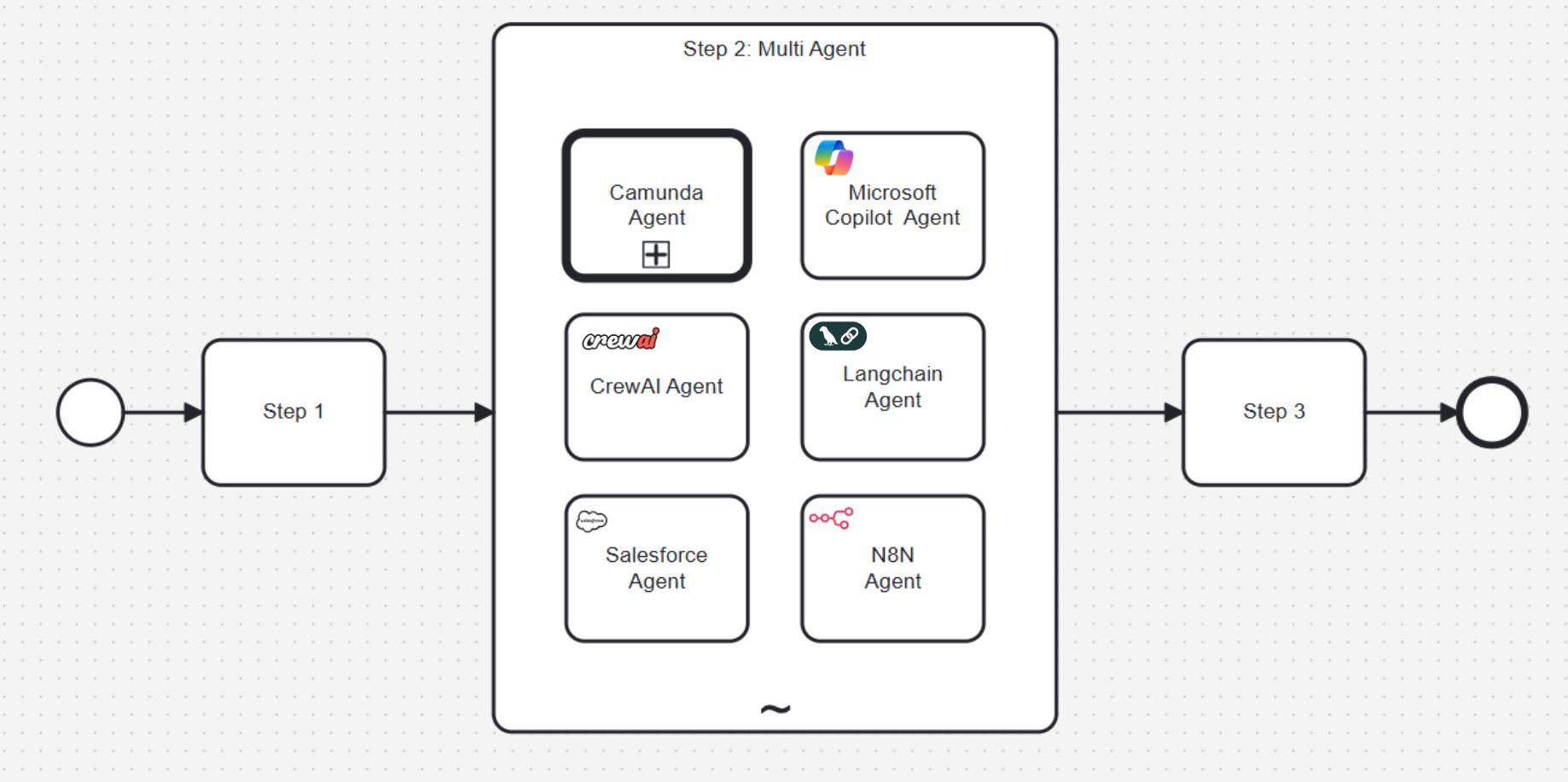
Design a central orchestrator
Model a central multi-agent in BPMN that plans, delegates, and synchronizes tasks across specialist agents.
Blend deterministic & dynamic logic
Keep critical steps fully deterministic while allowing agents to reason and adapt where autonomy adds value.
Protocol-ready connectors (MCP & A2A)
The power of the most advanced orchestration engine (Zeebe) with MCP (Model-Context-Protocol) and A2A (Agent-to-Agent) connectors allows you to take advantage of advanced patterns and infinite possibilities. Because Camunda correlates every message and event to a long-running process instance, these new protocol connectors unlock the most advanced agent-to-agent patterns while keeping the entire exchange transparent and auditable.
Enterprise-grade transparency
Every agent decision is logged, auditable, and interruptible—so operations, security, and compliance teams can trust what’s running in production.
Rapid path to production
Move from whiteboard to enterprise rollout with Camunda’s cloud-native engine and visual dashboards for live optimization.
Agentic orchestration solutions built by Camunda partners

Compliance Monitoring Agent
Provides comprehensive compliance monitoring for events in highly regulated industries, automating risk detection and safeguards through AI-powered contextual analysis.

Agentic AI Insurance Claims Processing
Delivers speed, accuracy, and clarity at scale when filing claims by automating document verification, analyzing data in real-time and detecting anomalies.

Agentic Financial Crime Compliance Transaction Monitoring
Empowers financial institutions to modernize transaction monitoring systems with agentic AI/ML models, seamless process automation, and real-time risk detection.

AI Customer Service Agent
Automates the resolution of email-based inbound requests, enabling organizations to grow support capacity, improve customer NPS, and enhance employee experience.

Agentic AI Assisted Quality Audit Process
Audits calls faster and smarter, reducing costs, increasing audit effectiveness, improving agent feedback, and ultimately improving the customer experience.

Automobile Claims Management
Provides access to policy details and automates customer verification and the collection of claim information. Agentic AI provides 24/7 automated customer support including streamlined document uploads.

Agentic Trade Exception Management
Reduces operational complexity and regulatory compliance risk by streamlining and automating trade exception handling, remediating pre- and post-trade errors, and managing exceptions faster.
Why Camunda for agentic orchestration?
- Unified agentic orchestration: Orchestrate both structured tasks and agentic logic within one BPMN model.
- Process-level determinism with agentic flexibility: Control process flow deterministically and layer in dynamic agent behaviors only where needed.
- Observability and governance: Unlike many frameworks, every process step—including AI reasoning—is observable, interruptible, and auditable.
- Access to real SDKs: Use actual AI agent toolkits like LangChain—not simplified UI wizards—ensuring you stay at the cutting edge of what’s possible.
Process orchestration gives you the flexibility that agents require
Agentic orchestration blends deterministic and dynamic process execution to give you the best of both worlds. Model out the parts of your process that require high levels of predictability and control, and let AI agents handle work that involves creativity and proactive decision-making. Increase the level of automation in hard-to-predict processes and free up knowledge workers to focus on other projects.

Agentic orchestration BPMN model example with Deterministic Guardrails
Key features
- Adaptive AI agent coordination – Ensure AI agents work effectively within a process structure
- Human-in-the-loop governance – Maintain compliance and ensure AI actions can be audited
- Scalable execution – Run hundreds or thousands of AI-driven processes in parallel
- Enterprise-ready integrations – Orchestrate any system via APIs, RPA bots, and data pipelines
- Real-time monitoring and insights – Get complete visibility into AI decision-making
Use cases
- Automated customer support – AI agents handle inquiries and escalate to knowledge workers when needed
- Governance, auditing, and compliance – AI agents review transactions while human auditors oversee exceptions
- Supply chain optimization – AI-driven demand forecasting with human approvals
- IT and security operations – Automated ticket resolution and proactive security alerts
Why Camunda?
Enterprise-grade orchestration
Proven process orchestration and automation trusted by global organizations
AI-first approach
Designed for the next generation of intelligent automation with scalability and resilience
Open and extensible
Works with any AI model, tool, service, or data source
Get started with agentic orchestration
Talk to an expert
Frequently asked questions
What is agentic orchestration?
Agentic orchestration is the coordination of AI agents, people, and systems inside a single governed business process. It enables you to model how agents should plan, act, and interact in an end-to-end business process, then let Camunda’s engine execute that model at scale. Agents are embedded within the process; deterministic steps handle predictable logic, while agents take over where AI-driven reasoning, planning loops, short-term memory, long-term memory, and RAG-style retrieval add value. The blend of deterministic control and dynamic agent behavior makes it possible to run complex, multi-step, AI-powered processes with transparency, governance, and human oversight. Every decision an agent makes is observable, auditable, and interruptible.
What are the benefits of agentic orchestration?
Agentic orchestration turns AI agents into reliable participants in end-to-end business processes. First, it maximizes ROI from AI by ensuring agents work inside real business processes, with clear goals, guardrails, and outcomes. Second, it improves governance and risk control because every agent decision is logged, traceable, and interruptible, which is critical for regulated industries. Third, it drives operational efficiency: agents can automatically coordinate with systems, APIs, and humans in long-running business processes, using planning loops and event-driven orchestration to adapt as context changes. Finally, it accelerates time to value. Camunda provides a cloud-native workflow engine, BPMN-based process and agent modeling, and connectors for agent protocols such as MCP and A2A, so you can move quickly from whiteboard to multi-agent production deployments without sacrificing control.
What are common use cases for agentic orchestration?
Agentic orchestration shines wherever processes are complex, exception-heavy, or knowledge-intensive; for example, compliance monitoring, insurance claim processing, financial crime and transaction monitoring, and trade exception management. In these use cases, AI agents can handle work such as document understanding, anomaly detection, policy interpretation, and proactive customer communication, while a process orchestrator manages approvals, escalations, and regulatory guardrails. Multi-agent patterns are common; for example, combining specialist agents for fraud analysis, document classification, and pricing under a central orchestrator modeled in BPMN. Outside of financial services and insurance, organizations apply agentic orchestration to service request management, healthcare care-path optimization, supply chain exception handling, and any process where agents must coordinate across systems, events, and human decision-makers over hours, days, or weeks.
How does agentic orchestration differ from RPA or task automation?
RPA and task automation focus on automating individual tasks or UI interactions, often in a single system. They are powerful for repetitive, rules-based work, but they do not inherently manage long-running, cross-system processes or complex agent behavior. Agentic orchestration, by contrast, coordinates full end-to-end processes that may span multiple systems, AI agents, and human participants. It blends deterministic process logic with dynamic agent behavior in one executable model, so you can define when to call an RPA bot, when to invoke an AI agent with planning loops and memory, and when to involve a person. Camunda also correlates events and messages to persistent process instances, which means agents and bots can participate reliably in processes that run for days or weeks, with full transparency and auditability instead of opaque scripts.
What’s the relationship between agentic orchestration and process orchestration?
Process orchestration is the foundation; it coordinates people, systems, and devices to execute end-to-end processes reliably and transparently. Agentic orchestration builds on that foundation by adding governed AI agent behavior into the same process model. In Camunda, you design a BPMN process that defines deterministic control flow, then embed agents where dynamic, AI-driven decisions, planning loops, and retrieval are needed. This gives you process-level determinism with agentic flexibility; the process remains predictable and auditable, while agents can adapt to real-time context and data. In short, process orchestration ensures the right work happens in the right order, and agentic orchestration decides where AI agents participate in that work and how their actions are governed, monitored, and optimized across the full lifecycle.
How can we use Camunda to get started with agentic orchestration?