
Enterprises are under pressure to deliver faster, smarter, and more autonomous processes. Yet, most automation initiatives stall because agents rely on accurate data to make reliable decisions and take reliable actions.

Most enterprise information lives in documents like claims, invoices, contracts, IDs, and medical reports. These are complex and variable, making them hard for LLMs or agents to interpret. Without structured, validated data, even advanced automation fails.

That’s why Camunda and ABBYY have joined forces—to unlock data locked away in documents and deliver reliable agentic automation.

Analysts agree: Intelligent Document Processing (IDP) is no longer optional, it’s foundational. Forrester notes that “Generative and agentic AI are transforming IDP into a cognitive engine that powers enterprise automation.” While Gartner calls IDP “a strategic enabler for intelligent automation,” and a critical component of intelligent automation strategies, enabling compliance and operational agility. That is why we are thrilled to announce our new partnership and integration with ABBYY, a Leader in 2025 Gartner® Magic Quadrant™ for Intelligent Document Processing Solutions.

This partnership combines Camunda’s agentic orchestration with ABBYY’s advanced document intelligence, creating a powerful synergy that accelerates automation for complex, document-centric processes.

Why this partnership matters

AI agents need trusted, contextual, and actionable information which they can use to make decisions and take actions. Here’s why it matters:

  • Better Decisions: Agents rely on data to evaluate context and choose the next best step. Poor data leads to wrong decisions and compliance risks.
  • Contextual Autonomy: Reliable data provides confidence scores and validation checks, enabling dynamic, context-aware processes instead of rigid workflows.
  • Compliance and Auditability: In regulated industries, every decision must be traceable. Trusted data ensures decisions meet compliance standards and withstand audits.
  • Fewer Escalations: Low-quality data forces agents to escalate cases to humans, creating bottlenecks. Trusted data minimizes exceptions and increases straight-through processing.
  • Continuous Learning: Agentic systems improve over time. If the underlying data is unreliable, the feedback loop becomes corrupted, leading to systemic errors instead of optimization.

The ABBYY-Camunda advantage

ABBYY and Camunda create an agentic loop for document-heavy processes:
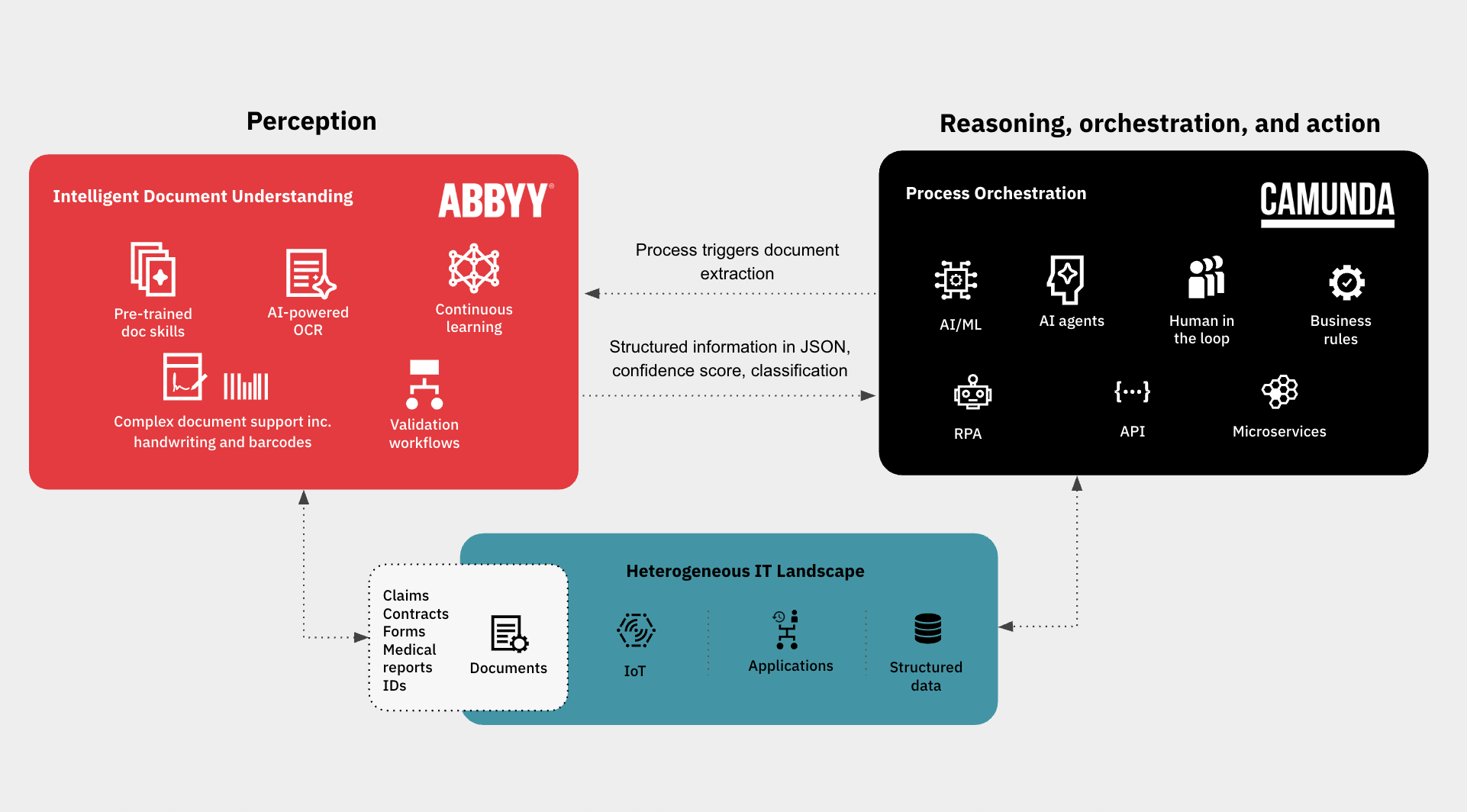
Image1

Perception: ABBYY brings best-in-class Document AI—classification, extraction, validation, and human-in-the-loop capabilities.

Reasoning, Orchestration, and Action: Camunda adds composable orchestration, connecting systems, agents, and people into a seamless workflow.

Together, they enable agents to perceive documents, reason with context, and act autonomously.

Use cases this combination solves for

Combining Camunda and ABBYY’s capabilities unlock transformative possibilities across many industries:

  • Financial Services: Automate loan origination and claims processing by extracting data from complex forms and orchestrating approval workflows.
  • Healthcare: Streamline patient onboarding and insurance verification with intelligent document capture and BPMN-driven orchestration.
  • Supply Chain & Logistics: Accelerate invoice processing and compliance checks by combining ABBYY’s OCR and Camunda’s decision automation.
  • Public Sector: Digitize regulatory workflows, ensuring transparency and auditability through integrated IDP and BPM.

Insurance claims example

Insurance claims involve diverse documents, like forms, reports, invoices, IDs, and every claim is different. Combining ABBYY–Camunda enables:

  1. Intake: Camunda triggers the workflow and sends documents to ABBYY
  2. Perception: ABBYY classifies, extracts, validates, and returns structured data
  3. Reasoning & Orchestration: Camunda applies DMN rules for policy checks, thresholds, and compliance, then orchestrates next steps across systems and people
  4. Action: Agents orchestrated by Camunda  approve, route, request missing documents, or escalate autonomously
  5. Human-in-the-Loop: Camunda dynamically involves adjusters only for ambiguous or high-risk cases
  6. Continuous Learning: Each cycle improves autonomy and reduces manual effort

Business outcomes:

✔ Faster claims processing (days → minutes)
✔ Consistent, auditable decisions
✔ Lower operational costs
✔ Better customer experience

Inside the integration

The ABBYY Vantage Connector, built using Camunda’s Connector Template, makes integration simple and scalable. It offers:

  • Native integration in Camunda Modeler
  • Secure OAuth 2.0 authentication
  • Easy configuration
  • Automatic JSON handoff into BPMN workflows
  • Support for multi-page documents and error handling

Available on both Camunda Marketplace and ABBYY Marketplace, organizations can start using it in minutes:

  • ABBYY Marketplace: Vantage Skills, sample workflows, JSON schemas, and accelerator guidance
  • Camunda Marketplace: Official connector, ready for BPMN/DMN integration

Ready to learn more?

Explore our joint solution resources (Camunda Marketplace and ABBYY Marketplace) or contact us for a demonstration of the joint capabilities.

Ready to get started?

Still have questions?

In today’s financial services landscape, customer experience (CX) is no longer a differentiator, it’s a survival imperative. With 73% of consumers citing CX as a key factor in choosing a provider, and $1.6 trillion lost annually due to poor experiences, banking, financial services and insurance (BFSI) organizations must rethink how they engage customers.

Legacy systems, fragmented journeys, and slow decision-making continue to hinder transformation. To overcome these challenges, BFSIs are turning to composable architecture, a modular, flexible approach that enables rapid innovation, seamless integration, and personalized engagement across every channel.

The strategic value of composability

Composable CX architecture allows financial institutions to build a tech stack that evolves with the business. Rather than relying on monolithic platforms, organizations can integrate interoperable components that adapt to changing customer needs and regulatory demands.

Gartner predicts that by 2026, 70% of organizations will be required to adopt composable DXP technology. Accenture reports that companies with high interoperability grow revenue six times faster than their peers. Deloitte highlights composable commerce as a driver of loyalty and curated digital experiences.

For digital and technology leaders, composability supports compressed transformation—where multiple areas of the business evolve simultaneously.

Composable CX architecture + agentic orchestration = intelligent engagement

Camunda-composable-cx

In a composable CX architecture, modularity provides flexibility, but true transformation comes from intelligent coordination. This is where agentic orchestration becomes essential. It enables BFSI organizations to route tasks, decisions, and interactions across a network of specialized agents, ensuring that every customer journey is seamless, responsive, and context-aware.

At the center of this is Camunda as the orchestration engine. Camunda doesn’t just automate workflows, it governs how agents interact, when decisions are triggered, and how processes adapt in real time. It ensures that every step in the journey is executed with precision, compliance, and transparency.

At Camunda Con New York 2025, our co-founder and chief technologist, Bernd Ruecker, explored how some of Camunda’s technology partners can work together in a composable digital experience architecture orchestrated by Camunda. Each partner acted as an intelligent agent or interface, fulfilling a distinct role:

  • GetVocal serves as a conversational agent, blending human oversight with deterministic AI to deliver punctual, protocol-driven conversations via voice, chat, or  every time. They guide customers, take actions, answer questions, and escalate when needed- ensuring full control and visibility throughout.
  • Taktile functions as the agentic decisioning layer, autonomously orchestrating data retrieval, executing business logic, and running the end-to-end steps required to assess risk, personalize offers, and determine eligibility. Experts define the policies and guardrails, while underwriting agents carry out the assessment process with full transparency, auditability, and consistency.
  • Liferay provides the experience layer, acting as the unified UI where customers interact with services, content, and agents. It ensures continuity across channels and enforces governance and access controls.

Together, these technologies form a coordinated ecosystem, connected through Camunda which orchestrates their interactions, enabling BFSIs to deliver agile, personalized, and compliant customer experiences.

Consider a customer applying for a mortgage as an example:

  1. The journey begins on a Liferay-powered portal, where the customer accesses the application.
  2. A GetVocal conversational agent initiates the interaction; collecting data, guiding the user, and escalating if needed. Every step is tracked and explainable- ensuring compliance and consistency.
  3. Camunda orchestrates backend workflows, triggering identity verification, credit checks, and eligibility assessments.
  4. Taktile evaluates the application by pulling in relevant data and applying configurable decision logic, producing eligibility and offering terms tailored to the applicant’s risk and profile.
  5. If further review is needed, Camunda routes the case to a human agent with full context.
  6. Throughout, Liferay maintains a consistent, branded experience

This is agentic orchestration in action, which delivers intelligent engagement across a composable, modular technology stack.

Final thought: Orchestrating the future of financial services CX

In the BFSI sector, customer experience is no longer a siloed initiative, it’s the connective tissue of competitive advantage. Composable architecture lays the foundation for agility, but it’s agentic orchestration that brings intelligence, precision, and personalization to every interaction.

By combining modular technologies with orchestrated intelligence, financial institutions can move beyond automation to create experiences that are context-aware, compliant, and deeply human. This isn’t just digital transformation, it’s experience transformation.

Orchestration is the critical component at the core of successful enterprise agentic automation, and a strategic enabler of intelligent engagement.. The question for BFSI leaders is no longer “How do we digitize?” but “How do we orchestrate meaningful, scalable, and adaptive experiences?”

The future belongs to those who can compose with robust flexibility, and orchestrate with trust, transparency, and purpose.

Ready to get started?

Still have questions?

Camunda is trusted by hundreds of innovators to automate complex, mission‑critical processes at scale. In financial services, though, pre-defined deterministic orchestration alone isn’t enough. Customer journeys hinge on high‑stakes decisions, Should we approve this applicant? How much credit should we extend? What’s the best next action on a delinquent account? These moments define profitability, customer trust, and compliance.

Camunda goes beyond deterministic orchestration, empowering enterprise agentic automation by allowing you to blend both deterministic and dynamic, AI-driven orchestration in one place. Camunda is well-known for its composability, which means that not only can you create enterprise-grade AI agents in Camunda, but you can tie in a wide variety of tools to incorporate your existing endpoints and accelerate your time to value.

Taktile is a popular AI-driven decision platform that is designed for financial institutions, and today, we’re excited to share that the Taktile connector is available in Camunda Marketplace. This connector enables teams to seamlessly embed Taktile’s advanced decision‑making into any Camunda process. With Camunda orchestrating end‑to‑end workflows and Taktile managing decision strategies, risk and product teams can move from static, hard‑coded rules to Talktie’s adaptive, data‑rich decisions, without adding brittle integration code or infrastructure.

Why this matters for Camunda customers

  • Cleaner architecture: Camunda continues to handle orchestration, and you can easily incorporate Taktile to handle critical risk decisions via a native connector.
  • Faster iteration: Non‑technical users design, test, and refine decision strategies in Taktile; IT ships governed changes via Camunda.
  • Data‑rich decisions: Plug into third‑party data providers to enrich decisions with real‑time signals.
  • Built‑in control: Maintain transparency and auditability for regulated use cases.

Where it helps across the lifecycle

  • Onboarding: Automate KYC/KYB checks, detect fraud with ML, and determine product eligibility in real time.
  • Underwriting: Score applicants using multiple data sources, simulate risk outcomes, and test pricing strategies before deployment.
  • Collections: Tailor repayment plans, prioritize recovery strategies, and adjust dynamically based on customer behavior.

Underwriting as a case in point

Underwriting is one of the most complex workflows in financial services. Intake, document handling, and compliance are only half the story, the real value lies in how you decide. With Taktile embedded in Camunda, you can seamlessly use Taktile to ensure:

  • Risk teams can combine internal models with external data providers.
  • They backtest strategies on historical portfolios before rollout.
  • They deploy changes in weeks, not months, while keeping an auditable trail of every decision.

Example: A lender launching a new SME product can experiment with scoring thresholds and pricing logic, simulate performance against past applications, and then deploy optimized strategies straight into the running Camunda workflow. The result is an underwriting process that’s automated and adaptive, transparent, and continuously improving.

How it works together

  1. Model the process in Camunda Modeler using BPMN with clear decision points (e.g., a Business Rule task).
  2. Design & Test strategies in Taktile (including backtests and champion/challenger experiments).
  3. Connect via the Taktile connector from Camunda Marketplace, no brittle glue code required.
  4. Run & Govern at scale: monitor process performance with Camunda; get decision‑level explainability and versioning in Taktile.

What customers can expect

  • Speed: Deliver real‑time decisions across onboarding, underwriting, and collections.
  • Agility: Adjust strategies as conditions change, with controlled testing before rollout.
  • Compliance: Transparent, auditable decisioning embedded inside governed processes.

Operationalizing enterprise agentic automation

At Camunda, we are dedicated to helping enterprises orchestrate their mission-critical processes. As Fred Stemmelin, Vice President, Partners at Camunda puts it, the partnership with Taktile is one more way Camunda is enabling enterprises to deploy new strategies and realize value faster in their business processes.

“At Camunda, we’re focused on helping enterprises operationalize AI by creating enterprise-grade agents in the processes that matter most. Our partnership with Taktile brings adaptive, data-rich decisioning directly into BPMN-modeled workflows, so financial institutions can test, govern, and deploy strategies faster, without sacrificing control or compliance. Together, we deliver an open, composable approach that lets teams start quickly, scale confidently, and turn better decisions into real business outcomes.”

Fred Stemmelin, Vice President, Partners, Camunda

Taktile offers a strong, no-code decision platform, and simplifying the integration with Camunda makes it easier for teams to take advantage of Taktile without making any compromises in their orchestration. Maximilian Eber, Co-Founder and Chief Product and Technology Officer at Taktile, put it this way:

“Camunda has long led the way in enterprise workflow orchestration, and we’re proud to bring Taktile’s capabilities directly into the Camunda platform. The Taktile connector empowers teams to design and refine decision strategies with ease, leverage external data, and inject AI into critical customer decisions, giving financial institutions the control they need to adapt and grow with confidence.”

Maximilian Eber, Co‑Founder and Chief Product and Technology Officer, Taktile

Get started

Ready to get started?

Still have questions?