Transform complex business processes into seamless customer and employee experiences
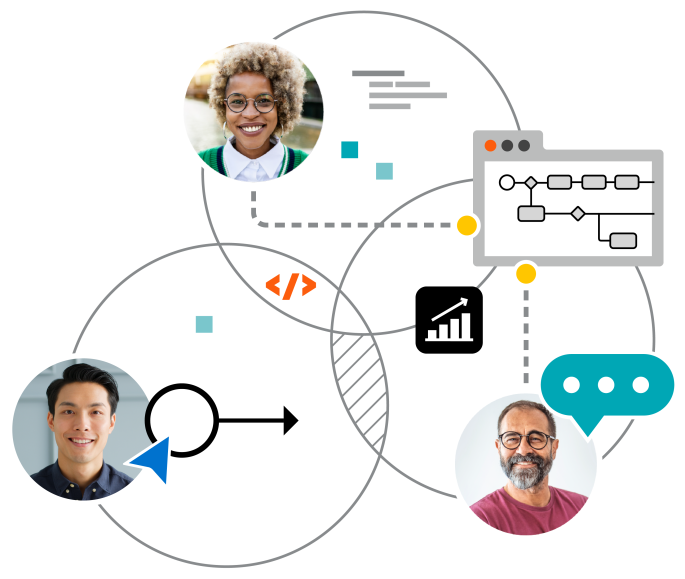
Human workflows deserve people-centric automation
Customers want services that are simple, fast, and accessible – anywhere, anytime – whether the experience is fully automated or involves interacting with your employees. When orchestrating business processes that involve people, you need a solution that helps you tame complexity and address inefficient workflows so that your employees can deliver exceptional customer experiences, every time.
Orchestration improves human workflows from start to finish
Design
Align business and IT using a common language for manual and automated tasks
Quickly build user task forms, connect them to processes, and deploy them in seconds
Automate
Get started fast with Tasklist, an out-of-the-box interface for human work
Connect custom applications to Camunda with full control thanks to a robust API
Improve
Use process heatmaps and branch analysis to identify bottlenecks in human workflows
Provide business and IT stakeholders with customizable process dashboards
Transform processes across people, systems, and devices
Camunda
Manual Workflows
Apply common work assignment patterns such as maker-checker, sticky user, content-based routing, and skill-based routing
Implement process flexibility by using BPMN to document processes, group tasks in stages, and manage task cancellations and exceptions
Enforce complex process controls such as escalations and multi-stage approvals
Automatically take action when the state of a task changes or when an SLA or another predefined threshold is reached
Send notifications by email, phone, SMS, or another channel when tasks reach a milestone or when tasks are completed
“The integration with almost any language, product, and even human tasks, is valuable. It’s very seamless to integrate into existing systems. It doesn’t require you to rewrite a lot of your existing system.”
Staff Software Engineer, Major Retailer
Incorporating human workflows in process automation
Long-running business processes often require both manual and automated work to create a unified, end-to-end workflow. The secret to streamlining processes and building better customer experiences starts with knowing how to orchestrate a combination of human- and machine-driven processes.
Quickly build forms for human workflows
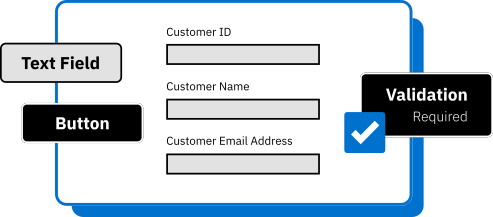
Camunda’s drag-and-drop Form Builder makes it easy to design, test, and deploy forms for tasks that must be done by people. Select from a wide variety of form controls, customize the layout and add field validation, and attach the form to a BPMN process model in a few clicks. Or, take advantage of Camunda’s AI Assistant to start building a form with natural language input.
Built-in user interface speeds up development
Tasklist is a ready-to-use interface for employees who need to complete tasks as part of business processes. It’s perfect for rapid prototyping as you design and test process orchestration solutions.
Create and connect your custom applications
Use your own UI to maintain a consistent look and feel. The open source form-js library and the Tasklist API make it easy to create a custom interface that matches end users’ expectations.
Hear how our customers succeed with Camunda
Learn how global organizations use Camunda to delight their employees and customers by adding a human-centric approach to digital transformation.
Learn how Jyske Bank increased customer satisfaction using process orchestration while adhering to strict international regulations.
Discover why citizens trust their city administration more after the City of Lugano transformed time-sensitive processes with a human-centric approach.
“Some customers thought they were interacting with a human due to the speed of the responses. In fact, even some Atlassian employees think [our virtual customer assistant] is a real person handling all of these tickets!”
Brajesh Bharti, Senior Engineer, Atlassian
Frequently asked questions
What is human workflow orchestration?
Human workflow orchestration is the end-to-end coordination of work that involves people, systems, and devices inside a single governed process. It brings user tasks, approvals, and handoffs into the same model as automated steps so teams can design, execute, and improve the full journey. In Camunda, you model human tasks in BPMN, build forms visually, and execute them through Camunda Tasklist or your own UI using APIs. Operations teams then monitor task SLAs, state changes, and outcomes, using heatmaps and branch analysis to spot bottlenecks and optimize the experience for customers and employees. This people-centric approach ensures that manual steps are first-class citizens in digital processes, with guardrails, auditability, and continuous improvement built in.
Why do human workflows need orchestration?
Human work is often the source of delays and inconsistency, especially when tasks jump between teams, tools, and channels. Orchestration provides a single source of truth that defines who does what, when, and with which inputs or approvals. With Camunda, you can enforce SLAs and escalate automatically when thresholds are reached, trigger notifications when milestones occur, and guide employees with forms that validate inputs and reflect real process logic. A shared process model also aligns business and IT, making it easier to adapt when policies or volumes change. The result is faster cycle time, higher quality, and better experiences, whether a step is manual or automated. Customer stories on the page highlight material impact, including dramatic turnaround time reductions and ROI from bringing people-centric tasks under orchestration.
What capabilities are essential for managing human workflows?
Effective human workflow management requires capabilities across design, automation, and improvement. On the design side, teams need BPMN modeling for manual and automated tasks, plus a form builder to quickly create, test, and attach user task forms. For execution, a ready-to-use Tasklist accelerates delivery, while open APIs and the open source form-js library let you keep a custom UI and brand. At runtime, you should apply common assignment patterns like maker-checker, sticky user, content-based routing, and skill-based routing; enforce controls such as escalations and multi-stage approvals; and act on state changes or SLA thresholds. For optimization, use process heatmaps, branch analysis, and customizable dashboards to identify and fix bottlenecks. These capabilities ensure manual work is predictable, auditable, and continuously improved.
What are some common use cases for human workflows?
Common use cases span any process where people must review, approve, or resolve exceptions. Examples include customer service case handling, employee onboarding and access approvals, claims and dispute resolution, KYC reviews, pricing or discount approvals, and operations work such as content review or field service coordination. These scenarios benefit from assignment patterns, staged tasks, and time-bound SLAs, plus notifications across email, phone, or SMS when milestones are reached.
Is it possible to mix human tasks with fully automated steps?
Yes. Human workflow orchestration is designed to combine manual and automated activities in one model. In Camunda, user tasks sit alongside AI agents, service tasks, RPA or API calls, and event-driven steps, all governed by the same BPMN process. You can group tasks in stages, cancel or reassign them when conditions change, and automatically take action based on task state or SLA thresholds. Notifications keep stakeholders informed across channels, while multi-stage approvals and escalations ensure control where risk is higher. This hybrid pattern lets you start with manual steps for confidence and gradually automate more over time as policies, data quality, and user experience mature, without ever losing visibility or auditability.
How can we use Camunda to get started with human workflow orchestration?
Pick a real process with visible handoffs and delays, for example, approvals, case handling, or request fulfillment. Model the process in BPMN and use the drag-and-drop Form Builder to create user task forms that validate inputs and guide employees. Run the process with Tasklist for rapid prototyping, then integrate your own UI through the Tasklist API or form-js when you are ready. Apply assignment patterns, SLAs, and escalations so work lands with the right person and keeps moving. As you go live, use heatmaps, branch analysis, and dashboards to identify bottlenecks and optimize throughput. Many teams start with Tasklist to accelerate time to value, then evolve to custom applications while keeping Camunda as the orchestration backbone.