
Design the process you're accountable for and ship it without waiting on a backlog
Camunda Modeler is where business teams sketch claims, onboarding, and order-to-cash workflows, and where those drawings actually run.
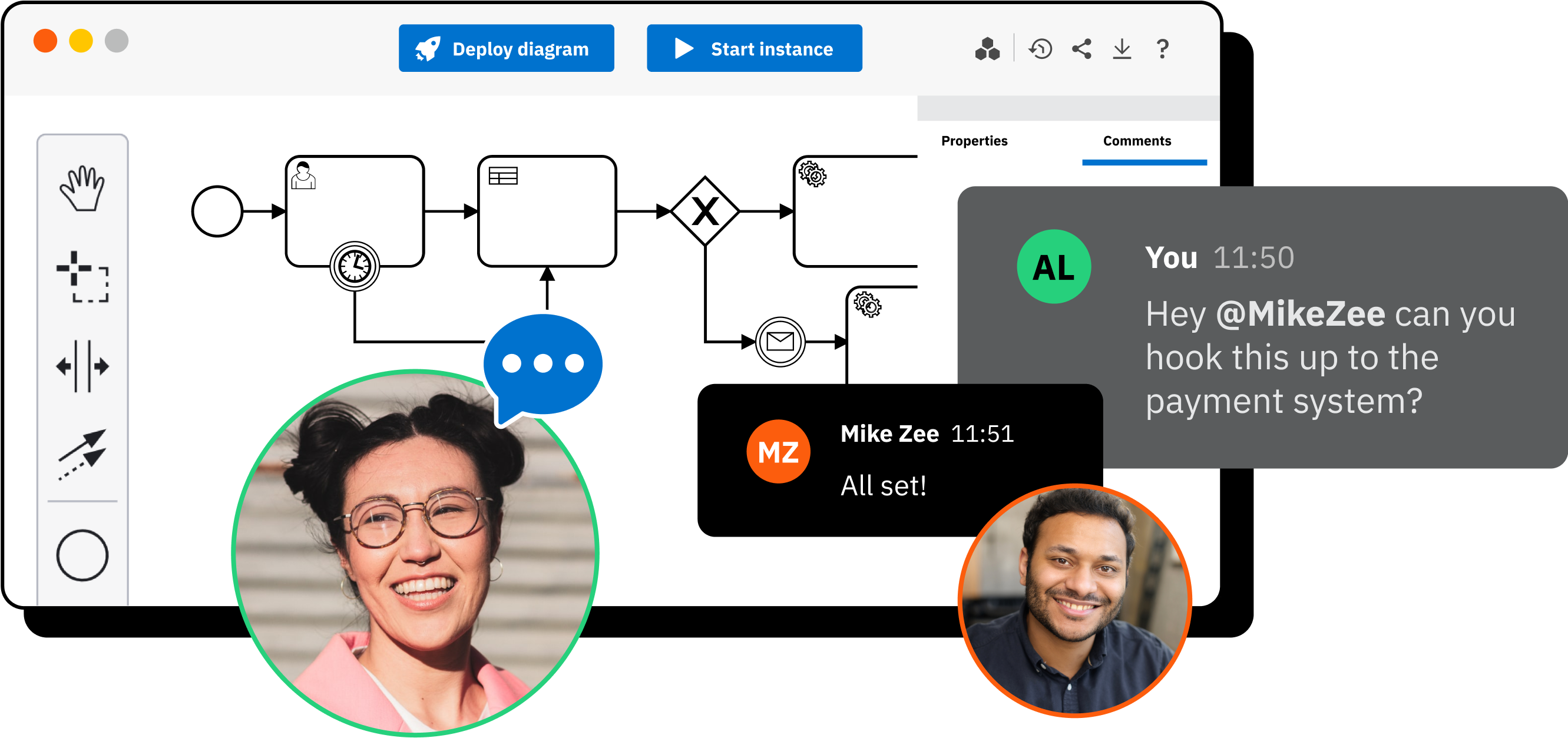
The gap between what you designed and what runs
A business team sketches a process on a whiteboard, hands it to IT, and waits. By the time the workflow ships, the policy that motivated it has changed twice. When the next change comes (a new regulation, a new agent, a new SLA), the whole loop runs again. Every quarter you wait is a quarter your customers feel.
Camunda Modeler removes the loop. Business stakeholders, low-code developers, and software engineers all author the same artifact. The visual diagram is the executable model. The executable model is what runs, monitors, and improves.
Key takeaways
- Business teams design and own the process — no requirements doc, no IT translation, no waiting on a backlog.
- The diagram business reviews is the exact model that runs in production.
- Changes ship in days: edit the diagram, redeploy, in-flight cases continue safely on the version they started.
- AI-assisted drafting turns a plain-language description into a working process in minutes.
- Built on open BPMN: your processes stay portable as infrastructure, agents, and frameworks evolve.
From whiteboard to production
The predictable steps that run automatically. The AI agents that handle exceptions. The human approvals that govern what matters most. Everything lives in one model, and the model is what runs.
One artifact from workshop to runtime
The diagram you sketch in a workshop is the system that runs in production. No requirements doc to translate. No IT rebuild. The same artifact moves from review to runtime.
From outcome description to working draft
Tell Camunda Copilot what the process should do. It generates the steps, the decisions, the connectors, and the forms. You review the diagram, edit what doesn’t fit, and deploy. Hours instead of weeks.
Your team stops waiting on IT
Business analysts add documentation and validation rules. Low-code developers wire connectors and forms. Engineers extend with code where it’s needed. Same diagram. No round-trips. Changes ship in days, not quarters.
Built for every role in the process
The leader who owns the outcome and the developer who builds the integrations work on the same diagram. No handoffs. No rework when the policy changes.
You’re measured on cycle time, error rates, and SLAs. Not on how the system gets built.
Sketch the process you want with drag-and-drop blocks. Set the policy rules and approval gates you’re accountable for. Mark where AI agents act and where humans review. Propose changes through the same diagram your IT team deploys, and see them ship in days, not quarters.
- Visual canvas with no XML or code to read
- Templates for claims, onboarding, order-to-cash, and casework
- Decision rules and policies in plain language
- Stakeholder comments and review built into the diagram
Compose the process. Don’t code it from scratch.
Browse hundreds of connectors in Camunda Marketplace. Plug in AI agents from any provider or framework. Work in your preferred programming languages, using your CI/CD pipeline.
- Drag-and-drop forms, decision rules, and connectors
- Marketplace templates across hundreds of integrations
- Process tests with click-based mocking and assertions
- Escape to code anytime, no rebuild required
The modeler is the first tool where my process team and the engineering team are looking at exactly the same thing.
Process Excellence Lead
Head of Process Excellence, Financial Services
AI-assisted process modeling
Describe the result you want, like “approve a loan within four hours when documentation is complete,” and Camunda Copilot turns the intent into a runnable process. Tasks, decisions, agent prompts, connector configurations, and forms are all generated for review. You stay in control. Every change is yours to edit and approve before it deploys.
ProcessOS takes that further. It discovers how your processes actually run, re-engineers them around the outcomes you define (cycle time, accuracy, cost per case), and continuously improves what’s in production. Every proposed change is backtested against your historical data before it reaches your review queue. You deploy with evidence, not hope.
Connects directly to the runtime
The diagram you publish in Modeler immediately becomes a running process. Every step is observable in real time. Every bottleneck and SLA breach is traceable. Every change is versioned and audited. Whether you start with one process or one thousand, you have one operating model, not three siloed tools.
Deploy in one click
Publish directly to Camunda SaaS or Self-Managed. Versioned process definitions mean no breaking changes for in-flight work. Cases already in motion finish on the rules they started under.
See every case in flight
Live dashboards show which step every claim, application, or order is on, who’s working it, and how long it’s been waiting. SLA breaches surface before customers feel them.
Open by design
BPMN is an international standard. If you ever switch infrastructure, AI providers, or agent frameworks, your processes go with you. No vendor lock-in.
Used by thousands of enterprise process teams
Banca CF+
Process delivery time cut in half. Workflows that took four weeks now ship in two, modeled and deployed on the same canvas.
Read case study →Generali Switzerland
Fully integrated and live in under six months, with no prior BPMN experience on the team. Modeling, learning, and shipping happened on one canvas.
Read case study →Jyske Bank
Reduction in manual task time on KYC compliance processes. BPMN modeling let the team orchestrate every step — timers, user tasks, and edge cases — precisely on one canvas.
Read case study →Frequently asked questions
Can business teams really design processes without IT?
Yes. Modeler is a visual canvas with drag-and-drop blocks, plain-language decision rules, and no code or XML to read. Business teams own the process design: the steps, the policies, the approval gates, the points where AI agents act and where humans review. IT provides the connectors, security, and runtime, on the same diagram and not in a separate layer. The result is faster delivery without losing governance.
How fast can a new process go from idea to production?
Days to weeks, depending on complexity and integrations. Banca CF+ cut process delivery time by 50%: workflows that used to take four weeks now ship in two. Generali Switzerland was live with Camunda in under six months, with no prior BPMN experience on the team. Because the diagram is the executable model, there is no translation phase between business design and IT implementation.
What is Camunda Modeler?
Camunda Modeler is the visual design tool for building executable business processes on the Camunda platform. Business stakeholders, low-code developers, and software engineers all author the same diagram. What you draw is what runs. Modeler is available as a free desktop application and as a collaborative web application in Camunda 8.
Do I need to know BPMN to use Camunda Modeler?
No. Modeler ships with templates for common processes (claims, onboarding, order-to-cash, casework) and Camunda Copilot, which generates a working draft from a natural-language description. You can start from a template or describe the outcome you want, then refine the diagram from there.
Is Camunda Modeler free?
Yes. The desktop Modeler is free and open source. The web-based Modeler is included with the Camunda 8 free trial and all paid plans.
What systems can I integrate with?
Hundreds of pre-built connectors for SAP, Salesforce, ServiceNow, and other enterprise systems. Plus connectors for AI agents from any major framework: Claude, Gemini, LangChain, CrewAI, and custom-built agents. When developers need to drop into code, SDKs are available for Java, Go, Python, and Node.js.